Neurotoned · ADHD Dating
Drawn to the ones who hurt you. Bored by the ones who don’t.
The same alarm is behind both.
You’re not bored. You’re untriggered.
With the hot-and-cold ones, a tiny alarm in your brain goes off, and it feels exactly like chemistry. With the steady ones, it stays quiet, so you call it “no spark.” The alarm was learned. It can unlearn.
Four weeks, a few minutes at a time, to teach it that steady is safe. So the late text stops owning your night, and the kind one finally gets a chance to feel like something.
Tap to try the one-minute move for the moment your phone lights up ↓
By Laurie James, Somatic Experiencing® Practitioner. Trained under Dr. Diane Poole Heller, who pioneered attachment repair for adults. 15 years of body-based work. 4.1 on Trustpilot, from 300+ reviews of Neurotoned
If you’ve tried dating with ADHD, this may sound familiar:
- The one who ignored you for two days felt like electricity when he finally texted.
- Three hours, no reply. You check again. You type “hey, all good?” and delete it four times, and you feel physically sick.
- You replay every word you sent, hunting for the one that ruined it.
- You stay long after part of you already knew.
- Dinner with the kind one, and you’re checking the clock. Then you’re home, checking whether the other one texted.
“...I end up feeling crazy for freaking out because they haven’t responded for a few hours and I just start assuming they hate me or I’ve done something wrong.”
And on Sunday, the nice one texts “Morning! How did you sleep?” And you feel nothing. You leave him on read and can’t say why.
Or he’s already on your couch: kind, steady, the one who texts back and means what he says. And some nights you feel nothing at all. Everyone says he’s perfect for you. You nod. Inside, nothing.
And the quiet fear underneath: that you’ll spend your best years on people who keep you guessing, and walk past the one who would have stayed. Maybe you already did: the one you let go because “it just felt like friends.” And you won’t know which one he was until years later, when someone keeps you guessing again and you think of him.
The one who texted back. The one you called boring.
If that’s been your love life, this page is for you. And what’s behind it isn’t what you’ve been told.
You’ve probably tried to fix it.
- You read the dating books and the attachment books. They explained the pattern. They couldn’t stop your stomach dropping when the text doesn’t come.
- You took a walk around the block instead of texting them. It got you through tonight. The alarm was still set tomorrow.
- You talked it through in therapy, maybe more often than you’d like to admit. You understood why. The panic came anyway.
- Maybe you hoped your medication would help here too, and it didn’t. It works on attention. It was never aimed at this alarm.
And every time, you promised yourself that next time you’d pick better.
You probably know, even now, that the panic over an unanswered text is irrational.
You know exactly why you feel it.
And the feeling stays anyway.
“...that feeling of conciously knowing you're overreacting, but still not being able to stop it... it's one of the things I hate most about having adhd.”
You’re not broken, and you’re not bad at picking people.
The pull is real.
The panic is real.
The flatness you feel with the calm ones is real too.
And there’s a physical reason almost nothing you’ve tried has touched it.
Every fix so far worked on the surface: your choices, your rules, your understanding.
The thing producing all of it sits deeper, in an alarm your body may have set a long time ago.
The Amygdala Alarm
That alarm lives in your amygdala, the tiny part of your brain behind both the pull and the flatness.
Its job is to flag what matters for your survival.
And it’s fast. In a 1998 brain-scan study at Massachusetts General Hospital and Harvard Medical School (Whalen and colleagues, Journal of Neuroscience), it still reacted to frightened faces flashed too fast for most people to notice. It fires before you’ve had a single thought.
When it fires, your body floods with cortisol and adrenaline:
- the racing heart,
- the knot in your stomach,
- the mind that won’t switch off at night.
And it learns early what matters.
If love, when you were young, came with unpredictability, if the people you needed were loving one minute and cold the next, or just impossible to read, your amygdala may have filed that feeling under “this is what love feels like.”
So now, when someone keeps you guessing, the alarm goes off.
And because that feeling is familiar, you read it as a sign that this person matters.
That’s the Amygdala Alarm: an alarm that learned to go off for love.
And when it goes off, it feels exactly like chemistry.
Take all of this as a model of what you feel, not a scan of your brain. It’s the model this work is built on, and it gives you something to do.
Think of someone who grew up next to a train line.
Move them somewhere quiet, and they can’t sleep. The silence feels wrong.
Nothing is wrong with the room. Their body just learned that noise is normal.
One alarm, two feelings
Someone keeps you guessing
The alarm goes off
Cortisol and adrenaline: the racing heart, the knot in your stomach.
It feels exactly like chemistry.
Someone steady
The alarm stays quiet
No flood, no racing heart, no rush.
So you decide there’s no spark.
But there’s no spark because there’s no alarm.
You’re not bored. You’re untriggered.
And if you have ADHD, it’s harder to see and harder to leave. Diagnosed or still waiting, this part is for you.
ADHD didn’t set the alarm. The alarm was learned.
But you already doubt your own read on things. So when someone tells you you’re overthinking it, or that it didn’t happen like that, you start retelling the story in their favor instead of walking away.
And when he goes quiet, your brain doesn’t hear “busy.” It hears “you blew it.”
Add a brain that hyperfixates on one person like nothing else, and a rejection sensitivity that turns a late text into a verdict on you, and you don’t just fall.
You attach to potential.
You stay faithful to the person they are on their best day.
“So many things that aren’t actually rejections just feel like rejections...”
★★★★★
“...the wired for love left me speechless... found myself crying like a child and felt that it was working even after the sessions...”
Wired for Love teaches the Amygdala Reset: four short weeks at home with Somatic Experiencing practitioner Laurie James, teaching your alarm that steady is safe.
$16.99 instead of $70, for women who came through this page, until the timer at the bottom of your screen runs out. All four weeks open the moment you join. 30-day guarantee.
So how do you tell a quiet alarm from just not being into someone? While the alarm is running the show, you can’t. That’s the point of this work: once the rush stops deciding for you, you can finally tell what you actually feel. Sometimes it’s still no. Sometimes it’s the first real yes.
Maybe you’ve been told the rush is just dopamine: your brain chasing a high, then losing interest when it fades.
Both can be true: dopamine is part of how any rush feels. What sets it off with the hot-and-cold ones, and not with the steady ones, is the alarm. And the alarm is the part you can retrain.
The Amygdala Reset
Here’s the good news: an alarm that learned can unlearn.
The same way your body learned that closeness means danger, it can learn that closeness means safety.
Your amygdala doesn’t learn from words. It learns by association, and it can learn a new, safer association the same way. The new one doesn’t erase the old one. It grows beside it, a little stronger each time, which is why the old alarm can still flare under stress, and why practice matters more than insight. That’s why therapy gave you the why, and the panic came anyway.
You won’t see it on a scan. You’ll feel it in your chest the next time your phone lights up. That’s where this work starts.
So you don’t need another book, another rule or another round of analyzing. You need your body to feel the new association. One 8-to-10-minute film a week teaches each practice. The practices take a few minutes, and the guide gives you a one-minute version for the six moments the alarm fires most.
Watch on your phone, in the app or on the web. Miss a week and nothing is lost.
That’s the Amygdala Reset: teaching your alarm, through your body, that steady is safe.
Here’s what one looks like when the text doesn’t come.
Try it now: a one-minute Amygdala Reset for when the text doesn’t come
- Feel where your body touches the bed or the couch, and where it feels heaviest.
- Notice your chest and your stomach. Don’t fix them. Just notice.
- Put the thoughts about the text on a shelf, for now.
- Rub your thumbs slowly along your fingertips.
- Let your eyes land on something in the room that’s pleasant to look at.
The short version, from Week 1 and The Trigger Interrupt Guide. About a minute, and nobody can tell you’re doing it.
Notice anything? Even a second of your chest letting go is your alarm hearing something it understands. Now imagine that after four weeks of practice. And if you felt nothing yet, that’s fine. As I say in the films, even not feeling much is information.
★★★★★
“...They break down nervous system regulation and attachment healing in a way that’s easy to understand and actually usable, not overwhelming or overly clinical...”
That’s one of six moments. The guide gives you all six, and Week 1 teaches the full practice this comes from, so it works when the alarm is loud, not just when it’s starting.
Watch Laurie guide the full practice: 2 minutes from Week 1
One calm moment doesn’t undo a pattern you’ve been running for years.
Twenty-eight days of them can start to.
And as your alarm learns that closeness isn’t danger, a steady, calm love finally gets a chance to register as love, instead of as nothing.
That’s Week 2. Here’s Laurie teaching it: for when the kind one feels like nothing
It’s for you if:
- you keep falling for people who keep you guessing,
- calm has always felt like something’s missing,
- or you’re single and want your body ready before the next person comes along.
If you’re looking for someone to tell you which partner to choose, this isn’t that.
It works on the part of you that does the choosing.
All four weeks open the moment you join. Start Week 1 tonight, before the next late text.
Who teaches it
I’m Laurie James, a Certified Professional Coach and Somatic Experiencing® Practitioner. I trained under Dr. Diane Poole Heller, who pioneered attachment repair for adults, and in the lineage of Dr. Peter Levine. For 15 years my work has had one aim: helping people feel safe in their own bodies.
Survival doesn’t speak logic. It speaks sensation.
Both traditions work with the body to reach responses that talk alone can’t reach. Wired for Love aims all of it at one thing: the alarm that goes off for the wrong people and stays quiet for the right one.
And if you take one thing from me, let it be this: you can’t think your way out of a body alarm.
★★★★★
“...I purchased the wired for love program... I feel calmer and l think I got out of the fight or flight mode...”
$16.99 until the timer runs out. Lifetime access. 30-day guarantee.

What you get
Wired for Love: Healing Attachment Wounds Through Nervous System Regulation
Four weeks of step-by-step nervous system retraining.
Inside, I teach the Amygdala Reset step by step. It’s built for real life, and for people who don’t have two hours a day to meditate.
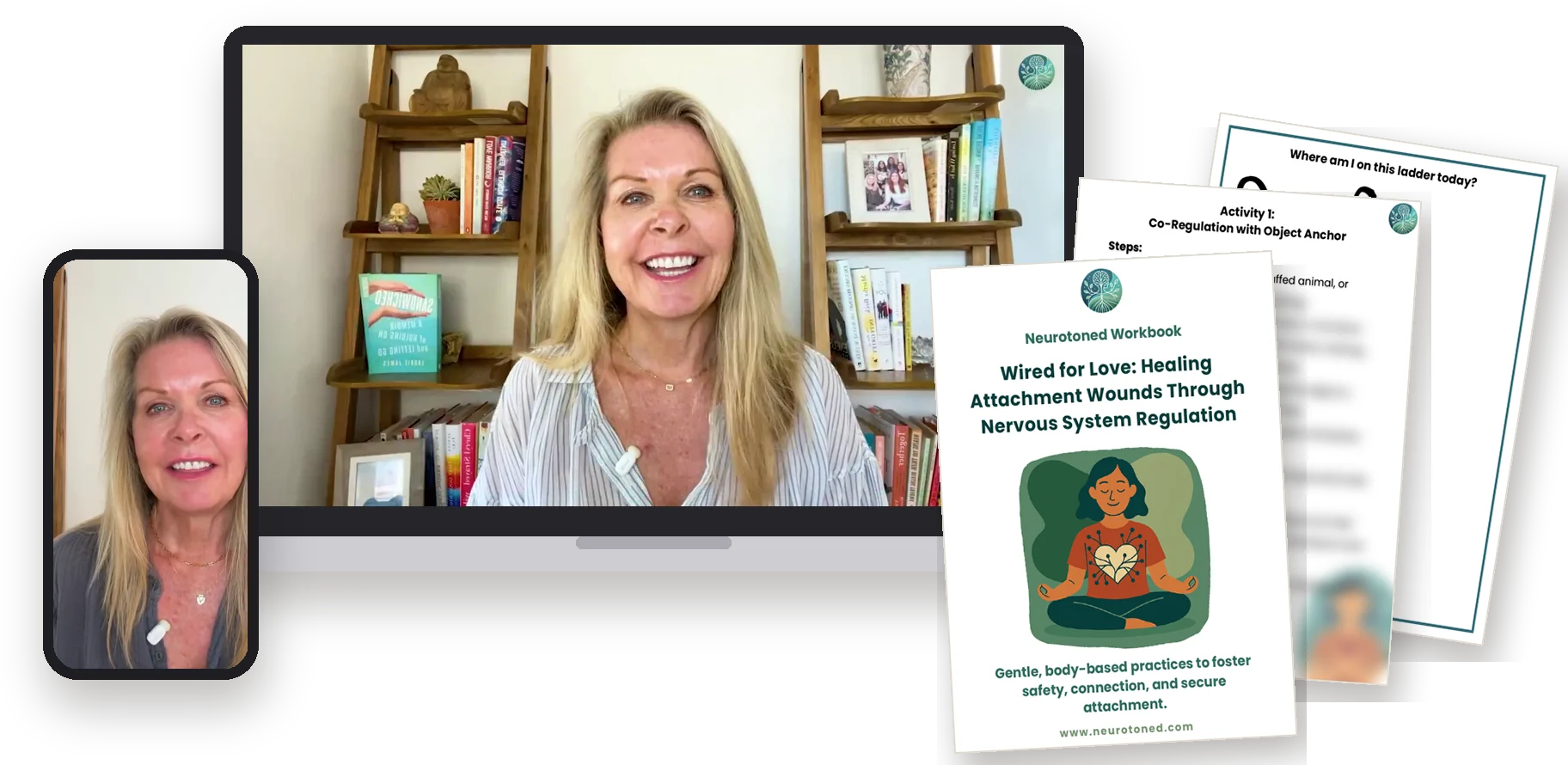
- Four weekly modules. Each one is a short teaching film, 8 to 10 minutes, with the exact practices, demonstrated, and why each one works.
- Practices of a few minutes, built for anywhere. Before you check your phone in the morning, right before a hard conversation, or the moment you feel the alarm starting. The guide below gives you the one-minute version. If every program you’ve tried asked for an hour a day, that difference matters.
- The Wired for Love workbook. 55 pages, so you can see your own pattern on paper and notice it changing week by week.
- Lifetime access. Go at your own pace, and repeat a week whenever you need to. Miss a week and nothing is lost.
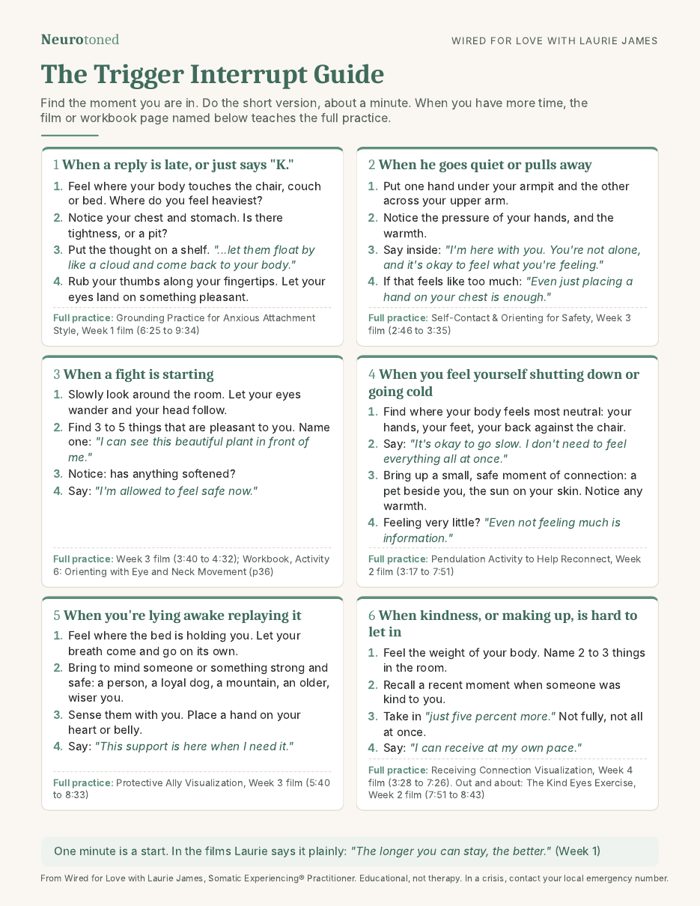
The actual guide. Screenshot it and keep it on your phone.
Bonus #1: The Trigger Interrupt Guide.
One page, six moments: when the reply is late or just “K.”, when he goes quiet, when a fight is starting, when you shut down, when you’re lying awake, and when someone is kind and your body wants to pull away. The one-minute version of each move.
Included: The 30-Day Neurotoned Program.
41 films of daily practices, 7 to 18 minutes each, from Neurotoned’s practitioners, with a whole module on co-regulation: how two nervous systems settle each other. Lifetime access.
Included: Unburdening the Body.
Somatic tools to process shame, guilt and suppressed emotions, with Candice Winterboer. A four-week program, about an hour of film and its own workbook. Lifetime access.
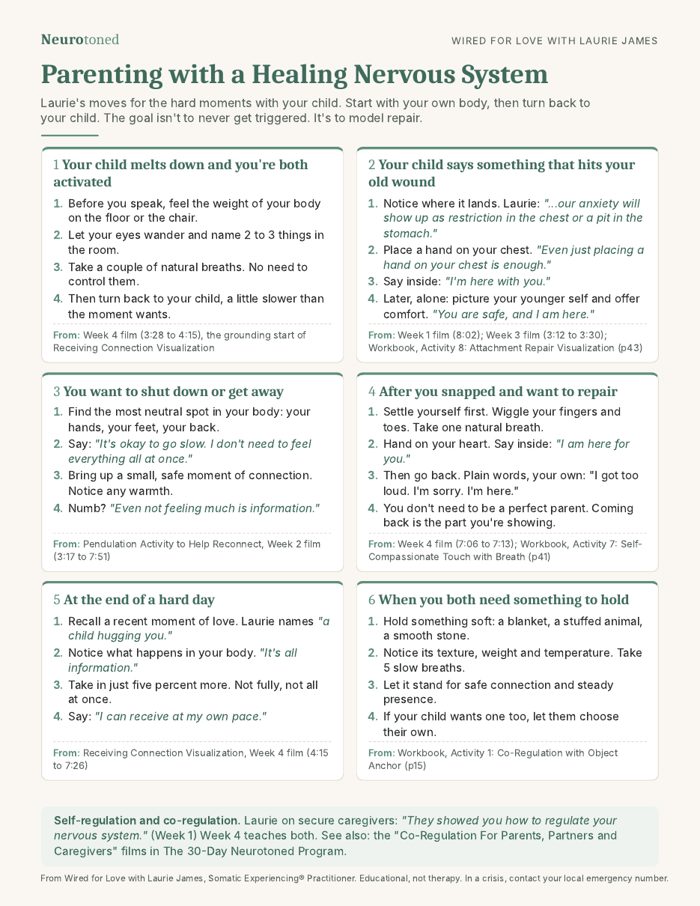
Bonus #2: Parenting with a Healing Nervous System.
If you have kids, or plan to: how to keep this alarm from being handed down. How to co-regulate when you’re both activated, what to say when your kid triggers your wound, and how to repair after you react in a way you regret.
How the four weeks unfold
- 1Week 1: Soothing Your Anxious Attachment Style. For the chase, the checking, the text you write and delete four times.
- 2Week 2: Rewiring to Receive and Become Less Avoidant. For when someone is kind to you and it feels like nothing, or like too much. And for the moment someone gets close and part of you wants to bolt. (Laurie teaching it is above.)
- 3Week 3: Reducing Overwhelm and Finding More Safety Within Your Body. For the nights the alarm won’t switch off, and the days you’re running on empty from it.
- 4Week 4: Becoming More Secure Through Connection. Letting someone steady get close, and staying.
Watch Laurie teach Week 2: for when the kind one feels like nothing
You’re not on a clock. Healing isn’t linear, so repeat any week as often as you need.
What people say about Neurotoned
Verified reviews on Trustpilot
★★★★★
“The first time in years that I felt completely understood and had real confidence that I am not broken and that there’s a way to heal....”
★★★★★
“I've tried many programs with no noticeable impact, making me feel like I'm the problem. On the other hand, Neurotoned makes me feel welcomed, nurtured and supported.”
How much does feeling safe in love cost?
Wired for Love is normally $70. Until the timer at the bottom of your screen runs out, you can join for
$16.99
with lifetime access.
- Wired for Love, four weeks and the 55-page workbook$70
- The Trigger Interrupt Guide, the one you just triedyours
- Unburdening the Body, included$70
- The 30-Day Neurotoned Program, included$69
- Parenting with a Healing Nervous Systemyours
All of it, bought one by one: $209. Until the timer runs out: $16.99.
One payment. No subscription. Nothing else is charged unless you choose it.
This price is for women who came through this page. When the timer at the bottom of your screen runs out, it goes back to $70. No warning email: this is the warning.
Why so low?
That’s about 61 cents a day for the 28 days. All of it costs less than the dinner you sat through checking the clock. Because I know the people who need this most have often already spent thousands trying to fix it.
What happens when you join
- 1Enter your details. It takes about two minutes.
- 2Get instant access to all four weeks.
- 3Start Week 1 today.
$16.99 until the timer runs out. Lifetime access. 30-day guarantee.
You’re covered by a 30-day money-back guarantee
Use the move on the next late text. Try all four weeks. If, within 30 days, it isn’t for you, email support@neurotoned.com and we refund every cent.
No hoops. No hassle.
I know you’ve been burned before.
You’ve been promised things and let down, so many times that hoping again can feel dangerous. I understand that, and I respect it.
That’s why the risk is ours, not yours.
The choice
You can close this page and go back to the love life you’ve been living:
- another round with someone who keeps you guessing,
- more nights awake checking your phone,
- and the next kind one you walk past, the way you walked past the last one.
Or you can give your body four weeks of the Amygdala Reset and find out what it’s like when the alarm finally stays quiet.

What if, a month from now, someone takes a few hours to text back and your body just stays calm?
What if you’re with someone steady, and your body lets you stay?
You’ll never feel completely ready. The alarm will always have a reason to wait.
But every day you wait is another day it runs your love life, and every time you interrupt it, you’re building the new pathway.
You deserve a love that isn’t something to brace for.
You deserve one you can rest in.
Why today, not someday
The next late text is coming either way: this week, maybe tonight. You can meet it with the old alarm, or with the move already on your phone. All four weeks open the moment you join. Start Week 1 tonight. And $16.99 holds only until the timer at the bottom of your screen runs out.
$16.99 until the timer runs out. Lifetime access. 30-day guarantee.
Questions people ask
Is this an ADHD treatment?
No. Wired for Love doesn’t treat ADHD. It works with your nervous system’s alarm, the part that decides who feels like love. And nothing here is a reason to stop or change a medication. That’s for you and your prescribing doctor.
I have ADHD. Will I actually stick with it?
It’s built so you don’t need much willpower. One 8-to-10-minute film a week teaches each practice, and the guide gives you a one-minute version for the moment the alarm starts. Miss a week and nothing is lost: you have lifetime access and can repeat any week.
I’m single. Is this for me?
Yes. Wired for Love starts by teaching your body how to feel safe on its own, so the next time someone new comes along, you’re not starting from the rush.
I’m already with the steady one. Is this for me?
Yes. Week 2 is for exactly this: when someone is kind to you and it feels like nothing, or like too much. The work doesn’t tell you to stay or to go. It quiets the alarm, so you can finally tell what you feel for him.
My childhood was fine. Can this still be me?
It can. Your alarm may have learned from someone who was loving one minute and cold the next, or just hard to read. It doesn’t take a dramatic story.
How is this different from therapy?
Therapy helps you understand. This works on the alarm itself. Many people do both.
How long until I see results?
The first time a text is late and you use the move, you’ll feel whether your body answers. That’s day one. One calm moment doesn’t undo a pattern you’ve been running for years. Twenty-eight days of them can start to.
Can I really get my money back?
Yes. Use the move on the next late text. Try all four weeks. If, within 30 days, it isn’t for you, email support@neurotoned.com and we refund every cent.
$16.99 until the timer runs out. Lifetime access. 30-day guarantee.
P.S. If you take one thing from this page, take this.
The rush you’ve been calling chemistry is your Amygdala Alarm, and you can’t think it quiet.
It learns through your body, a little at a time, until safe love gets a chance to feel like love.
That’s what the Amygdala Reset does.
P.P.S. The next time your phone lights up and it isn’t him, you’ll want the move already there. Week 1 opens the moment you join. And you have 30 days to try all of it. If it isn’t for you, email support@neurotoned.com and you’ll get your money back.
I’ll see you inside.
Laurie James
Somatic Experiencing® Practitioner
© Neurotoned. This page is not medical advice. Wired for Love is an educational wellness program and is not a treatment for ADHD or any other medical condition. Individual results vary and are not guaranteed. Never stop or change a prescribed medication without the guidance of your prescribing clinician. Pictures of people on this page are illustrations; nobody pictured is a customer.