Neurotoned · You're not lazy. Your brake is off.
ADHD burnout. Crashed by noon, still wired at midnight.Every little thing sets you off, and nothing gets you going until it's urgent.It comes from a second brake nobody told you about: a nerve, not your willpower.
ADHD gets called a race-car brain with bicycle brakes. Everyone talks about the brakes in your brain. There's another one in your body, a nerve, and urgency, the one thing that gets you moving, keeps switching it off. Here's why, and a 4-week protocol you can do at home, lying down.
No sound right now? Everything in the film is on this page.
"...Naturally, I couldn't get myself in gear, and didn't start... It's super simple, smaaaall baby steps..."
There is a kind of tired that coffee, a full night's sleep and even a good med day stop touching. You feel wired and wiped out at the same time, which seems like it shouldn't be possible, and yet.
Your body refuses to move in the morning, no matter how long you slept. The meds give you a few good hours and wear off by noon, and the crash afterward feels like being sedated for surgery. Nothing on the list gets started until there's a crushing deadline nearby. The grocery shopping has been put off for ages. You stay up late scrolling, exhausted, because it's the only time all day that feels like yours.
And underneath the tired, you're on edge: a noise you can't get away from, a tag in your shirt, someone chewing, a text that just says "can we talk?" Small things land like big ones, and you go from fine to overwhelmed, or to snapping at someone you love, before you can catch it. Then you feel awful about it all evening.
You've had the "have you tried a planner?" talk more times than you can count. You've taken iron, vitamin D and magnesium for long enough to stop expecting them to do anything. You bought the planner, the app and the alarm you have to cross the room to silence. The noise-canceling headphones help. So do the loop earplugs, the soft clothes and the cold water on your face when a spiral starts. They get you through the day. They don't get you out of it. And at some point the 2am Google spiral ended with you deciding you're just failing at being a grown-up.
And the scary part isn't today. It's the job you feel one missed deadline from losing, the people who read the crash as not caring, whoever gets what's left of you at 7pm, and the quiet fear that this is just who you are now.
You're not lazy, and you're not broken. The crash is real, the overwhelm is real, the wired-and-wiped-out feeling is real, and there is a specific reason almost nothing you've tried has reached it.

Every fix so far worked on something downstream: your attention, your to-do list, your sleep, the noise around you. Underneath all of it sits one piece nobody aimed at: a nerve that has been running on emergency settings for years, so your body has forgotten how to come back down.
That nerve is your vagus nerve. It's the main line between your brain and your body, running from your brainstem down through your throat, your chest and your gut. One of its most important jobs is to work as a brake. Researchers call it the vagal brake. It slows your heart and brings your body back down once the danger has passed. (The term is Stephen Porges's, from his Polyvagal Theory.)
Picture stress as a mountain. Something urgent happens and you climb: heart up, adrenaline up, focus switched on. That climb isn't the problem. Your body is built to climb. The problem is coming back down, and coming back down is the brake's job.
Here's where ADHD comes in. For a lot of people with ADHD, urgency is the only thing that reliably gets them moving: the deadline tonight, the last-minute panic, the third coffee. None of that is a choice: an ADHD brain often starts on urgency because that's how it gets started at all. But every one of those is a climb, and every climb takes the brake off. Run your days on urgency for years and the brake gets used to being off. It doesn't break. It just forgets how to grip.
So you stop coming all the way down. You live high on the mountain, close to the peak, and when you're already close to the peak, it doesn't take much. A noise, a tag in your shirt, one message, and you're at the top again. That's one reason the overstimulation gets worse when you're burned out: you're already most of the way up.
Live up there long enough and your body does the only thing it can. It shuts down. The body that won't move in the morning, the hours on the couch knowing exactly what needs doing and not being able to do any of it: that's not a lack of willpower. That's a body that has been on the mountain too long.
That's the brake in your body. Not your focus, not your willpower: a nerve that's been held off for years. And a nerve can be retrained.
That's why every fix missed. The meds work on attention, the planner on the task, the headphones on the noise, therapy on the thought. None of them were aimed at the brake. So the fix can't be another system to keep up. It has to be small, physical and short: practices you can do lying down, in pieces, with nothing to set up and no streak to break.
This is what the brake is for. A noise lands as a noise, not an alarm. The afternoon comes down instead of crashing. The grocery list gets started before it's an emergency, and the evening isn't spent apologizing for 4pm. That's what the Reset trains your body back toward.
And here's why talking yourself down never worked. Most of the vagus nerve's fibers, roughly eighty percent, carry signals up from the body to the brain, not down. So you can't think the brake back on. You have to signal it through the body.
Try one now, wherever you are
Close your mouth and hum, low and slow, for one long breath out. Do it three times. Then notice your shoulders and your jaw. If either dropped even a little, that was your body coming down one step. Thirty seconds, no willpower. Humming is one of the five signals the films teach (with a long breath out, gentle rocking, a hand on the chest and slow neck and throat work), because the nerve runs right past your vocal cords.
Three members, in their own words
"...I have had much more success going back to work since starting these practises - where I previously felt overwhelmed and stressed, my body is slowing beginning to find a new pattern..."
"...The techniques really helped me feel better and safer in my body, helped me come back to work without overstimulation, and reduced my anxiety."
"...After just 14 days, I already felt calmer, less overstimulated, and slept better..."
The Vagus Nerve Reset: four weeks of short films with somatic practitioner Taryn Elise Herselman, done lying down. Start with six minutes tonight. Regular $70. $16.99, once: less than one crash-night takeout.
Start tonight · 6 min · the campaign price →One payment. Lifetime access to the program. 30-day guarantee.
You know what happens to the tabs you'll "come back to later".
Retraining the brake doesn't take a clinic. The vagus nerve responds to a particular kind of input, and that input is teachable. You don't need a $200 weekly appointment. You don't need to take anything, or stop taking anything. You start with one six-minute module, lying down. After that it's ten to twenty minutes a day at most, sitting up, lying down, or hiding from your family in the bath.
Why every fix you tried missed the brake.

When the brake stops holding, your body can't come back down after stress, and energy, sleep, mood and how easily you get overwhelmed all go with it. With that in mind, look back at what almost everything you tried was actually doing.
ADHD medication works on attention. For many people it's what makes work, focus and starting possible, and that matters. It was never designed to bring your body back down the mountain. Nothing on this page is a reason to stop or change a medication. That decision belongs with you and your prescribing doctor, and nowhere else.
Planners, apps and productivity systems work on the task. They organize the to-do list. They can't change what happens in your body when you face it. That's why each new system works for a week or two and then quietly stops.
Headphones, earplugs, soft clothes and cold water work on the input. They turn the world down, and you should keep using them. But they help you survive the peak. They don't teach your body the way down, so tomorrow starts just as high up.
Therapy and ADHD coaching work on understanding. They help you see the pattern, and that's worth a lot. But seeing it doesn't bring the body down, which is why you can name the spiral and still be in it.
Supplements work on one pathway at a time. A body stuck high on the mountain is out of balance in many places at once, and no single nutrient puts the brake back on.
Generic breathwork and meditation apps are well-meant, but a body near the peak often can't follow "breathe deeply" or "just sit with it". The practices have to be chosen and ordered for the state you're actually in. Most apps don't do that.
Running on urgency works on adrenaline. It's the one tool that always got you moving, and it's the reason the brake is off. Using the climb to get through the day is using the problem to fix the problem.
None of these were wrong. They were aimed at the task, the chemistry, the input or the thought, and the brake sits underneath all of them. Once you see that, every failed fix stops being about whether you tried hard enough. It starts being about which level of the body it was actually reaching.
That's the gap the Vagus Nerve Reset was built for.
What the vagus nerve actually responds to. And why most people are giving it the wrong input.
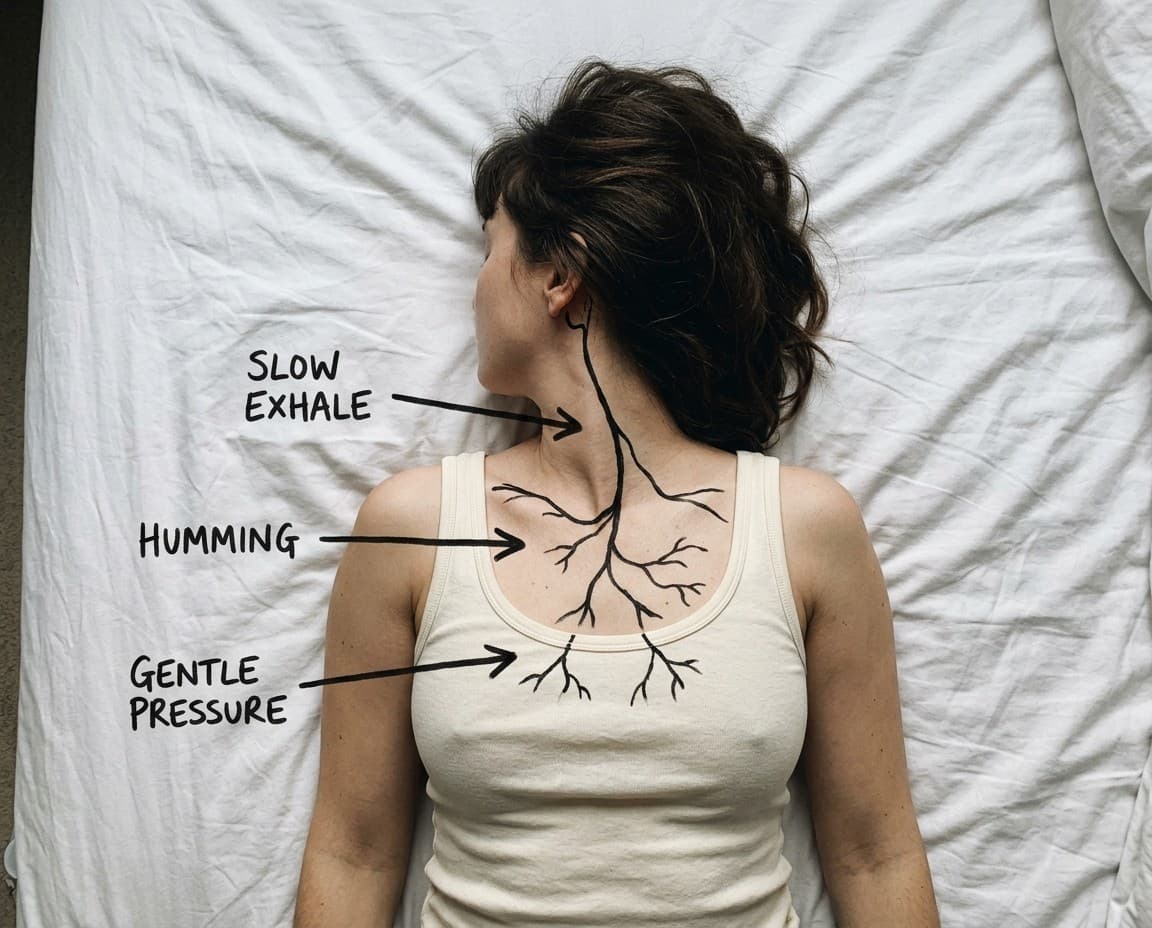
What ties the five signals together (a long breath out, humming, gentle rocking, a hand on the chest, slow neck and throat work) is that they are body inputs, low effort, sustained, and matched to a body that is already tired. The system does not need to be persuaded. It needs to be shown. For a brain that gets bored fast, that's good news: these are small, physical, and short.
What it won't respond to is being told what to do. "Just breathe deeply" can make a tight chest tighter when you're already near the peak. "Do some yoga" asks a body in shutdown for energy it doesn't have. "Try meditation" asks a racing brain to sit still first. Right idea, wrong order.
What works, in years of somatic practice, is a sequenced protocol. Start where the body actually is. Use very low-effort vagal inputs first. Build vagal tone gradually before asking the system to handle more. Come back down in steps: out of the crash, then down from the peak into the valley, then into trust, on enough days that the valley becomes where your body lives by default and the peak is a place you visit. Many members notice sleep and stress shift in the first week. The deeper changes take longer.
The Vagus Nerve Reset is exactly that kind of sequence. Short daily practices, in the right order, calibrated for a body that does not have energy to spare, with an on-ramp for the days when even starting feels like too much.
If you've read enough. The rest of this page is the detail.
- · "Too Exhausted to Start": about six minutes, lying down, for tonight
- · Four weekly films with Taryn, about eight to twelve minutes each, watched in pieces if you like
- · Reference cards and a one-page guide, so you never hunt for the right film
- · The workbook and a second 30-day program, included
- · Yours for life: one payment, no streak, nothing resets if you miss a week
Taught on film by Taryn Elise Herselman, MA Psychology, fifteen years in somatic practice. Regular price $70. $16.99, once. If it doesn't reach the brake, you have thirty days and we refund every cent.
One payment. Lifetime access to the program. 30-day guarantee.
Who built it. And why it fits an ADHD brain.

Taryn Elise Herselman is a Johannesburg-based somatic practitioner and nervous-system specialist with fifteen years in somatic practice. She holds an MA in Psychology, and between 2008 and 2020 spent twelve years in full-time, residency-style training in body-based practice for the nervous system. She directs her own practice and training center in Johannesburg, where she certifies other practitioners in the same body-based therapeutic work. Her work focuses on nervous-system recovery, stress-related conditions, and the somatic dimension of emotional health.
What Taryn designed for Neurotoned is a 4-week protocol that takes the sequence she has used in years of one-on-one practice, paces it for a body with no energy budget, and adds an explicit on-ramp for the days when starting at all feels like too much. The work is gentle. The work is short. The work is sequenced so that each week makes the next one easier rather than harder. There are no prerequisites. You can do the practices sitting up, lying down, in bed, in the bath, or in a chair at a kitchen table. For anyone with ADHD, the design matters: nothing to set up, sessions you can watch lying down and in pieces, and no streak to break.
What you get the moment you start the Reset.
.png)
Four guided weekly films with Taryn plus daily practice in between. Gentle, body-based, sequenced so you can't do them wrong. 10 to 20 minutes a day. Built for a body that's been running on emergency settings.
A gentle on-ramp added after hearing from people who almost didn't begin because everything felt like too much. Low-effort practices that meet the nervous system in shutdown. Start here if you need to. For the days you're on the couch knowing exactly what needs doing and can't make your body do any of it.
In Taryn's words, "reference cards, which allow you to quickly repeat a practice later without needing to rewatch the full video". One card, one practice, no hunting for the right film.
A second program, included free, for when the 4-week protocol leaves you wanting to go deeper. Inside it, a lesson on vagal toning for sleep, for the nights you stay up late because it's the only time that feels like yours. There is no rush and no expiry. Use it next week or next year.
A one-page reference for recognizing whether your system is activated, shut down, or overwhelmed, and which practices match each state. Print it. Stick it on the fridge.
So you can track what is shifting on paper, like a human being, instead of squinting at a notes app at midnight.
All of it, yours forever. The program is a one-time purchase, not a subscription. No expiry, no clock. Come back to any week in any order whenever your body needs it. Miss a week and nothing resets. There's no streak to lose.
How the protocol actually unfolds.
Two or three very low-effort practices that meet a body in shutdown. No prerequisites, no sequencing. Begin here if you need to. The rest of the protocol is still waiting whenever you're ready.
Gentle practices that work with the neck, shoulders, throat, and breath to start signaling the vagus nerve that the emergency is over. Sitting, lying down, or standing at the kitchen counter.
Slow rhythmic movements that change the signals the body is sending upward to the brain. This is the week for a body that has learned effort gets punished, which is exactly what years of running on urgency teach it: nothing here asks you to push, and the aim is to move the system out of energy hoarding without asking for energy it does not have.
After prolonged stress, body awareness gets turned down to protect the person from overwhelm. Useful at the time. Less useful now. Week 3 rebuilds the body-awareness signal gently, through touch, movement, and vibration.
Small moments of movement and awareness that help the body find steadiness without effort. Grounding practices designed to survive the transition from practice to real life so regulation does not collapse at the grocery store.
Each weekly film runs about eight to twelve minutes, and you can watch it lying down, in pieces if you need to. You learn the week's practices in the film, then practice daily, ten to twenty minutes at a time, until your body has the new pattern. The workbook tracks what is shifting. The Quick Guide PDF tells you, on any given day, which practice to reach for based on how your system feels.
More time doing the work than watching someone talk about it. That is the whole design.
What people are saying
when they stop being polite.
Real people. Real words. Verified members of the Neurotoned program.
Individual results vary. The testimonials below are personal accounts of program members and are not a prediction of what your own outcome will be.
"...No matter what I had learned in therapy sessions, it just never seemed to work when I was in the thick of it. When I started using Neurotoned, listening to the different bite-sized videos they have through the app, it became my safe haven. Whenever I feel anxious, overwhelmed or tired, I always found something to help me there..."
"I've got long covid and brain fog so bad I forget why I walked into a room. I was worried this would be another thing I bought and didn't finish. The sessions are short enough that I can actually do them. I've done 22 in a row. That's the longest streak of anything I've managed in two years."
"Bought it at 2am while catastrophising about my catastrophising. Did the first practice the next morning in my pyjamas. By day five I noticed I wasn't white-knuckling my coffee anymore. I don't know how to explain it better than that. Something loosened."
"I was sceptical because the internet is 90% snake oil in a wellness wrapper. But this was genuinely useful... Just the practices, the app, and a workbook. Sleep got better in week two. That alone was worth it several times over."
Why we priced it the way we priced it.
The regular price of the Vagus Nerve Reset is $70. Compared to almost any other route into this work, that is already inexpensive. A single somatic therapy session in most cities runs between one hundred fifty and two hundred fifty. A year of supplements people typically reach for in this state can run a few hundred dollars on its own.
Neurotoned's view is that the right number of people doing this work is more, not fewer. While our current acquisition campaign is running, the price is $16.99. One payment, and lifetime access to the program. When the campaign closes the price returns to $70 and stays there.
$16.99 in context.
- · One session with a somatic therapist: $150 to $250
- · Six months of "nervous-system supplements" people often try: $200 to $400
- · Another planner, app or productivity system that works for two weeks: you've already paid for a few
- · The takeout on the nights you crash too hard to cook: most weeks, more than this
- · Another year of running on deadlines: free, and you've been paying for it every afternoon
What happens when you click the button.
You click. You enter your email and your payment on the Neurotoned checkout. You are taken straight to your members area on the Neurotoned app. The "Too Exhausted to Start" module is right there. Week 1 of the protocol unlocks immediately. The full thirty-day program sits in your library from the first minute. The workbook PDF arrives by email alongside your login. You can be doing your first practice inside ten minutes of clicking.
One payment. Lifetime access to the program. 30-day guarantee.
The guarantee, written in plain language.
Try it for 30 days. No homework. No quiz at the end. Just watch the sessions and try a practice or two.
If it genuinely isn't for you, email us any time in the first 30 days and we refund every cent. No conditions. No forms. No "retention specialist" with a script. No three-step exit survey that politely talks itself into a pause you never asked for.
We do not ask you to prove anything first. This work has been refined over years with real practitioners, so we'd rather you used the program and decided than closed the tab and wondered. If it's not for you, no biggy. The refund is yours.
The Vagus Nerve Reset is lifetime access, not a subscription. You pay $16.99 once and the whole program is yours for life, with no expiry, no renewal, and nothing you have to cancel to keep it. We say this more than once on this page because apparently some of you have been burned and honestly, fair enough.
There's no "cancel" button on the program because there's nothing to cancel. It's like buying a book. You just have it.
From here, the choice is yours.
You can close this tab and go back to the version of your week you've been living in: climbing all day and crashing when it's over. We're not going to argue with that. If you have ADHD, you've probably closed dozens of tabs like this one, and have a few still open.
Or you can spend $16.99, take six minutes tonight with the "Too Exhausted to Start" module, lying down, and find out whether the brake under all of it is something a sequenced body protocol can reach. If yours doesn't respond, the 30-day guarantee is built for exactly that.
You won't find a fake countdown on this page. After everything it just said about running on deadlines, we're not going to invent one. The price is real, though: $16.99 while this campaign runs, $70 when it closes, and there will be no warning email because the warning is this paragraph. The other reason to start tonight is that tonight is when you'll still remember reading this. If your jaw dropped even a little when you hummed up there, you've already felt what the first week builds on. Tomorrow's 4pm crash is coming either way. Tonight you can have six minutes already done before it gets here.
Start tonight · 6 min · the campaign price →One payment. Lifetime access to the program. 30-day guarantee.
Thank you for reading this far.
This is a long letter, and we know it. If you have ADHD and you made it here from the top, without a deadline making you, take a second to notice that. It says something about how much you want this to change. The rest of the page is FAQs.
Start tonight · 6 min · the campaign price →One payment. Lifetime access to the program. 30-day guarantee.
Honest answers to honest questions.
I have ADHD. Is this an ADHD treatment?
No. The Vagus Nerve Reset doesn't treat ADHD and isn't a replacement for anything your doctor prescribed. It works on something underneath the burnout: the nervous system's ability to come back down after stress, the vagal brake. It's the part the other fixes weren't aimed at.
I take ADHD medication. Can I do this?
The practices are gentle movement, touch and sound, with nothing to take. Nothing here is a reason to change your medication; if you're unsure, talk to your prescriber.
I've abandoned every system I've ever started. Why would this be different?
Because it isn't a system to keep up. There's no streak, no setup and no 5 a.m. routine. The sessions can be watched lying down and in pieces, the daily practice is ten to twenty minutes, and if you miss a week, it's all still there. Lifetime access means there is no clock. (Priya's review says it better than we can.)
I get overstimulated really easily. Will the practices be too much?
They're built for a body that's already overloaded: small, quiet and slow, and you can do them in bed. On a bad day you step down to the "Too Exhausted to Start" practices instead of pushing through.
What exactly am I buying?
A 4-week vagus nerve reset protocol built by somatic practitioner Taryn Elise Herselman, plus a "Too Exhausted to Start" on-ramp, reference cards for every practice, the full 30-Day Neurotoned program, a Quick Guide PDF, a printable workbook, and lifetime access on the Neurotoned app. One payment, and the program is yours for life rather than a subscription. $16.99 during the campaign. $70 after.
Is there a subscription?
No. The Vagus Nerve Reset is one payment and the program is yours for life, with no renewal on it and nothing you have to cancel to keep it. One thing you should hear from us rather than find out on your own: on the page straight after checkout we offer you our membership, for people who want the rest of the library once these four weeks are done. It is optional, separately priced, and passing on it takes one tap and changes nothing about what you just bought. Your program is paid for either way. We get it, the internet is a minefield. We are not hiding anything, which is why this paragraph is here.
Will this actually work for me?
If your burnout has a nervous-system side, the protocol is designed to address the upstream state rather than the downstream symptoms. If yours does not respond, the 30-day refund is there. Individual results vary.
I was only diagnosed in my 30s (or 40s). Is it too late for this?
No. The brake has been carrying the load since long before the diagnosis. The practices meet it where it is now, and they're the same whether you were diagnosed at 8 or at 48.
How long does each day take?
Start with the six-minute module. After that, ten to twenty minutes at most. You can do it in bed. You can do it in the bath. You can do it in a chair at your kitchen table. We designed it for people who do not have energy to spare.
What if I'm too exhausted to start?
We added a module specifically for this. "Too Exhausted to Start" sits before Week 1, with a few very low-effort practices that meet a nervous system in shutdown. No prerequisites, no sequencing, no pressure. Start there. Lifetime access means there is no clock.
I've tried meditation and breathwork before and they didn't help. Why would this?
Generic breathwork and meditation expect a baseline of regulation the depleted nervous system does not yet have. The protocol works in the other direction. It builds the regulation first, in low-effort body inputs, before asking the system to handle anything that resembles traditional meditation.
Why is it only $16.99?
Because we'd rather you actually do it than look at your cart and close the tab. And because if it works, you might tell someone. That is most of our marketing budget. Word of mouth, and a tired team that would rather you felt better than paid more.
How do I actually buy it?
Click any orange button on this page. The Neurotoned checkout opens. Enter your email and your card. You will be in your members area within about sixty seconds, with the "Too Exhausted to Start" module ready to begin.
One payment. Lifetime access to the program. 30-day guarantee.
P.S. If you scrolled straight here (no judgment, plenty of us read that way): urgency takes your vagal brake off, and years of it leave a body that can't come back down. The Vagus Nerve Reset is a 4-week, lying-down protocol by somatic practitioner Taryn Elise Herselman that works on that brake. Start with six minutes tonight. $16.99 during the campaign, once. 30-day guarantee.
P.P.S. If you have a question this letter did not answer, email support@neurotoned.com and a real human will reply. Replies are not instant. They are real.