Jaw, head, pelvic floor or heel pain that keeps coming back? It's neurofascial bracing. Here's how to release it.
Your nervous system keeps the fascia around the sore spot clamped tight, long after it needs to. Theresa Moodie's 4-week plan teaches it to let go: wake up without a sore jaw, get through the afternoon without a headache, sit without that pull in your pelvis, take your first steps without bracing.
One of these or all four: start with the one that hurts most. Gentle movement, breathing and acupressure, with a version for your worst day.
★ 4.1 on Trustpilot · 300+ reviews of Neurotoned
“Living with chronic pain for the last 35 years this was a new amazing experience... The option to choose what resonates with you and having no pressure makes the program enjoyable.”
1Sound familiar?
One of these, or all four? Read on.
- Your jaw. You wake up with sore teeth and a tired jaw. By noon you catch yourself clenching again.
- Your head. By mid-afternoon a headache starts at your temples or climbs up from your neck. There goes the rest of the day.
- Your pelvic floor. A tightness low in your pelvis that won't let go. Sitting hurts. Sleep is harder. Intimacy is harder. You've never told anyone.
- Your heels. Your first steps out of bed feel like stepping on glass. You hobble to the kitchen and hope it eases.
You've done the rounds. The dentist. The doctor. The physical therapist, if you got that far. The podiatrist and the insoles. You've bought the night guard, the foam roller, the stretching straps.
Each one called it common. Each one treated the spot that hurts. It got a little better, then it came back. For a lot of women it doesn't stay in one place either: the jaw first, then the headaches, then the heel.
That's the part that wears you down. You've started to wonder if this is just what the rest of your life feels like. It doesn't have to be.
“...At 67 years old, I experienced a shoulder injury. Then, over the course of a year my whole body gradually broke down. Chronic pain wore me down... I was losing hope. There had to be a better way. Neurotoned was the way...”
2The real problem
Everything you've tried works on the spot that hurts.
That's the trap. The pain is in your jaw, so you treat the jaw. It's in your heel, so you treat the heel. But the spot that hurts is not where the problem starts. And most of the standard advice tells you to push harder on that spot:
- Night guards. They protect your teeth. A 2007 Cochrane review found not enough evidence that they stop grinding. Keep yours, but it doesn't touch the clenching.
- Kegels. Right for a weak pelvic floor. But many women's pelvic floors are too tight, not too weak. Squeezing harder is the wrong way to go.
- Deep massage and hard stretching. They help for an hour. Then the tissue clamps down again, and you're often sorer the next day.
- Rolling the foot and new insoles. They support the heel. They do nothing for the bracing in your calf and arch.
None of these reaches the part of you that is doing the clamping: your nervous system. And while it stays switched on, the pain keeps coming back, or moves.
What researchers found
Jaw pain, headaches and some long-lasting pelvic pain show up together so often that researchers call them chronic overlapping pain conditions. In a national survey, people with both headaches and neck pain had jaw and face pain 5.6 times more often than expected.
3The hidden cause
Neurofascial bracing: your nerves and your fascia, locked together.
Fascia is the web of connective tissue that wraps every muscle, from your scalp to the soles of your feet. For a century it was treated as packing material. Then researchers looked closer.
What researchers found
Fascia is wired to your nervous system. Anatomist Carla Stecco documented fascia layer by layer and found it densely supplied with nerve endings: the receptors that report pressure, stretch and position.
What researchers found
Your nervous system sets how tight it holds. No pair of hands is strong enough to force dense fascia to change, yet it changes under them. Robert Schleip's answer: slow, sustained pressure stimulates the receptors in fascia, which changes nervous system output, which changes muscle tone.
Put those together and you have neurofascial bracing. When a spot hurts, your nervous system tightens the muscles and fascia around it to protect it. For a day, that helps. But when nothing tells it the danger has passed, it keeps the brace on for months. The tissue gets stiff and tired, the area gets more sensitive, it hurts more easily, and the brace tightens again. Theresa calls this the pain-tension cycle.
“The nervous system determines muscle tone. Fascia reflects the history of that tone.”
And the brace spreads, because fascia is one connected web. This is what the research shows about the four places this program works on:
What researchers found
Jaw and head. People with painful jaw problems had 4 to 5 times the odds of migraine. And in 23 of 30 people with chronic tension headaches, pressing tender spots in the temple muscle, a chewing muscle, brought on their usual headache.
What researchers found
Neck and head. Nerves from your upper neck and the main nerve of your face and head feed into the same relay in the brainstem. That's one reason pain from the neck is felt as a headache.
What researchers found
Breath and pelvic floor. Your breathing muscle and your pelvic floor move together with every breath. Many women notice that when they clench their jaw, they also hold their breath and tighten their pelvic floor.
What researchers found
Heels. The plantar fascia runs under your foot, and it stiffens overnight. In a trial of 48 people with heel pain, a simple heel-raise strength routine helped more at 3 months than daily stretching. By 6 and 12 months both groups were about the same.
None of these studies tested this program. They show how fascia, nerves and these four places are linked.
The good news: a brace is not damage. Nothing is torn or worn out. It is your nervous system protecting you long after it needs to, and you can't force it open. You release it by changing the signal: gentle, steady input that tells your nervous system it is safe to let go. That is exactly what this program does.
4The program
Beyond the Pain Cycle: 4 weeks to release the brace.
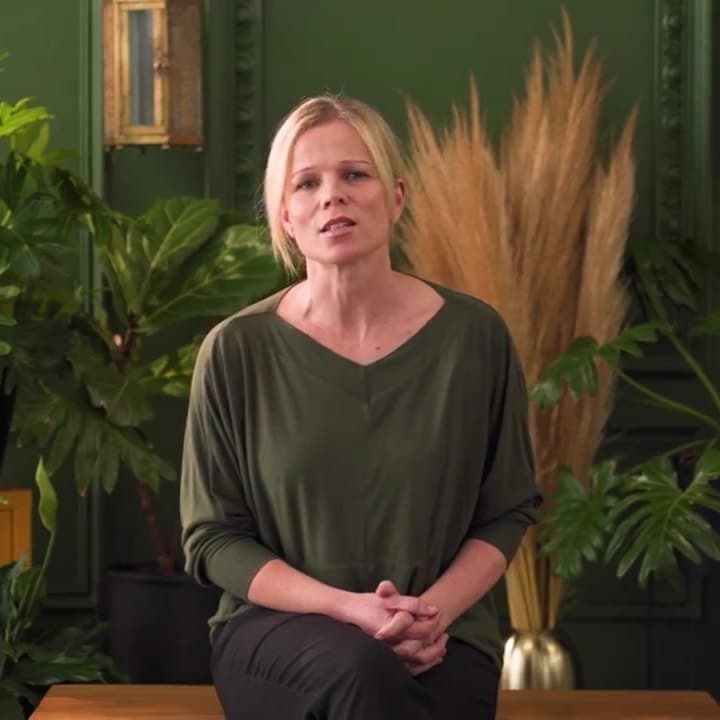
Theresa Moodie spent years in sports massage and Shiatsu, pressing on the spot that hurt, then trained in acupuncture and learned the opposite: work away from it, “so as not to bring pain to pain.” She is not a doctor or a physical therapist, and this is not medical treatment.
Every practice sends your nervous system the signal that releases the brace, using three tools you already have: gentle movement, your breath, and your own hands on a few pressure points. One area a week. Have one of these pains? Start with that week. Have two, three or all four? Take them one week at a time, the one that hurts most first. It is the same brace underneath, so what you learn in one week carries into the next.
Why this works when pushing didn't: every practice comes in three sizes.
A braced body meets force by bracing harder. Other plans ask for the same effort every day, so on a bad day you either push through and flare, or skip it. This plan never asks you to push. You pick the size that fits today, so the signal always says “safe”.
A good day
The full practice, to make the next flare less likely.
It's starting
A short version and pressure points the moment you feel it build.
A bad day
A version you can do lying in bed. In Theresa's words: “You are allowed to do less.”
 Week 1
Your jaw: stop clenching
Catch and release clenching during the day, two pressure points for a jaw that won't let go, and a bedtime wind-down for clenching at night. Keep your night guard: this works on the muscles around it.
Wake up with a looser jaw.
 Week 2
Your head: catch headaches early
Pressure points for the first sign of a headache, a neck and shoulder release for the headache that starts lower down, and a comfort plan for a bad migraine day. It works alongside your own migraine plan, never in place of it.
Catch a headache before it takes your afternoon.
 Week 3
Your pelvic floor: let it relax
Breathing and supported positions that help a tight pelvic floor let go, rest positions for a bad day, plus sitting and bathroom tips. Done clothed, from the outside, nothing internal. Had pelvic surgery? Check with your surgeon or a pelvic health physical therapist first.
Sit and lie down without that pull.
 Week 4
Your heels: easier first steps
A seated stretch and arch massage to do on the edge of the bed before you stand, then a 4-level heel-raise ladder to build strength one small step at a time. Plus a quick shoe check.
Take your first steps in the morning without bracing.
After 4 weeks, for whichever ones are yours
- Waking up with a looser jaw and no sore teeth.
- Catching a headache early instead of losing the afternoon.
- Sitting, sleeping and intimacy without that pull low in your pelvis.
- First steps in the morning without bracing.
- A written plan for every flare, so one bad day doesn't ruin the week.
★ 4.1 on Trustpilot · 300+ reviews of Neurotoned
“...By week three my neck pain was surprisingly almost gone completely....”
“This is a very comprehensive program presented in a simple non threatening way. I am very impressed. The exercises are really helping me. I have chronic pain and have experienced emotional traumas...”
“...I'm sleeping better and have less chronic pain. Neurotoned is a rich and thoughtful program and I use it nearly daily.”
Start tonight and all four weeks are done before Christmas.
One payment. Yours for life. 30 days, one email, every cent back.
5What women say
300+ reviews. 4.1 stars on Trustpilot.
Trustpilot reviews of Neurotoned, word for word.
“...I suffer from chronic anxiety and severe IBS. This programme has made such a difference to me. My mind and body are much calmer than they used to be. I go at my own pace with the sessions and listen to how my body responds...”
“Neurotoned finally taught me things about my nervous system that actually helped me make positive change in my body. I am a nurse and have learned a lot about the nervous system but not all the neurotoned has. I have tools to teach my body to relax....”
“I have done a few weeks into this course and already very helpful, feeling my body relax, also feeling much safer... Due to my health and time being limited I enjoy that it is not strict times, instead you get to go through at your own pace”
“I was willing to try anything and have in the past and been really disappointed... Neurotoned have delivered what they have promised. It's not very expensive for what you get... no pressure sales and no annoying promises that don't deliver...”
“...From the beginning I noticed a shift in my stress level and calming my body. I will continue practicing so that to overcome a serious somatic problem with frozen muscles, that I feel it is improving day after day!”
Reviews of Neurotoned. Beyond the Pain Cycle is new. Results vary.
6The offer
Everything you get today.
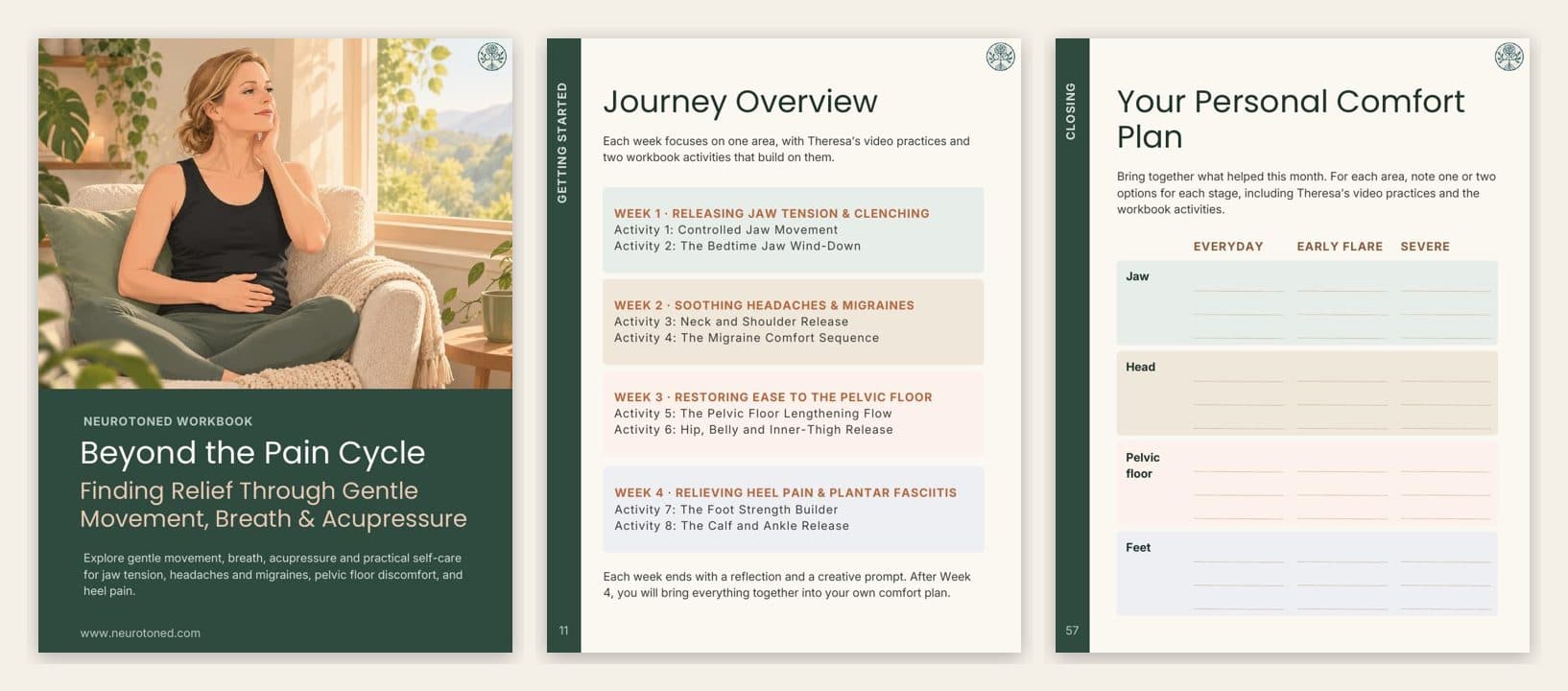
- Week 1, your jaw: Releasing Jaw Tension and Clenching (8:31)
- Week 2, your head: Soothing Headaches and Migraines (15:03)
- Week 3, your pelvic floor: Restoring Ease to the Pelvic Floor (26:22)
- Week 4, your heels: Relieving Heel Pain and Plantar Fasciitis (15:11)
- The introduction: the pain-tension cycle and how to use the program (2:56)
- Three sizes of every practice: a good-day, an early-flare and a bad-day version
- The 63-page workbook: eight extra practices, a short reminder of every film practice, and weekly reflections
- Your personal comfort plan: what to do for each area on every kind of day
- Lifetime access in the Neurotoned app: one payment, nothing that renews
- 30-day money-back guarantee: one email to support@neurotoned.com
$16.99
Four areas, for less than one co-pay
That's $4.25 an area. One payment, yours for life.
Compare
- One physical therapy visit costs more than this whole program, and covers one of the four places.
- Custom insoles cost more than this whole program, and only touch your heel.
- A night guard protects your teeth. It doesn't teach your jaw to let go.
- Another month of the same four pains, each treated on its own: free, and you know how that goes.
What happens when you tap the button. You enter your email and card on the Neurotoned checkout. If a page with an offer comes after, you can skip it in one tap. Then you're in the app. Start with the area that hurts most today. No equipment to buy: your hands, a chair, a couple of pillows, a warm and a cool pack, a tennis ball and a towel.
One payment. Yours for life. 30 days, one email, every cent back.
The guarantee
Try it for 30 days. If it isn't for you, one email gets you every cent back.
Email support@neurotoned.com within 30 days. No forms, nothing to prove. The risk is ours, not yours.
7Your call
Two ways the next month can go.
Option one: keep treating the spot that hurts. The sore jaw in the morning, the headache by three, the tightness you don't mention or the stab in your heel at the first step. Another appointment, another thing to buy, and the brace still on.
Option two: start tonight with the area that hurts most. Ten minutes, sitting down, at the size that fits today. In four weeks you know how to release the brace wherever it shows up, and you have a plan ready for the next flare.
$16.99, once, with 30 days to change your mind.
Start tonight and all four weeks are done before Christmas.
One payment. Yours for life. 30 days, one email, every cent back.
8Questions
Straight answers.
What exactly am I buying?
Beyond the Pain Cycle: five films with Theresa Moodie (about 68 minutes in all), each practice in three sizes for a good day, an early flare and a bad day; the 63-page workbook with eight extra practices and your personal comfort plan; and lifetime access in the Neurotoned app. One payment, not a subscription, with a 30-day money-back guarantee.
I only have one of these. Or I have all four. Is it for me?
Yes, either way. Just one: go straight to its week, and the others are there if the pain moves. Two, three or all four: one area a week, the one that hurts most first. It is the same brace underneath, so each week builds on the last.
Will it cure my TMJ, migraines, pelvic pain or plantar fasciitis?
Nobody honest can promise that. It is an educational wellness program, not a treatment. It gives you a gentle, practical plan for each area on every kind of day, alongside the care you already have.
Is there anyone this isn't right for?
New, sudden or severe pain goes to a doctor first: a sudden worst-ever headache, sudden severe pelvic pain, a jaw that locks, or heel pain after an injury. Keep your dentist, your doctor, your physical therapist and your migraine plan; this works alongside them. If you have had pelvic surgery, check with your surgeon or a pelvic health physical therapist before Week 3. If you are pregnant, a few pressure points are traditionally avoided, and Theresa says which; ask your clinician before you start.
I've tried stretching and massage. How is this different?
Hard stretching and deep massage push, and a braced body braces harder. That's why the relief lasts an hour. They work on the tissue; the brace is set by your nervous system. Here every practice, the stretches included, is gentle enough that your nervous system lets go instead of fighting it, down to your worst day.
Do I need any equipment?
No. Your hands, a chair, a couple of pillows, a warm and a cool pack, a tennis ball and a towel cover almost everything.
I'm not flexible or fit. Can I do this?
Yes. Every film has a version you can do sitting or lying down.
Is it a subscription?
No. You pay once and it is yours for life. Nothing renews.
30 days to change your mind.
One payment. Yours for life. 30 days, one email, every cent back.
P.S. Jaw, head, pelvic floor or heel pain that keeps coming back is rarely about the spot that hurts. It is neurofascial bracing: your nervous system keeping the fascia around it clamped tight. You can't force it open. Beyond the Pain Cycle is Theresa's 4-week plan to release it, one area a week, starting with the one that hurts most, at a size that fits even your worst day. $16.99 today. Yours for life. 30-day money-back guarantee.
P.P.S. Questions? Email support@neurotoned.com and you will get an answer.