For health anxiety in midlife: the checking, the googling, the what-ifs
The tests came back clear. The health anxiety didn't.
In four weeks, your body believes them too.
Every all-clear makes the next fear louder. A licensed counsellor's 4-week method breaks that loop. The next flutter comes and goes. Your fingers stay off your wrist, your phone stays on the table, and you trust your body again. Start with the 4-minute welcome from Cate Evans, who has anxiety herself.
Two fingers on your wrist.
Counting. Again.
It starts with one beat out of place. You are halfway up the stairs with the washing, and your heart skips. Just once.
Two fingers go to your wrist. You count. You press the spot under your ribs to see if it hurts. You get the blood pressure cuff out of the drawer, just to be sure. Then the phone, just one search. Ten searches later you are reading about a condition you had never heard of an hour ago, and your heart is beating harder than when you started. To the frightened part of you, that feels like proof.
What if it's something? What if this time it's real?
So you go back to the doctor. She runs the heart trace, turns the screen so you can see it, and says the words you came for: everything looks normal. You walk back to the car lighter than you have felt in weeks.
It lasts until Thursday. Then a flutter at 4am, and the last test no longer counts, because this one feels different. You need a better one.
This is the part of health anxiety nobody warns you about: the relief is real, and it is what brings the next fear back sooner. Getting checked is right, so keep doing it. The trap is what happens after.
You were never an anxious person. You were the one who drove to the hospital and knew where the papers were. Then, in midlife, your body started doing new things, and your mind read every one as the start of something terrible.
And it is costing you. The walk back to the car to check your pulse where nobody can see. A good Saturday gone by lunch, because a twinge started at breakfast. The searching you hide from the people you love, because you have seen the look. And under it all, the fear you never say out loud: that one day it will be something real, and nobody will take you seriously. Not even you.
Left alone, it does not fade. Every check and every search teaches the alarm to ring again. Another year of this is another year of evenings spent listening to your own heart.
You are not the only one. A Neurotoned member wrote on Trustpilot, about Neurotoned as a whole: "...I visited doctors, underwent testing, and everything seemed to be fine..." Her whole review is further down. What she describes is what this programme is built for.
Reassurance, logic, willpower, even the app and the therapy: all of them speak to the thinking part of you, and the fear does not start there. It starts lower down, in your body, before you have had a single thought. We call it the Inward Alarm. It has a reason, it is not your fault, and it can be taught to stand down.
In this letter you will see:
Why people with more health anxiety sense their heartbeat less accurately, not more.
Why the doctor's all-clear wears off by Thursday, and what the alarm is doing in the meantime.
Why every pulse check and every search makes the next flutter louder.
The finger trap a counsellor uses to show why fighting the fear tightens it.
Why breathing exercises make some women feel worse, and the gentler way in.
The card by your bed for the first minutes after a flutter wakes you.
Your body sounds the alarm first,
and your mind goes looking for a reason.
Key idea
It was never your mind letting you down. It is an alarm pointed the wrong way, and an alarm can be taught to stand down.
First, the important part: any new or changed symptom, especially in your chest, deserves a doctor. Everything below is about the fear that stays after the tests are clear.
Your body has an alarm whose whole job is to watch for danger. Most of the time it faces outwards: the car that pulls out, the step you miss, the sound in the night.
In health anxiety, it turns round. The vagus nerve carries messages from your heart, lungs and gut up to your brain, all day long. One leading explanation, from Paulus and Stein in 2006 and still being tested, is that in people prone to anxiety the alarm over-reacts to these small changes inside. The alarm turns inward. Your heartbeat, your breathing, every small twinge starts to read as danger.
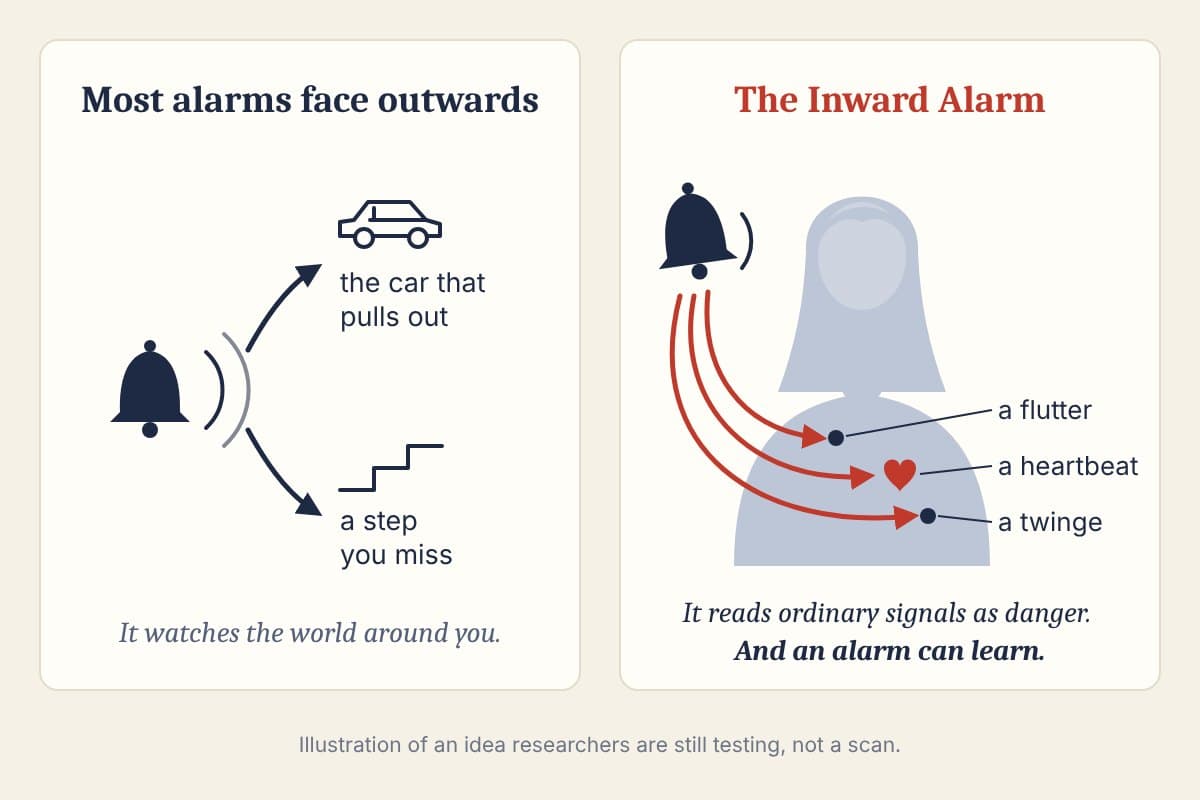
Picture a smoke alarm that has been moved into the kitchen. Often nothing is burning, but every kettle and every slice of toast sets it off. To an alarm like that, your heartbeat is the kettle.
Cate Evans, the licensed counsellor who teaches this programme, says it in one line: "There's no danger out here, so my system is now becoming hyper alert to what's happening inside."
You would think people with health anxiety feel their bodies more sharply. A 2014 study by Krautwurst and colleagues, in 100 university students, found the opposite. Those with more health anxiety sensed their own heartbeat less accurately, and tended to overestimate harmless body signals. The researchers suggested that this bias, not a sharper sense of the body, is probably what matters more in keeping health anxiety going. The students were not women in midlife, so it is one study, not the last word. But in it, more health anxiety did not mean feeling more. It meant reading harmless signals as danger.
And if this began in your forties or fifties, when you were never an anxious person, there is a reason for that too. In SWAN, a long study of 3,276 midlife women, about half had a moderate or high chance of palpitations in the years around menopause, and those palpitations were not linked to early signs of artery disease. In another SWAN study, women who had not been anxious before were more likely to report high anxiety during and after the change. New sensations arrive at the very age new anxiety becomes more likely, so the alarm is handed more to read. It is not a flaw in your character showing itself late.
And this is why the all-clear never lasts. The test answers your mind. The alarm never heard it. So the next flutter sets it off again, and you check, and search, and ask. Each answer buys a little relief, and then the alarm needs the next one. That is the reassurance trap. As Cate puts it, going over it again and again "creates even more anxiety and sometimes more symptoms inside."
Now much of what you have been living with starts to make sense. Why you wake at 4am already afraid, before you have had a single thought. Why one flutter sends you to the search bar. Why the fear is so physical: the tight chest, the buzzing, the heat. And why your mind races: it is looking for a reason for an alarm that is already ringing. And why logic never reached it. In Cate's words: "It's not something we can just think our way out of."
Cate names this exact fear in her lesson on frightening sensations: "If we're having tightness in our chest or an irregular heart rate, we can start to become afraid of those symptoms." And even once we know they are not a health condition, "our brain can still tell us that they might be." That is the alarm.
If you cannot argue with an alarm,
you can give it a different signal.
That is what the Inward Alarm Protocol does, with two rhythms your body already understands. We call them the Two Steady Rhythms. Both start where everything you have tried has stopped: below the thinking.
First, Cate shows you why fighting the fear only tightens it. She does it with a Chinese finger trap: the harder you pull, the tighter it grips. Both rhythms are the opposite of pulling.
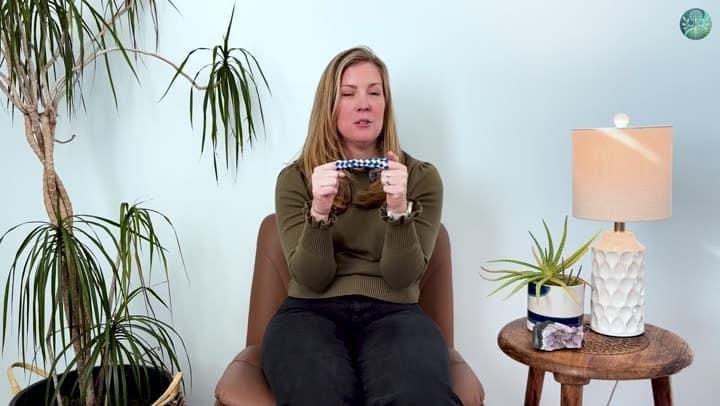
Rhythm one gives the alarm a steady signal. It is for the alarm that has been reading your heartbeat as danger. Cate's reason is simple: "Our heart rhythm has the ability to shift our entire system into more coherence." So the first rhythm starts with the heart itself: not to check on it, but to give it a different signal from the one the alarm expects. It is short, the kind of thing you can do while you wait for an appointment, with no monitor and no set count. It uses the breath gently, at whatever rhythm feels best for you, and Cate says one ingredient matters more than any count. It is not the breath.
If breathing exercises have ever made you feel worse, there is a simple reason. Being told to watch your breath points an alarm that already watches your body straight at it. Here the breath is not what you watch, and the workbook even has a practice with no breath control at all, made for women who find breathwork hard.
Rhythm two teaches the alarm the signal is safe. It is for the flutter or the twinge you would normally search: a steady side-to-side rhythm, borrowed from Cate's EMDR training. You never start with your worst fear. You start small, and meet a sensation with something steady in your hands instead of running from it. Starting small is the point: the alarm meets a signal it can handle, not a flood. Then she sends your attention somewhere you would never think to look.
Why this reaches what your app, your worksheets and the all-clear did not. Each of those speaks to the thinking part of you. An app asks a racing mind to calm itself down. A worksheet asks it to weigh the evidence. The all-clear hands it a fact. The alarm hears none of it. The Two Steady Rhythms go the other way. You do not argue with the feeling, and you do not run from it to the search bar. You stay, and your body learns it can settle. That is how an alarm learns: not by being told, but by ringing and finding, again and again, that it can stand down.
Meeting a sensation instead of running from it is the body half of cognitive behavioural therapy, the half a worksheet cannot give you. A 2008 review by Smits and colleagues found that across 24 trials, CBT that usually includes it lowered people's fear of their own anxious sensations. For health anxiety itself, a 2016 Swedish trial by Hedman and colleagues, in 132 people diagnosed with health anxiety, tested help built on facing the worries instead of checking and seeking reassurance. Used at home with no therapist, online or even as a book, it led to large improvements compared with waiting. None of this research studied this programme, and Cate's tapping has not been tested on its own. What it shows is that the way out of the reassurance trap can be learned, at home.
And the change is something you feel, not only something you understand. Anna, 54, wrote on Trustpilot about Neurotoned as a whole, after anxiety for most of her life: "I noticed a change after the first couple of sessions, I was calmer, had more clarity and felt much less anxious than usual."
Nobody is asking you to stop feeling your body. You are learning to read it again. As the workbook puts it: "Sensation is not damage."
Key idea
Not ignoring the signals, and not fighting them. Teaching the alarm it does not need to ring for them, until it stops ringing.
Your teacher
Cate Evans,
a licensed counsellor who has anxiety herself.
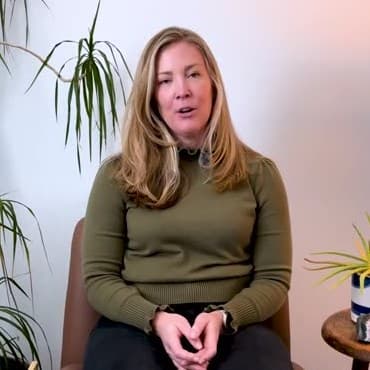
The woman who teaches the Two Steady Rhythms knows the alarm from both chairs: as a counsellor, and as someone who lives with anxiety herself.
Cate Evans is a Licensed Professional Counselor of Mental Health and a Somatic Experiencing® Practitioner. She guides clients through stuck patterns using somatic, EMDR and polyvagal-informed approaches.
She also knows this from the inside. In her own words: "I'm also a person in this world who has anxiety and who uses nervous system regulation regularly throughout my week."
She knows how hard the first step is. "I can attest that it is so difficult to get started in this process at times," she says in her welcome. So every practice she teaches is small on purpose, a few minutes at a time.
In this programme she brings tools from Somatic Experiencing and from EMDR, such as side-to-side tapping, into short practices you can do on your own, at home, at your own pace. "These techniques help us not to just think our way out of anxiety," she says, "but actually be able to feel a change inside."
She does not promise endless calm. "We're talking about being able to fluidly move between states," she says, and she is honest that off days happen: "It happens to me as well."
The 4-week protocol
Four weeks,
from braced to steady in your own body.
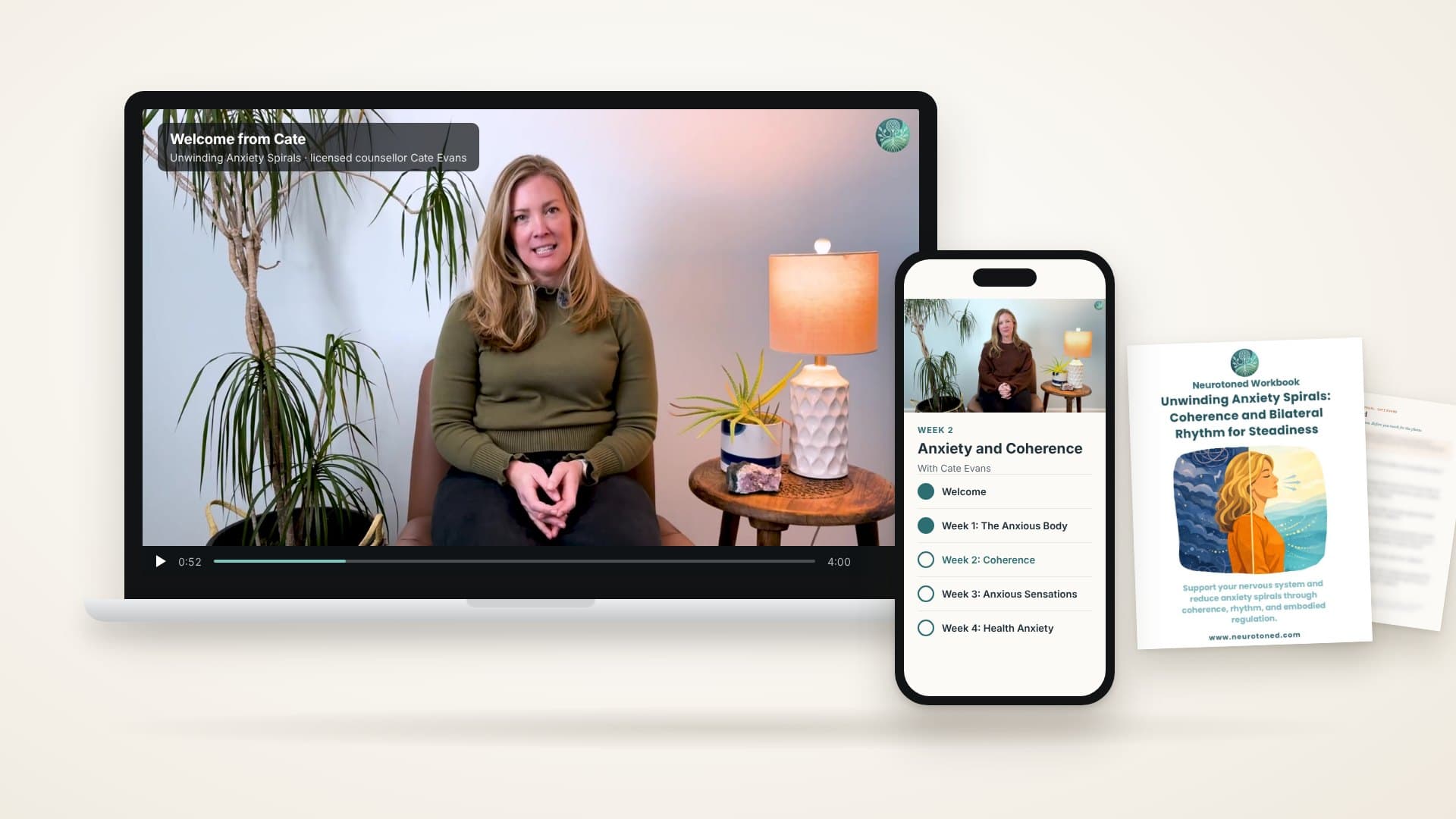
One short lesson a week, or faster if you like, each with something to do that day. The heart-focused rhythm takes 1 to 3 minutes once you know it, the kind of thing you can do while you wait for an appointment. Watch on your phone, tablet or computer. A Neurotoned member wrote on Trustpilot that the practices are "not so long that they are overwhelming to do when my system is activated."
Cate's welcome
What anxiety is, how it lives in your body, and why off days are normal, even for Cate.
Working With The Anxious Body
Why fighting the fear tightens it, shown with a Chinese finger trap, and the first practice that gives your body a moment of ease to come back to: the ground both rhythms stand on.
Anxiety and Coherence
A heart-focused rhythm of 1 to 3 minutes that gives your alarm a steady signal instead of a frightening one. Gentle, no set count, no monitor, and when to use it in an ordinary day.
Rewiring Anxious Sensations
For the fear that stays after the tests are clear: what to do with a flutter or a twinge instead of searching it, and a counsellor's way of staying with a small sensation until your body learns it is safe.
Working with Health Anxiety
Cate's lesson on health anxiety: the watchfulness, the what-ifs, and the loop she names herself: "What is this symptom that I'm having now? Researching, consulting people." She gives the worries somewhere to go other than the search bar, and small movements that "speak to the nervous system that it's safe to move".
What changes in four weeks
From braced and searching
to a body you can trust again.
Picture the next flutter. You notice it, you know exactly what the alarm is doing, and it passes. Your fingers stay off your wrist. The phone stays on the bedside table. Then a whole day you do not spend checking, then a week, until the fear is no longer running your life. In the workbook's words: "Pattern recognition builds trust more effectively than reassurance."
The tests said you were safe. Now your body knows it too.
Verified reviews
What people say about Neurotoned
in their own words.
Public reviews, left on Trustpilot by members who were not asked to write them, and quoted here exactly as they were written.
For many months, I was scared because I was experiencing symptoms that I thought were signs of a serious illness. I visited doctors, underwent testing, and everything seemed to be fine. One day, while scrolling through social media, I came across Neurotoned and decided to give it a try. When I started following the techniques and practices of the different coaches, my life changed. I especially loved the vagal toning exercises and orienting and grounding skills. I still practice them every day.
I have found the Neurotoned program to be a benefit in helping me to regulate my nervous system out of flight/ fight mode of anxiety. The practices are helpful and not so long that they are overwhelming to do when my system is activated. I appreciate the fact that the therapists are honest and relay the fact that consistently is the key to recovery, there is not a quick and easy fix. Thank you Neurotoned for this program and ongoing support.
Hi, I am so glad I found Neurotoned. The gentle exercises are very accessible due to its bite-size offerings, as it allows me to fit them into my daily busy routine flexibly. I now find myself doing the breathing exercises automatically when feeling anxious. A big thank you to the Neurotoned team, you ladies are doing awesome work. Looking forward to learning more from all of you!
Grateful This program is so authentic and the practices are so well explained and gentle. They have helped calm my nervous system and reduce my feelings of overwhelm. I’m so grateful I came across Neurotoned.
I tried talk therapy for a while and felt like I made progress on some level, after many sessions. I was able to pinpoint my problems, and talked about things I could generally do get them fixed over time. It made sense, logically, but it always felt like there was a missing piece. My body was still always tired, even after resting. I was always falling back into my old ways and snapping as soon as something out of the ordinary came up. No matter what I had learned in therapy sessions, it just never seemed to work when I was in the thick of it. When I started using Neurotoned, listening to the different bite-sized videos they have through the app, it became my safe haven. Whenever I feel anxious, overwhelmed or tired, I always found something to help me there. The best thing is that it didn’t stop there. The things I learned were very easy to internalize and remember when I actually needed to use them again later. A big thank you to the team and all the valuable information they have put into this program!
The email reminders to check in with myself daily helped me a great deal. My body and mind were stuck in the daily pattern of becoming anxious and I need the external reminder to check in and regulate my nervous system until I break the pattern. Thank you for the support.
I found Neurotoned a month ago when I was trying to recover from burnout and trauma. I was very desperate, as I couldn't sleep, didn't have an appetite, and my body didn't feel safe to exercise. Everyday techniques from the programme, along with some meds and a good sleeping and eating routine, really helped me feel better and safer in my body, helped me come back to work without overstim, and reduced my anxiety.
Absolutely amazing, I haven’t felt so calm for ages, or more like never in my life. I am very grateful! 🙏 🩷
I’m really enjoying this program, it’s making a big difference to my wellbeing. I like the daily practices and I now have a good toolkit to draw on. My nervous system is gently settling down and I feel I’m able to handle life better.
The programme
The Inward Alarm Protocol,
yours for life.
Everything you need to stop the checking, leave the phone alone at 4am and trust your body again: four weeks with Cate, the workbook for the harder days, and the card that keeps the first steps by your bed. And free with it, a whole second programme: Self-Acupressure For A Stressed Nervous System. One payment, yours for life.
The Inward Alarm Protocol
The Inward Alarm Protocol
a licensed counsellor's 4-week method to calm an anxious body, taught by Cate Evans, with Self-Acupressure free
Why it costs
less than a counsellor every week.
Because we would rather thousands of women who are frightened by their own bodies try this than a handful who can afford a counsellor every week.
If spending on yourself feels like a luxury, think of who leans on you. They get you back steadier, and the 30 days mean finding out costs you nothing.
And because you have probably already spent a great deal, in money, in appointments and in hope, on reassurance that wore off by Thursday. This should not be another big bet. It should be an easy yes, with every cent back if it is not for you.
This is a licensed counsellor's method, in order, with a whole lesson on health anxiety.
What it costs you to find out: one evening with Cate's Week 1, and thirty days to decide.
Or, instead, you could have:
- Part of one counselling session
- One more appointment to be told you're fine, and a day of relief
- Another month of searching at 4am: it costs nothing, and it has already cost you plenty
What happens when you press the button
You go to a secure checkout. Once you have paid, the programme is open to you straight away, and an email follows with how to sign in, so you can come back to it any time, on any device. One payment, nothing recurring, nothing to cancel. In your library the films and the workbook sit under the course's own title, Unwinding Anxiety Spirals, and The 4am Card is there to print.
Regular price: $70 → Today: $16.99
One payment. Lifetime access to the program. 30-day guarantee.
Try it for 30 days.
Watch Cate's welcome. Watch Week 1. Go as slowly as you like.
If it isn't for you, for any reason, email support@neurotoned.com within 30 days and we will refund every cent. No conditions, no questions.
We would rather you tried it and decided it wasn't for you than spent another night at 4am wondering. The risk is ours, not yours.
Thirty days. Every cent back if it isn't for you.
You have tried to think your way out of it.
It was never going to work, and that was never your fault. The alarm in your body was not broken, and neither are you. It was doing the job it was built for, watching for danger, and somewhere along the way it started watching the wrong thing.
It does not need to be argued with, and another test will never settle it. It needs to be shown that it can stand down, and that is what these four weeks do. The flutter passes without the spiral. Your fingers stay off your wrist, and your phone stays on the table. You trust your body again, and you get your life back.
You do not need to feel ready. You need one evening with Cate's Week 1, and thirty days to decide.
One payment. Lifetime access to the program. 30-day guarantee.
Honest answers,
before you decide.
What if it really is something?
Then it deserves a doctor, and this programme is no substitute for one. Any new or changed symptom, especially chest pain, palpitations, breathlessness or dizziness, should be checked. Cate says it plainly in Week 3: "It's always important to get things checked out by a doctor." This programme is for the fear that stays after the tests are clear, and for the anxiety that can come with living with a health condition.
Are you saying it's all in my head?
No. The flutter, the tight chest and the buzzing are real, and they are in your body. What this programme works on is the alarm that reads them as danger, which is in your body too. That is why logic never reached it, and why the practices start in the body.
My anxiety is not about my health. Is this still for me?
Yes. In Cate's words, these techniques "will also work for general anxiety... or overwhelm or stress." Health worry is one face of the alarm: Week 3 is for the fear that stays after clear tests, and Week 4 is Cate's lesson on health anxiety. The rest is for anxiety you feel in your body whatever it is about: the racing heart, the tight chest, the buzzing, the one worry that becomes ten.
Who is this not for?
It is not for a new or changing symptom that has not been checked, frequent panic attacks, or days you cannot get through: those need a professional first, and the workbook lists the signs. It is for the anxiety that sits in your body, and the fear that stays after the tests are clear.
I know my fears are irrational. Why doesn't knowing help?
Because knowing happens in the thinking part of you, and the alarm is not there. That is why reassurance and logic wear off. The practices here work from the body side instead, with breath, rhythm and attention.
I have tried CBT, apps and meditation. Why would this be different?
Talk-based approaches and worksheets mostly work through the thinking part of you. The CBT that lowered fear of sensations in the 24 trials above usually includes a body half too: meeting a sensation instead of running from it. Cate's practices borrow that idea, in a gentler form, and they are short enough to use at the moment it happens.
Am I too old for this to change?
Nothing in it depends on age. Cate teaches it as practice and repetition, a few minutes at a time, at whatever pace suits you.
Breathing exercises make my anxiety worse. Is this for me?
Many people find that, and it is why nothing here asks you to force your breath. The breath in Week 2 is gentle, at whatever rhythm feels right, and you can stop any time. The tapping in Week 3 does not use the breath at all, and the workbook has a practice called Rhythm Without Breath Control, made for people who find breathwork hard.
I have a health condition. Is this still for me?
Yes. Week 4 is written for the watchfulness that comes with a health condition: the not knowing when symptoms will come, how long they will last, whether today is a good day. The practices sit alongside the care you already have and never replace it.
Is this therapy?
No. It is an educational programme of gentle, self-guided practices, taught by a licensed counsellor. It sits alongside therapy rather than in place of it. The workbook includes a short list of signs that it is time to get extra support from a professional, such as frequent panic attacks or difficulty getting through the day.
Is this EMDR?
No. Cate is trained in EMDR, and the side-to-side tapping is a tool borrowed from it, but this programme is not EMDR therapy and does not work through past trauma. It is short, gentle practice you do on your own.
Will I have to think about my worst fears?
No. Week 3 starts small, never with your worst. If anything feels like too much, you pause, and come back another day.
What if a practice makes it feel worse?
It can, briefly. Cate says so in Week 3: sometimes sensations "got a little bit worse before they got better." She shows you what to do when that happens, and you can always pause and come back another day. The workbook's rule is plain: if at any point something feels like too much, pause.
I was never an anxious person. Is this menopause?
It can be part of it. Research following women through midlife has found new anxiety is more likely, and palpitations common, in the transition. Your doctor is the right person to talk to about hormones. This programme does not treat menopause. It gives you a way to settle the alarm in your body, whatever set it off.
How long does it take?
About 65 minutes of video in all: a four-minute welcome and four weekly lessons. The heart-focused rhythm takes 1 to 3 minutes once you know it. The lessons are laid out a week each, but you can go at whatever pace suits you and repeat any of them as often as you like.
What do I need?
Somewhere to sit, a few quiet minutes and a phone, tablet or computer to watch on. No heart-rate monitor, no extra app, nothing else to buy.
I'm on medication. Can I still do this?
This is gentle practice, not medical treatment, and it does not replace your care. Keep taking anything you have been prescribed, and talk to your prescriber before changing it.
How is this different from the Vagus Nerve Reset?
The Vagus Nerve Reset works with an exhausted, overwhelmed nervous system as a whole. This programme is aimed at one thing: the alarm that reads your own body as danger, the fear of sensations and the health worry, with a licensed counsellor's practices for it.
Is this a subscription?
No. One payment, yours for life, nothing recurring and nothing to cancel.
What if it's not for me?
Email support@neurotoned.com within 30 days and we will refund every cent. No conditions, no questions.
One payment. Lifetime access to the program. 30-day guarantee.
P.S. The fingers on your wrist, the 4am searching, the fear that comes back after every all-clear: underneath, it is the same alarm, pointed the wrong way. The Inward Alarm Protocol teaches it to stand down: the next flutter passes without the spiral, your fingers stay off your wrist, the phone stays down at 4am, and you trust your body again. Self-Acupressure comes free with it. Yours for life, and every cent back if it is not for you.