Neurotoned · Limerence
You can’t stop thinking about him. And you already know it makes no sense.
It isn’t him you can’t let go of. It’s something your body is doing, and words don’t reach it.
It’s called limerence.
One person takes over your head. Your whole day rides on him: a reply, a look, whether he was online. You check, you replay, you rehearse. And telling yourself to stop does nothing.
Nothing on this page judges you, or tells you what to do about him.

By Laurie James, Somatic Experiencing® Practitioner. Trained under Dr. Diane Poole Heller, who pioneered attachment repair for adults. 15 years of body-based work. 4.1 on Trustpilot, from 300+ reviews of Neurotoned

If one person has moved into your head, this may sound familiar:
- You check your phone before your eyes are fully open. Not for the time.
- One reply, one look in a hallway, one green dot by his name, and you’re lighter for the rest of the day. Nothing, and the day goes gray.
- You replay a two-minute conversation for days. You rehearse the next one in the shower, in the car, in meetings.
- You look at his profile, or when he was last online. Then you hate that you looked.
- He turns up in your dreams, and the whole morning after is his.
- You’re at dinner, or reading to your kids, or lying next to someone who loves you. And you’re somewhere else.
Maybe he runs hot one week and cold the next, and you never know which one you’ll get.
Maybe he’s been gone for years. There’s no thread and nothing to wait for. Just an old profile, and the dreams.
Maybe he’s someone you see every week and would never, ever act on. There are no messages at all. Only a look in a corridor that runs you for four days.
Whoever he is, you didn’t choose this. Nobody in your life knows. And you’re tired.
“I would do anything to break out of this.”
Under the tiredness there’s a quiet fear: that this is costing you the life that’s actually in front of you. The day’s work you lost because he was online and silent. The people at your own table. The years.
And the question you never say out loud: what kind of woman does this?
If that’s where you are, this page is for you. And what’s behind it isn’t what you’ve been told.
Two things before we go on.
If you’re married or with someone, and he isn’t the one in your head: nothing here tells you what to do about your marriage, or about him.
And you don’t have to cut him off. For some women that isn’t even possible. He’s a colleague, or the father of your kids.
You’ve already tried to stop.
- You tried cutting him off. You blocked him, or muted him, or took the stairs so you wouldn’t pass his desk. Maybe it lasted nine days. Maybe it held, and the thoughts kept going without him.
- You stayed busy. Work, the gym, friends, a full calendar. It helped while you were moving. Then you stopped moving.
- You made the list of everything wrong with him. You can recite that too. It changed nothing.
- You read about it. Maybe you talked it through with a therapist. Maybe you’ve never told a soul. Either way you understand it better now, and you still reach for your phone.
You know it’s out of proportion. You could explain exactly why to anyone who asked.
And then your phone lights up, and none of that is in the room.
“Yeah. Now what? I've always been self aware but never been able to change it”
You’re not weak, and you’re not crazy.
The word for this has been around since the 1970s. A psychologist named Dorothy Tennov gave it to an involuntary, overwhelming longing for one person’s attention. She called it limerence.
It isn’t a diagnosis. You won’t find it in the manual doctors use. But researchers are studying it now, and what they’re finding sounds a lot like your week.
In the largest study so far, researchers checked in with 51 people in the middle of it, several times a day for a week. Thoughts of the person took up about half of their waking thinking. And those thoughts came most when they felt sad or lonely.
Evans and colleagues, 2026. People who said they were limerent and chose to take part.
Half of every waking hour. So no, you’re not being dramatic.
★★★★★
“The first time in years that I felt completely understood and had real confidence that I am not broken and that there’s a way to heal....”
And there’s a reason almost nothing you’ve tried has touched it.
Every fix so far worked on him, or on your thoughts: block him, distract yourself, think it through.
What’s producing the thoughts sits lower down than that. Not in what you think. In what your body does when it doesn’t know where it stands.
The attachment alarm
It isn’t him your body can’t let go of. It’s not knowing.
Here’s the way I explain it to the people I work with.
Your body has an alarm for the people you’re attached to. Its one job is to keep track of where you stand with them. When it knows, it rests. When it doesn’t, it goes off.
You feel it before you think anything:
- the tight chest,
- the drop in your stomach,
- the hand already reaching for the phone.
Now look at who it goes off for. Not the people who are clear with you. The one who is warm on Monday and gone by Thursday. The one who almost said something. The one you can’t have and can’t quite rule out.
The one you can’t read.
Researchers have seen a small version of this. In one experiment, college women looked at profiles of men who had seen theirs. Some were told the men liked them a lot. Some were told they couldn’t be told. The women who didn’t know were more attracted, and thought about those men more.
Whitchurch, Wilson and Gilbert, 2011. One experiment, with strangers’ profiles.
Another research team found that anxiety about one particular person is strongest before anything is certain, and that it goes with wanting to be near them. They called it a normal part of early attraction (Eastwick and Finkel, 2008).
So picture what happens when it never becomes certain. When he gives you just enough to keep the question open.
The alarm never gets its answer. So it never stops looking for one.
That’s what the thoughts are. The alarm, looking.
The loop
1. You don’t know where you stand
He’s warm, then gone. Or he was never yours to read.
2. The alarm goes off
The tight chest, the drop in your stomach.
3. You go looking
You check. You replay. You rehearse.
4. A crumb arrives
A reply, a like, a look, his profile. Relief, for a little while.
The alarm learns that looking works. Back to 1.
This is why a reply from him feels so good, and why it makes things worse. The relief is real. It doesn’t last. And it teaches your alarm that checking works.
And if he gives you nothing? If he’s been gone for years, or he barely knows you’re there?
Then you fetch the crumb yourself. His profile. An old photo. Two minutes by a printer, replayed until they feel new. The alarm doesn’t care where the crumb comes from.
It’s also why the thoughts get loudest when you’re lonely, or stressed, or lying awake. That’s when the alarm has the least to hold on to.
And it isn’t only in your head. It’s in your body.
Across 60 studies, going over and over something went with a faster heart, more of the stress hormone cortisol, and lower heart rate variability, one sign of a body that isn’t settling (Ottaviani and colleagues, 2016).
Think of a smoke alarm with a low battery.
It chirps every few minutes, all night. You can leave the room. You can turn up the TV. You can tell yourself there’s no fire.
It keeps chirping. It isn’t waiting for you to understand something. It’s waiting for you to reach up and deal with the alarm.
Maybe you’ve read that you’re “addicted” to him. I don’t use that word. Nobody has shown that, and it leaves you with nothing to do but white-knuckle it.
An alarm is different. An alarm can be answered.
Answering the alarm
You can’t think an alarm quiet. You can answer it in the language it speaks.
Your alarm doesn’t speak logic. It speaks sensation.
That’s why the list of his flaws did nothing. You were talking to it in words, and it was waiting to feel something.
So the work I teach doesn’t start with him, and it doesn’t start with your thoughts. It starts with what your body is doing in the ten seconds before you pick up the phone.
You learn a short practice. When the alarm goes off, you give your body something steady to feel, so the urge can crest and pass without him being the thing that ends it.
Each time that happens, your alarm gets a new piece of information: I didn’t know where I stood, and I was still okay.
You stop needing his answer to settle. That’s the whole aim.
Here’s what one looks like. Try it now, while you’re reading.
Try it now: one minute, for the moment you reach for your phone
- Put the phone face down. Feel where your body touches the bed or the chair, and where it feels heaviest.
- Notice your chest and your stomach. Don’t fix them. Just notice.
- Put the thoughts about him on a shelf, for now. They’ll keep.
- Rub your thumbs slowly along your fingertips.
- Let your eyes land on something in the room that’s pleasant to look at.
The short version, from Week 1 and The Trigger Interrupt Guide. About a minute, and nobody can tell you’re doing it.
Notice anything? Even a second of your chest letting go is your alarm hearing something it understands. And if you felt nothing yet, that’s fine. As I say in the films, even not feeling much is information.
That was your alarm being answered once. It will go off again tonight. That’s one of six moments in the guide.
Watch me guide the full practice: 2 minutes from Week 1
That minute is for when the alarm is only starting.
On the loud nights, when he’s been online and silent for six hours, or you’ve woken from a dream of him, that minute won’t hold it. The films teach the full practice, guided, so you have it for those nights. And they teach the ones this minute doesn’t touch: what to do lying awake replaying it, and why steady care from the people who love you can feel like nothing.
One calm minute doesn’t undo something that’s been running for months or years.
Four weeks of them gives your alarm a lot of new information.
★★★★★
“I am completely taken by surprise! I purchased the wired for love program, and by week two I started recalling funny experiences from my childhood years, accompanied by tears and unexpected emotions . By week three my neck pain was surprisingly almost gone completely. My relationship with my husband and son improved significantly. I feel calmer and l think I got out of the fight or flight mode. Thank you.”
Matina wasn’t writing about limerence. No review we have is. I’m showing you hers because she wrote about this program by name, and about what four weeks of these practices were like for her.
Wired for Love is four short weeks at home with me, teaching your body to settle without his answer. The full practice opens the moment you join.
$16.99 instead of $70 until the timer runs out. One payment. 30-day guarantee.Private: you do it alone, on your phone, and nothing in the program uses the word limerence.
★★★★★
“...I've tried many programs with no noticeable impact, making me feel like I'm the problem. On the other hand, Neurotoned makes me feel welcomed, nurtured and supported....”
What I won’t tell you
The alarm is the model I work from. It fits what the research shows so far, and it gives you something to do. It isn’t a scan of your brain, and nobody has proven exactly what causes limerence yet.
Nobody has tested a body-based practice for limerence in a study, and this program hasn’t been tested for it either. I built Wired for Love for anxious attachment, which is the name for an alarm like this one. It doesn’t mean you’re anxious with your husband or your partner. You can be settled at home and still have this go off for someone else. I never use the word limerence in the films.
So I can’t promise he’ll be out of your head by a date. Nobody honestly can. What I can give you is a way to settle your body when the longing spikes, so that you get to decide what happens next. And 30 days to find out if it helps, or your money back.
It’s for you if:
- one person takes up far more of your head than you want,
- you understand it perfectly and it hasn’t helped,
- and you want something you can do alone, in private, without telling anyone.
If you’re hoping for a way to make him come back, or text first, this isn’t that.
It works on the part of you that’s waiting.
Who teaches it
I’m Laurie James, a Certified Professional Coach and Somatic Experiencing® Practitioner. I trained under Dr. Diane Poole Heller, who pioneered attachment repair for adults, and in the lineage of Dr. Peter Levine. For 15 years my work has had one aim: helping people feel safe in their own bodies.
Survival doesn’t speak logic. It speaks sensation.
Both traditions work with the body to reach responses that talk alone can’t reach. In Wired for Love I aim all of it at one thing: the alarm that goes off when you don’t know where you stand with someone.
And if you take one thing from me, let it be this: you can’t think your way out of a body alarm.

What you get
Wired for Love: Healing Attachment Wounds Through Nervous System Regulation
Four weeks of body-based practice, at home, on your phone.
Built for real life, and for a head that’s already full.

- A practice for the moment the alarm goes off. So the urge to check can rise and pass on its own. Each week’s short film, 8 to 10 minutes, shows you one, step by step, and why it works.
- Something you can do anywhere, and nobody can tell. At your desk, in the car, in bed at 1am. A few minutes for the full practice. One minute for the short version.
- Your own pattern, on paper. The 55-page workbook, so you can see your own pattern on paper and notice it changing week by week.
- Lifetime access. Go at your own pace and repeat any week. If he turns up again in six months, the practice is still there.
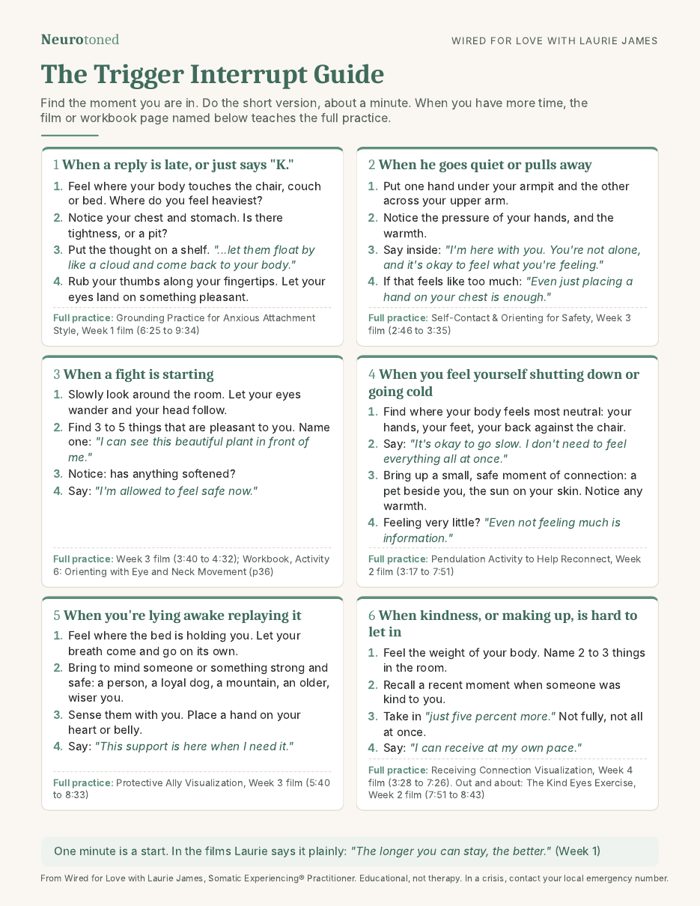
The actual guide. Screenshot it and keep it on your phone.
Bonus #1: The Trigger Interrupt Guide.
For when you can’t stop and watch a film. One page, six moments, the one-minute version of each move: a late reply or just “K.”, when he goes quiet, when you’re lying awake replaying it, and three more.
Included: Unburdening the Body.
For the shame of it. Somatic tools for guilt, shame and feelings you’ve kept to yourself, with Candice Winterboer. A four-week program, about an hour of film and its own workbook. Lifetime access.
Included: The 30-Day Neurotoned Program.
For the rest of your nervous system: sleep, tension, exhaustion. 41 films of daily practices, 7 to 18 minutes each, from Neurotoned’s practitioners. Lifetime access.
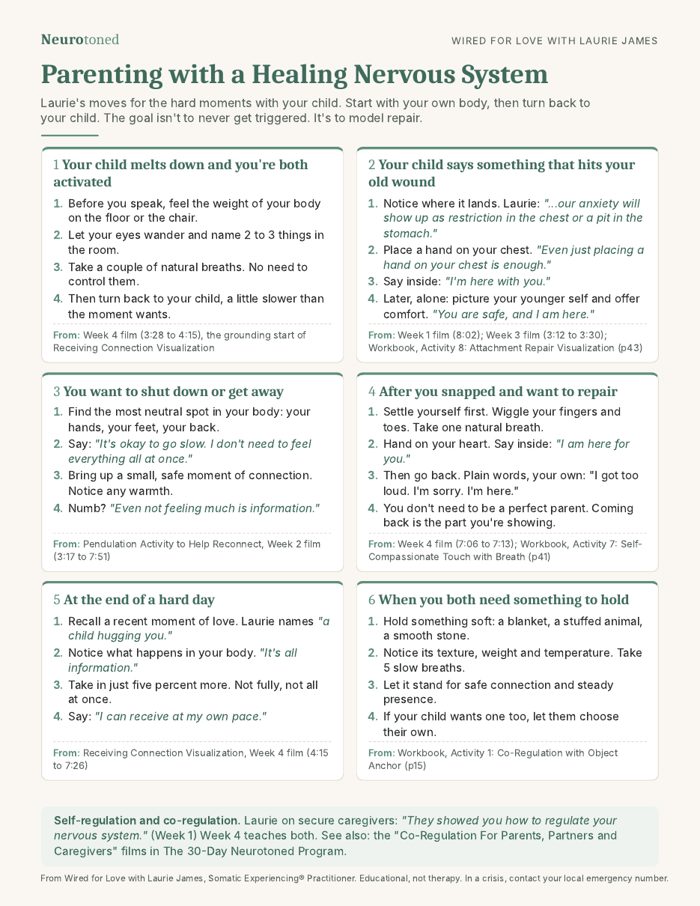
Bonus #2: Parenting with a Healing Nervous System.
If you have kids: how to co-regulate when you’re both activated, what to say when your kid triggers your wound, and how to repair after you react in a way you regret.
You don’t have to do all of it. Week 1 and the one-page guide are enough to start. The rest is there when you want it.
How the four weeks unfold
- 1Week 1: Soothing Your Anxious Attachment Style. For the checking, the waiting, the reply your whole day hangs on.
- 2Week 2: Rewiring to Receive and Become Less Avoidant. For why the people who are clear with you can feel like nothing, and how to let steady care land.
- 3Week 3: Reducing Overwhelm and Finding More Safety Within Your Body. For the nights it won’t switch off, and the days you’re worn out from it.
- 4Week 4: Becoming More Secure Through Connection. Feeling settled with the people who are actually here.
You’re not on a clock. All four weeks open at once, and you can repeat any of them.
★★★★★
“...the wired for love left me speechless... felt that it was working even after the sessions... Great work, better than I ever expected.”
What is your own head worth to you?
Wired for Love is normally $70. Until the timer at the bottom of your screen runs out, you can join for
$16.99
with lifetime access.
$16.99 ends in 06:00:00
- Wired for Love, four weeks and the 55-page workbook$70
- The Trigger Interrupt Guide, the one you just triedyours
- Unburdening the Body, included$70
- The 30-Day Neurotoned Program, included$69
- Parenting with a Healing Nervous Systemyours
One payment. No subscription. Nothing else is charged unless you choose it.
This price is for women who came through this page. When the timer at the bottom of your screen runs out, it goes back to $70. No warning email: this is the warning.
Why so low?
I wanted this to be something you could start tonight without having to think about the money.
What happens when you join
- 1Enter your details. It takes about two minutes.
- 2Get instant access to all four weeks.
- 3Start Week 1 tonight.
$16.99 until the timer runs out. Lifetime access. 30-day guarantee.
The find-out guarantee: 30 days, every cent back
Use the move the next time you reach for your phone. Try all four weeks. If, within 30 days, it isn’t for you, email support@neurotoned.com and we refund every cent.
No hoops. No hassle.
I told you I can’t promise he’ll leave your head by a date. This is how I make that fair: you find out with our money at risk, not yours.
The choice
You can close this page and keep doing what you’ve been doing:
- checking, and hating that you checked,
- another month of your best attention going to someone who isn’t in the room,
- and waiting for it to burn out on its own, the way you’ve been waiting.
Or you can give your body four weeks of a different answer, and see what your head is like with some room in it.

What if, a month from now, your phone is in the other room and you haven’t noticed?
What if you get through a whole dinner and you were actually there for it?
In the largest survey so far, of 1,647 people who’d been through this, an episode lasted about two years. And most had been through it more than once (Evans and colleagues, 2026). Waiting it out is a real plan. It’s just a slow one, and it leaves the alarm set for the next person. And two years is an average. If yours has run far longer, you’re not a worse case. Your alarm has just had longer to practice.
You deserve your own mind back. All of it.
Why today, not someday
The next time you reach for your phone is coming either way: tonight, probably. You can meet it the old way, or with the move already in your hands. All four weeks open the moment you join. And $16.99 holds only until the timer at the bottom of your screen runs out.
$16.99 until the timer runs out. Lifetime access. 30-day guarantee.
And if you have ADHD
A lot of women with ADHD tell me this hits them harder. They call it hyperfixating on a person.
“I just let it destroy me until it fades.”
I’ll be careful here. No study has shown that ADHD causes limerence. What researchers do say is that strong, fast-changing emotions are common with ADHD (Shaw and colleagues, 2014).
So if a late reply lands on you like a verdict (some people call that rejection sensitivity), and your attention locks onto one person the way it locks onto everything it loves, that fits.
The practice is the same. It’s short on purpose: one film of 8 to 10 minutes a week, and a one-minute version for the moment itself. Miss a week and nothing is lost.
Wired for Love doesn’t treat ADHD, and nothing here is a reason to change a medication. That’s for you and your prescribing doctor.
Questions people ask
Is limerence a real diagnosis?
No. It’s a word a psychologist gave this experience in the 1970s, and researchers are still working out how to define it. It isn’t in the manual doctors diagnose from. You don’t need a diagnosis to be worn out by it.
Will this make me stop thinking about him?
I can’t promise that, and nobody honestly can: no body-based practice has been tested for limerence. What it gives you is a way to settle your body when the urge spikes, so the urge can pass without him. You have 30 days to find out if that helps you.
I’m married, and he isn’t my husband. Is this for me?
Yes. Nothing here tells you what to do about your marriage, or about him. You do the practices alone, on your phone, and nobody needs to know why.
Do I have to go no contact?
No. That’s your call, and for some women it isn’t even possible: he’s a colleague, or the father of your kids. The practice is for the moment the alarm goes off, wherever he is.
How is this different from therapy?
Therapy helps you understand, and for some women it’s what finally turned this down. This works on what your body does in the moment. Many people do both.
★★★★★
“...They break down nervous system regulation and attachment healing in a way that’s easy to understand and actually usable, not overwhelming or overly clinical...”
How much time does it take?
One film of 8 to 10 minutes a week. The practices take a few minutes, and the guide gives you a one-minute version. Miss a week and nothing is lost.
Can I really get my money back?
Yes. Try all four weeks. If, within 30 days, it isn’t for you, email support@neurotoned.com and we refund every cent.
$16.99 until the timer runs out. Lifetime access. 30-day guarantee.
P.S. If you take one thing from this page, take this.
The thoughts aren’t a verdict on him, and they aren’t a flaw in you. They’re an alarm that never got its answer.
You can’t argue with it. You can answer it, through your body, a minute at a time.
P.P.S. Week 1 opens the moment you join, and you have 30 days to try all of it. If it isn’t for you, email support@neurotoned.com and you’ll get your money back.
I’ll see you inside.
Laurie James
Somatic Experiencing® Practitioner
If the thoughts ever turn dark, or you ever feel you can’t go on, call or text 988 in the US, call Samaritans on 116 123 in the UK and Ireland, or your local crisis line, right away. A person first. This program can wait.
© Neurotoned. This page is not medical advice. Limerence is not a medical diagnosis. Wired for Love is an educational wellness program; it has not been tested as a treatment for limerence and is not a treatment for ADHD or any other condition. Individual results vary and are not guaranteed. Never stop or change a prescribed medication without the guidance of your prescribing clinician. Quotes marked as Reddit posts are strangers’ public posts, not customers. Pictures of people on this page are illustrations; nobody pictured is a customer.