A Gentle Nervous System Plan for Back-to-Office Anxiety
Going back to the office can wake up a lot in your body.
You might feel tense the night before, wired on your commute, or “on” all day in a way that leaves you drained by the time you get home.
There is nothing wrong with you for feeling this way. Your nervous system is responding to change, pressure, and old memories of stress, even if you “know” the office is fine now.
If you want a clearer picture of how your body responds under stress, you can take the Stress Loop Quiz.
This plan is not about forcing yourself to be “fine.” It is about giving your body tiny, repeatable signals of safety before, during, and after work.
Quick Overview: What Helps Back-to-Office Anxiety
Back-to-office anxiety is often your body’s survival wiring, not a character flaw. Commutes, noise, social pressure, and performance expectations can all signal “threat” to your system. Gentle, body-based tools like orienting, short somatic exercises, and nervous-system-friendly microbreaks may help your system feel less cornered and more supported through the day. Small, kind steps work better than pushing.
If you want a broader foundation first, you can read this gentle guide on how to reset your nervous system after trauma for more context on why your body reacts the way it does.
Why Your Body Reacts So Strongly To “Just Going Back to Work”
Your body remembers old work stress
Even if your current job is safer than past ones, your body may remember earlier burnout, conflict, or times you had to push through. That history sits in your muscles and breath patterns.
A short, practical overview of this is in Signs Your Nervous System Is Dysregulated and What to Do, which explains how stress can show up as “too much” or “too little” energy in daily life.
Transitions wake up survival wiring
Changes in routine, commute, lighting, and social contact all count as “load” for your nervous system. It is common to feel jumpy, on guard, or emotionally thin when your system has not yet adjusted.
Your system may flip between “go” and “shut down”
Some people feel wired, buzzy, or panicky. Others feel numb, heavy, or like they are moving through fog. Both are understandable survival states.
If you notice this a lot, you may find support in How to Widen Your Window of Tolerance Daily, which explains how to expand the range where your body feels safe enough to function.
Step-by-Step Nervous System Plan For Back-to-Office Days
Step 1: The Night Before – Shift From “What If” To “What Helps”
The night before work often activates fear of the next day. Instead of trying to think your way out, give your body a small dose of safety.
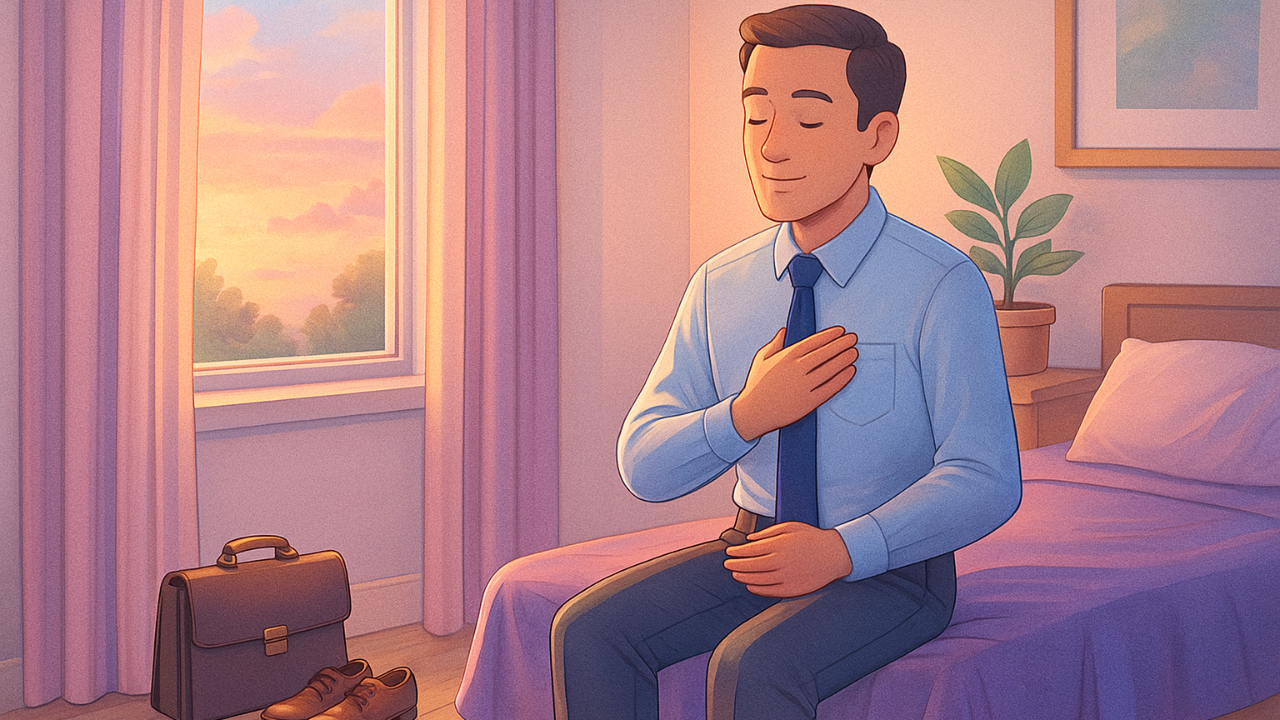
A 60-second evening practice
-
Sit or lie somewhere you feel relatively okay.
-
Place one hand on your chest and one on your belly.
-
Let your shoulders drop, even slightly.
-
Exhale softly through your mouth, like a quiet sigh. No deep breathing.
-
Say (out loud or in your mind):
“Right now, I am here. I am not at work yet. I am allowed to rest.”
If deep breathing tends to make you more anxious, you are not alone. You might find comfort in Why Deep Breathing Makes Me More Anxious, And What To Do Instead, which gives gentler options you can swap in.
If your nights are especially busy with thoughts, How To Calm Racing Thoughts At Night (Nervous System Tools That Help) offers specific nighttime tools.
You can also retake the Stress Loop Quiz anytime to see how your pattern shifts over time.
Step 2: Morning Of – Arrive In Your Body Before You Arrive At Your Desk
Many people wake up already bracing for the workday. A tiny morning reset can soften that edge.
If mornings are rough, you may like Somatic Tools for Morning Anxiety, which offers simple practices for that first hour.
A 2-minute morning reset
-
Sit on the edge of your bed or a chair, feet on the floor.
-
Look around the room slowly and name three things that feel neutral or pleasant.
-
Let your breath stay natural.
-
On the next exhale, gently whisper “ha” or “mmm” as the air leaves your body. Keep it small and easy.
-
Notice one place in your body that feels even 2 percent less tense.
If you want a structured option, A 10-Minute Nervous System Reset For Overwhelm You Can Do Anywhere gives a short routine you can do before leaving home.
Step 3: Commute & Arrival – Use Microbreaks, Not Marathon Coping
You do not need a 30-minute practice on the train or in the car. You need small, doable moments.
On your commute
-
If walking: Feel your feet roll from heel to toe for 10 steps.
-
If using public transport: Let your gaze rest gently on something outside the window. Soften your jaw. Exhale through slightly parted lips.
-
If driving: At red lights, loosen your grip on the steering wheel, roll your shoulders once, and let out a quiet sigh.
When you first sit at your desk, give yourself a 30-second “arrival” pause.
-
Place your hands on the desk.
-
Feel the texture and temperature.
-
Let your eyes scan the room once, then land on something that feels okay.
-
Remind yourself, “I can arrive before I perform.”
For more ideas, 10 Nervous System Microbreaks to Calm Your Body During the Workday was created exactly for these moments.
And if you often feel scattered and foggy once you open your laptop, How to Focus When You Feel Dysregulated can help you pair focus tasks with regulation cues.
Step 4: During the Workday – Support Your Body, Not Just Your To-Do List
Back-to-office anxiety often grows quietly over the day. Muscles tighten, breathing gets shallow, and your window of tolerance shrinks.
You do not have to wait until you are on the verge of panic. You can drip tiny resets in.
Quick tension check
-
Jaw: Gently unclench. Let your tongue rest low in your mouth.
-
Shoulders: Shrug up once, then let them fall.
-
Belly: Place a hand over your lower ribs and let your next exhale soften into that hand.
If you notice yourself freezing or going numb at your desk, Why Your Body Goes Numb During Stress (and Gentle Somatic Ways to Reconnect) explains what is happening and offers soft ways back.
You might also like Track Your Window of Tolerance With a Simple Daily Journal, especially if you want to see patterns in which meetings, tasks, or times of day spike your anxiety.
Step 5: After Work – A Downshift So You Do Not Take The Office Home In Your Body
Many people carry work in their nervous system all evening. Even if you physically leave, your body stays “on.”
A small downshift ritual can help close the loop.
A 5-minute after-work downshift
-
When you finish work, pause for one minute before leaving your space.
-
Stand or sit and feel both feet on the ground.
-
Gently sweep your hands down your arms or legs, like you are brushing off dust.
-
On each sweep, let a small exhale fall out. Imagine letting the day slide down and away.
-
Once home, sit or lie down for 2 minutes with one hand on your chest and one on your belly. No fixing. Just arrival.
You can explore more ideas in After-Work Downshift Routine for Your Nervous System, which goes deeper into designing an end-of-day ritual that fits your life.
If your work is hybrid or still includes some remote days, Nervous System Microbreaks to Help Remote Workers Stay Calm and Focused offers ideas you can apply on the days you are not in the office, so your system builds consistent safety.
You can periodically retake the Stress Loop Quiz to track how these shifts impact your pattern over time.
A Gentle 7-Day Back-to-Office Nervous System Plan
This is not a performance checklist. It is a menu. Keep what works, drop what does not.
Day 1: Try the 60-second evening hand-on-chest practice. Notice how your body feels afterward.
Day 2: Use the 2-minute morning reset before you check your phone or email.
Day 3: Pick one commute microbreak and repeat it the whole way.
Day 4: Add a 30-second arrival pause at your desk and one microbreak from the workday list.
Day 5: Experiment with a short after-work downshift using the brushing-off practice.
Day 6: Spend 5 minutes with A 10-Minute Nervous System Reset For Overwhelm You Can Do Anywhere and adapt one piece you like into your workday.
Day 7: Reflect: Which tiny practices felt kind? Which felt like pressure? Keep the kind ones, let the rest go.
Common Sticking Points (And Gentle Responses)
“I feel silly doing this at my desk.”
You are not doing anything wrong. Many of these practices are invisible: softening your jaw, lengthening an exhale, relaxing your grip. Your body deserves this care, even if no one else sees it.
“I forget to use the tools until I am already spiraling.”
This is normal. Try pairing one practice with something you always do, like washing your hands, opening your computer, or logging off. Habit stacking can slowly retrain your body.
“My anxiety feels too big for these tiny steps.”
Tiny steps are not meant to fix everything. They are meant to give you islands of relief. If your distress feels overwhelming or constant, consider talking with a qualified professional for added support.
“I am worried I am just burned out, not anxious.”
You might be both. For a deeper look at this, you can read Shutdown Response vs Burnout: How to Tell the Difference.
FAQs
Why does my anxiety get worse right before going back to the office?
Your body is anticipating demand. Commutes, social contact, and performance pressure all count as “load.” Survival wiring activates in advance, which is why you often feel it the night before.
Is it normal to feel foggy or numb at work instead of panicky?
Yes. Numbness and fogginess can be protective states too. They are part of the same survival system. Gentle movement, microbreaks, and soft sensory input may help you reconnect without forcing it.
How long before these practices start to help?
Many people notice small shifts within a few days when they practice consistently. This is not about instant calm, it is about giving your body repeated proof that it is allowed to feel safer.
What if deep breathing makes my anxiety spike?
You can focus on softer, shorter exhales, grounding through your senses, or simple touch instead. Deep breathing is not required for regulation, and for some people it feels too intense.
Do I need hours a day for nervous system work?
No. Most of the practices in this plan are under two minutes. Consistent small signals are often more effective than one long session once a week.
More Gentle Reads
If back-to-office anxiety is part of a bigger pattern of stress and burnout, you might also like:
-
A kind roadmap in Nervous System Regulation for Burnout Recovery, especially if work has felt like too much for a long time.
-
A seasonal support plan in A Gentle Nervous System Plan for Holiday Stress, helpful if office culture and social events ramp up at the same time.
-
Extra tools if back-to-office anxiety is triggered by social anxiety in Gentle Vagus Nerve Exercises For Real-Life Social Anxiety.
Disclaimer: This article is educational and not medical advice. If you have health concerns, consider speaking with a qualified professional.
Discover Your Vagal Tone
Find out how dysregulated your nervous system is and get your personalized roadmap to feeling calm, energized, and in control