A Soft, Connected Bedtime Routine For Anxious Kids (The Parent Version)
If bedtime with your child feels like walking into a storm, you are not failing. Night can be a loud time for small bodies. The day finally slows down and suddenly every worry, sensation, and memory has space to show up.
When your child is anxious, your nervous system often jumps too. You might feel wired, braced for resistance, or already exhausted before you even start. That makes sense. Your body has its own history of stress and survival patterns, which may be why you sometimes feel “ready to jump out of your skin for no reason,” as described in this gentle guide on big trauma and chronic activation.
You do not need a perfect script. What helps most is a simple, repeatable routine where both your body and your child’s body get clear cues of safety.
If you want a clearer sense of your stress patterns and survival loops, you can take the Stress Loop Quiz.
Quick, gentle answer
A helpful bedtime routine for anxious kids is slow, simple, and connection-first. Start by grounding yourself, then use predictable steps: dim lights, one task at a time, a shared regulating practice, and a tiny ritual that repeats every night. Your child does not need you to erase their fear. They need to feel safe while having it, and your regulated presence is the main medicine.
Why kids often feel more anxious at night
Night removes distractions. There is less noise, less movement, and fewer tasks. For many kids, this is when:
- Separation fears show up
- Body sensations feel louder
- Memories from school, social moments, or conflict replay
- Their nervous system struggles to “come down” from fight, flight, or freeze
If your child’s body goes into panic, their symptoms can look very similar to adult panic attacks, with racing heart, tight chest, or a sense that something terrible is about to happen. This is explained in more depth in What Are Panic Attacks? Why Do They Happen? Can I Stop Them?
A key idea: your child’s anxiety response is not a character flaw. It is a survival system trying to protect them, even when there is no real danger in the room.
Your nervous system is the anchor
Before we talk about steps for your child, I want to name this clearly.
Bedtime is not just “their anxiety.” It is also:
- Your history of nights that went badly
- Your own fear that you will lose patience
- Your exhaustion after a long day of caregiving
You are not supposed to be a calm robot. You are a human with a sensitive system who is parenting in real life.
Many caregivers find it helpful to see themselves as nervous-system caregivers, not just behavior managers. This article on trauma-informed nervous system tips for caregivers may give you language and validation for what you are already doing.
You matter in this story. Your regulation is not selfish. It is the foundation your child is borrowing from.
If you want to explore your own patterns more deeply, the Stress Loop Quiz can help you map them.
The parent-centered bedtime routine, step by step
This is not a strict formula. Think of it as a menu of gentle options. Choose what fits your home and your energy.
Step 1. Prepare your own body for five small breaths of time
Before you start “bedtime” with your child, give yourself a short nervous-system pause.
Options:
- Stand in the hallway and let out one slow, quiet sigh through your mouth
- Place one hand on your chest and one on your belly and feel the warmth under your palms
- Take three slow looks around the room, naming out loud what feels neutral or pleasant
If traditional deep breathing makes you more anxious, you are not alone. Many people find softer breath alternatives more regulating, like the ones in this gentle guide.
This first step is not a luxury. It is a way to tell your body, “We are safe enough to do this slowly.”
Step 2. Shift the environment into “night mode”
You can think of this as your child’s body receiving a clear “We are moving toward rest now” signal.
Simple environmental cues:
- Dim the main lights, turn on a single soft lamp
- Lower the volume of your voice and your pace of movement
- Reduce screen input if possible, or move screens out of the bedroom
For more support on this transition from “day mode” to “night mode,” especially if your own nervous system struggles to wind down, you may like this guide on calming your nervous system before bed.
Your goal here is not silence. It is softness and predictability.
Step 3. One clear step at a time, narrated gently
Anxious kids often feel overwhelmed by multi-step instructions. Their nervous system is already busy managing worry, so executive function tasks can feel like too much.
Try giving one step at a time:
- “First we brush teeth.”
- “Now we choose pajamas.”
- “Next we pick a story.”
You can narrate your own actions, too:
“I am walking to the bathroom with you. I am right here.”
This kind of simple, predictable narration is especially helpful when you are regulating with small kids around, as explored here in Regulating Your Nervous System with Small Kids Around.
Your words become a soft path they can follow.
Step 4. Build in one shared grounding practice
Instead of “just calm down,” offer something your bodies can do together.
You might choose:
A grounding touch practice
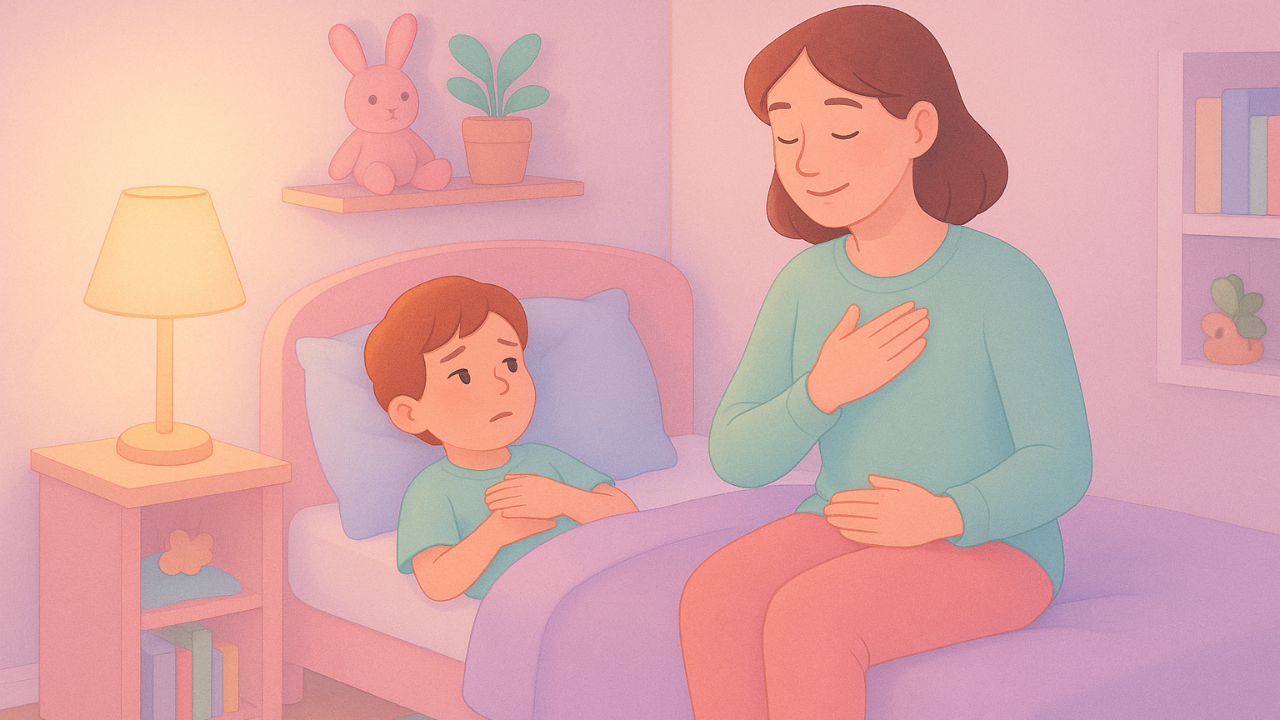
- You sit beside them on the bed.
- Each of you places one hand on your chest and one on your belly.
- Together, you notice three slow rises and falls of the breath, without forcing it.
You can say:
“Let’s feel our hands move with our breath. We do not have to breathe big or deep. Just noticing is enough.”
A simple somatic grounding moment for worry thoughts
If their mind is full of “what ifs,” you can borrow ideas from somatic grounding for intrusive thoughts, like gently shifting attention between worry and something that feels okay in the room.
You could say:
“Your worry is very loud. Let’s let it be here, and also notice your cozy blanket. What does it feel like on your hand?”
A panic-sensitive option
If your child’s body tips into panic, talk therapy is often too much in the moment. Instead, you can use location-based grounding, temperature changes, or simple counting, like the guide in Grounding During Panic Without Talk Therapy suggests.
The rule: nothing has to be perfect, and you stop or change the exercise if their distress increases.
Step 5. A tiny, repeatable connection ritual
Your child’s nervous system loves rituals. Repeating the same tiny action night after night tells their body, “We know this path.”
Choose something you can realistically do every evening, even on hard days:
- A short, repeated bedtime sentence like, “Your body can rest. I am close.”
- A hand on their back, tracing small circles for 20 seconds
- A two-line song or poem that you always whisper at the end
If you want more options for gentle somatic exercises to create this sense of safety, you might like this collection of simple practices in 5 Simple Somatic Exercises to Feel Safe Again.
Think of this ritual as your nightly nervous-system handshake with your child.
Step 6. A kind exit plan
The moment you leave the room is often when your child’s anxiety spikes. You are the main safety cue, and your absence can feel sudden.
You can experiment with:
- Leaving the door slightly open
- Saying, “I am getting a glass of water and will come back to check on you,” and then doing exactly that
- Sitting in the hallway for a minute as a halfway step
If your child tends to have nervous-system insomnia or wakes frequently, you may also find this nervous system–based nighttime routine helpful.
You are not abandoning them by stepping away. You are teaching their body that safety can exist even when you are not physically touching them.
A 7-day gentle bedtime plan for parents
This is a tiny, realistic plan. Adjust as you need.
Day 1: Choose one personal grounding practice for yourself before starting bedtime.
Day 2: Shift the lighting and sound in your home 15–20 minutes before bed.
Day 3: Practice giving one-step instructions and narrating what is happening.
Day 4: Introduce one shared grounding practice with your child. Keep it under two minutes.
Day 5: Decide on a tiny connection ritual you can repeat every night.
Day 6: Test a gentle exit plan. Keep your promise if you say you will come back.
Day 7: Review what felt supportive and what felt like too much. Adjust by making things smaller, not bigger.
If you want help tracking your own nervous system patterns and how bedtime feels over time, this simple journal-based approach can be a kind companion.
Common sticking points and gentler options
“My kid gets more clingy when I try to leave.”
This does not mean you have made things worse. Their body is noticing a change. Consider shrinking the exit. Sit just outside the door, or do shorter check-ins.
“I lose my patience and then feel awful.”
Your nervous system has a limit. If nights are a big trigger, you may be living with chronic dysregulation. This guide on building resilience through nervous-system awareness may give you perspective and warmth.
You are allowed to be a learning nervous system, not a finished product.
“My child refuses the exercises.”
Drop anything that feels like pressure. You can do the grounding practice yourself beside them. Many kids regulate by watching, not by obeying instructions.
“I feel like my own anxiety is the real problem.”
You are not the problem. Your body has survived a lot, and it is still trying to protect you. Tools like gentle sleep-focused work, breath alternatives, or trauma-informed care can support both you and your child over time.
If you want support seeing your patterns clearly and choosing your next small step, you can explore the Stress Loop Quiz.
FAQs
1. What actually helps anxious kids at bedtime?
What helps most is not a perfect script, but a felt sense of safety. Slow pacing, soft lighting, clear one-step instructions, a shared grounding moment, and a repeated connection ritual all send “you are safe enough” messages to the nervous system.
2. How do I stay calm when my child is melting down at night?
Start with your body, not your thoughts. One soft exhale, one hand on your chest, or a short grounding practice can shift you into a more regulated state. You can explore more calm-at-night ideas in How To Calm Racing Thoughts At Night (Nervous System Tools That Help).
3. Should I explain their anxious thoughts away?
You do not need to convince them that everything is fine. Instead, you can name what they feel and offer presence. For example, “Your body feels scared. I believe you. I am with you.”
4. How long until a new bedtime routine starts to work?
Most families notice small shifts within one to two weeks. The key is consistency and making the steps small enough that you can keep them going, even on hard days.
5. What if my child’s anxiety seems extreme or gets worse?
This article is educational and cannot see your full picture. If your child’s anxiety feels unmanageable, intense, or is impacting daily functioning, consider reaching out to a qualified professional for tailored support.
6. Where can I learn more about regulating with kids in everyday life?
You might find it helpful to explore more caregiver-focused resources, like these nervous system tips for caregivers.
More Gentle Reads
If this topic touched something tender for you, these pieces may feel like company:
Disclaimer: This article is educational and not medical advice. If you have health concerns or symptoms that worry you, consider speaking with a qualified healthcare professional.
Discover Your Vagal Tone
Find out how dysregulated your nervous system is and get your personalized roadmap to feeling calm, energized, and in control