How To Combine Orienting And Humming For Vagus Nerve Calm
When you feel wired, jumpy, or shut down, it can be hard to know where to start. You might already know that orienting helps you come back into the room, and humming can soothe your vagus nerve. But knowing how to combine orienting and humming for vagus nerve support in a simple, repeatable way is another story.
This guide is for the days when you feel “too much” or “not enough,” and you just want one small thing that does not require privacy, equipment, or deep concentration.
If you want a clearer picture of your own stress patterns while you read, you can take the Stress Loop Quiz.
Quick answer: How to combine orienting and humming for vagus nerve support
You combine orienting and humming for vagus nerve calm by first letting your eyes slowly scan your environment and land on something that feels neutral or pleasant, then adding a soft hum on the exhale while you keep your gaze there. Orienting signals “I am here, I can see,” and humming sends gentle vibration through the throat and chest, which may help support vagus nerve activity. You repeat this loop a few times, adjusting for whether you feel wired or numb.
If you are new to orienting itself, you may want to read this gentle step-by-step first: a simple orienting practice to calm your system.
Why learning how to combine orienting and humming for vagus nerve support matters
Your nervous system is always scanning. For many trauma survivors and sensitive nervous systems, the scan has a strong bias toward threat, even when the room is quiet and safe.
-
Orienting helps your body notice the actual environment, not just the memories inside your head.
-
Humming gives a soft, non-forceful vagus nerve signal that says, “You can soften a little.”
If you like to understand the “why,” you may enjoy this simple explanation of how your vagus nerve fits into the bigger picture: Polyvagal Theory Explained Simply.
Many people find that orienting alone helps them feel more present but still a bit tense. Others hum or use vocal toning and feel floaty, spacey, or disconnected from the room. When you mix the two, you give your body both a place to land (your environment) and a signal to soften (the hum).
If you want more ideas on sound-based support, this piece offers a broader view of how sound can soothe: How Humming and Gargling Calm Your Nervous System.
Step-by-step: Combining Orienting and Humming
You can do this sitting, standing, or even lying down with your head slightly raised.
1. Start with a soft pause
- Let your body be supported by a chair, couch, wall, or pillows.
- You do not need perfect posture, just “non-straining.”
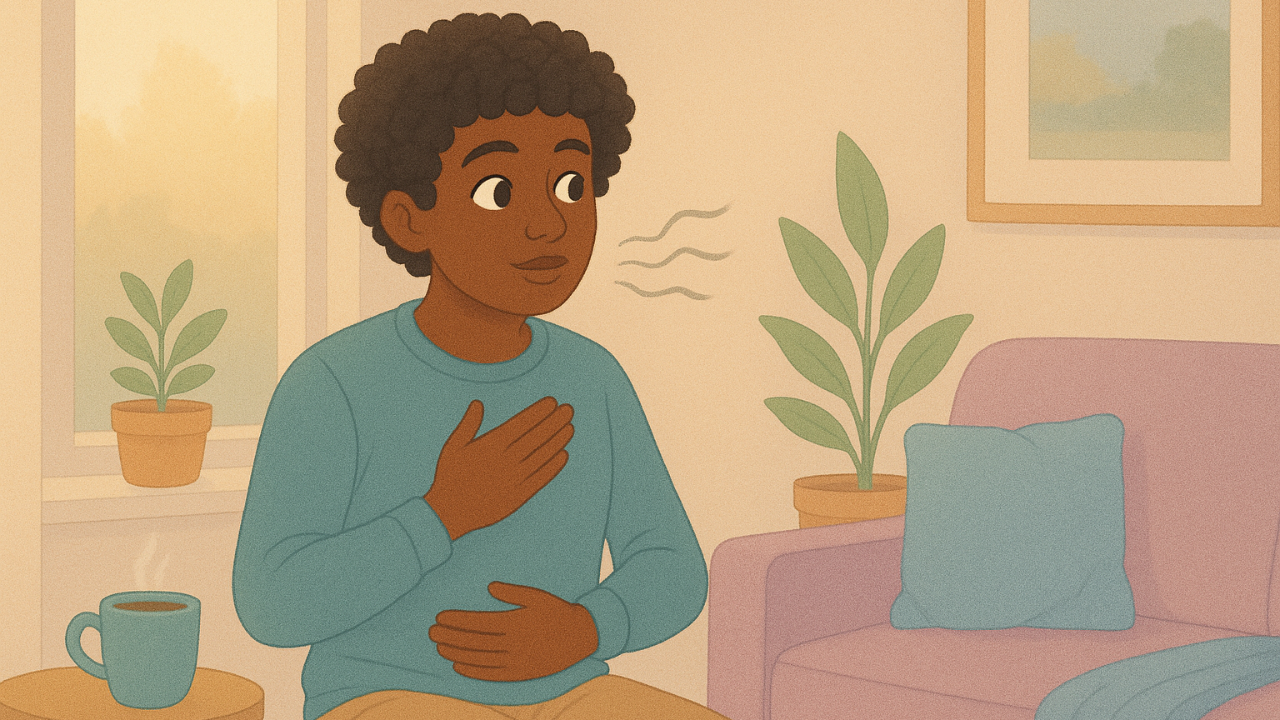
- If it feels good, place one hand on your chest or upper belly.
No need to take a deep breath. Just notice your natural inhale and exhale, like you are watching waves come and go.
If deep breathing has ever made you more anxious, you are not alone. Many people find this article reassuring: Why Deep Breathing Makes Me More Anxious, And What To Do Instead.
2. Gently orient with your eyes
Now, let your eyes slowly scan the space around you.
- Notice colors, shapes, and light.
- Let your gaze move at the speed that feels tolerable.
- When your eyes want to stop on something, let them.
This might be a plant, the edge of a window, a pattern on the blanket, or a patch of light on the floor. You are not “looking for something calming.” You are simply allowing your nervous system to notice, “I am here, in this room, right now.”
3. Stay with what feels neutral or slightly pleasant
Once your eyes land, hang out there for a few seconds.
- Notice any small shifts in your body.
- Maybe your shoulders drop a little.
- Maybe your jaw unclenches.
- Maybe nothing changes yet, and that is OK.
Orienting does not have to create a dramatic “ahh” moment. Sometimes it just stops the spiral from getting worse.
If your system likes structure, you might enjoy playing with a full simple routine like this: A 10-Minute Nervous System Reset For Overwhelm You Can Do Anywhere
4. Add a soft hum on your exhale
Keeping your eyes on the chosen spot (or gently returning there if your focus drifted):
- Let a small hum come out on your next exhale.
- It can be very quiet, even “under your breath.”
- You can hum with lips closed if that feels safer.
You are not performing or singing. You are simply letting gentle vibration move through your throat and chest. This vibration may help stimulate vagus nerve pathways that tell your body it is allowed to settle.
If you like having more options for sound-based tools, this article might give you extra ideas:
Gentle Vocal Toning for the Vagus Nerve Without Singing.
5. Repeat the loop
You can think of the sequence as:
Look around → Land → Hum → Rest → Repeat.
Try three to six rounds. There is no prize for doing more. Your system may respond better to tiny, consistent doses rather than long sessions.
If you love having a menu of vagus-supportive ideas, you may also like Vagus Nerve Stimulation Exercises Without Devices: A Gentle At-Home Guide.
Adjusting the practice for “wired” vs “numb” states
If you feel wired, jumpy, or on edge
Signs you are in this zone:
- You feel like you could jump out of your skin.
- Thoughts are fast and loud.
- Your body wants to move, pace, scroll, or “do.”
You can:
- Keep the orienting shorter and the humming slightly longer.
- Use a lower pitch hum that feels grounding.
- Let your exhale be a bit longer than your inhale without forcing it.
You might also find it helpful to add a vagus-friendly breath later, once you feel a bit safer: Vagus Nerve Breathing For Trauma Recovery: Small, Kind Steps That Actually Help.
If you feel numb, shut down, or far away
Signs of this zone:
- You feel distant from your body.
- Everything feels heavy or foggy.
- You may feel like you “cannot reach” your feelings.
You can:
- Lengthen the orienting portion by taking more time to scan.
- Look for small details, like shadows, textures, or tiny movements.
- Keep the hum short and gentle, almost like a curious “hmm.”
If numbness is very familiar to you, this piece might help you feel less alone and offer other gentle ways to reconnect: Signs of Dorsal Vagal Shutdown and How to Gently Come Back.
If, while reading this, you are wondering, “Is my whole system just dysregulated all the time?”, you may find clarity in the Stress Loop Quiz.
A 7-day micro-practice plan
Keep it tiny. You are allowed to stop the moment it feels too much.
Day 1
- One round of orienting + one soft hum.
- Notice any shift, even a 2% change.
Day 2
- Two rounds.
- Try placing a hand on your chest or upper back while you hum.
Day 3
- Three rounds.
- Do it in a different room or near a window and notice how your body responds.
Day 4
- Try the practice when you feel mildly stressed, not at peak overwhelm.
- Think of it as “training” in easier moments.
Day 5
- Add a simple supportive tool after your last hum, like a butterfly hug or gentle stretch.
- You might mix this with other somatic tools over time, as in, A Simple Vagus Nerve Morning Routine for Anxious Minds.
Day 6
- Use the practice briefly during a more intense surge (before a meeting, after a hard message, on the way to bed).
- Even one round counts.
Day 7
- Reflect: When did this feel most accessible? Wired days? Numb days? Mornings? Evenings?
- Adjust the practice to match your real life, not the other way around.
If you like tracking patterns, you might eventually pair this with journaling about your states, like in Track Your Window of Tolerance With a Simple Daily Journal.
Common sticking points and gentle adjustments
“I feel silly humming.”
You are not alone. Many people feel embarrassed, especially if they grew up needing to be quiet or “have it all together.” You can:
- Hum very softly.
- Do it in the shower or car.
- Imagine you are humming to a scared animal, not performing for anyone.
“My throat tightens when I try to hum.”
This might be your body saying, “Slow down.” Try:
- Humming for just one second, then stopping.
- Exhaling first with a sigh, then adding the tiniest hint of sound.
- Experimenting with different pitches to see what feels least tight.
If anything feels worse, you can stop. That is not failure. That is wise self-protection.
“My eyes dart too fast during orienting.”
That is OK. Your scan is used to quickly checking for danger. Over time, with titration, your gaze may naturally slow down. For now:
- Let the eyes dart, then gently invite them to rest on one thing for one breath.
- If that is too much, just notice the darting without trying to change it.
“This feels like nothing is happening.”
Nervous system shifts are often subtle. Tiny changes like needing one less scroll, falling asleep slightly quicker, or being able to pause before reacting can take time to notice.
More Gentle Reads
If this article speaks to you, you may also find comfort in:
If you would like a simple way to understand your own stress patterns and where to begin, you can take the Stress Loop Quiz.
FAQs
1. Do I need deep breathing for this to work?
No. Deep breathing can feel overwhelming or even make some people more anxious. This practice uses your natural breath with a gentle hum. That is enough.
2. How often should I combine orienting and humming?
You can start with once a day for one to two minutes. Some people like to use it as a quick “check-in” before work, before sleep, or after difficult conversations.
3. Can I use this during a panic attack?
Sometimes yes, sometimes no. If you are in the middle of an intense panic surge, it may be hard to track your environment or hum. You might wait for the peak to pass, then use orienting and humming to help your body come down more gently. You may also want to read Grounding During Panic Without Talk Therapy: A Gentle Guide You Can Use Anywhere.
4. Is this safe if I have a trauma history?
Many people with trauma find this kind of practice supportive because it is small, adjustable, and not invasive. That said, if anything feels too intense, you can stop immediately and reduce the dose (fewer rounds, quieter hums, shorter orienting). Consider talking with a trauma-informed professional if you are unsure.
5. What if I feel more emotional after doing this?
Sometimes, as the body feels safer, feelings that were held under the surface start to come up. You can:
- Shorten the practice.
- Add a familiar grounding tool afterwards.
- Reach out for support if the feelings feel too big to hold alone.
6. Can kids or teens use orienting and humming?
Yes, if it feels playful and not forced. You might turn it into a game like “find your favorite color in the room and hum your favorite sound while you look at it.”
Disclaimer: This article is educational and not medical advice. If you have health concerns or symptoms that worry you, consider speaking with a qualified healthcare professional.
Discover Your Vagal Tone
Find out how dysregulated your nervous system is and get your personalized roadmap to feeling calm, energized, and in control