Five-Minute Reset for Sensory Overload
Some days it feels like the world is turned up too loud.
Too many tabs open. Too many noises. Too many people needing something from you.
Your brain knows you are “just” at work, or in the kitchen, or scrolling on the couch.
But your body feels like it is going to snap or shut down.
You are not broken. This is your nervous system trying to protect you from too much, too fast. A simple five minute reset can give your body one clear path back toward “just enough.”
If you want a clearer sense of how your nervous system gets stuck in overload, you can start with the Stress Loop Quiz.
Quick answer: What is a five minute reset for sensory overload?
A five minute reset for sensory overload is a short, step-by-step sequence you can do almost anywhere that reduces incoming stimulation, anchors your body in one safe point, and adds a small dose of movement or breath your system can actually tolerate. By lowering the “input volume” and giving your body a predictable script, many people find they can think and respond again instead of spiraling or shutting down.
Why sensory overload feels so intense
Your nervous system constantly tracks three things:
-
How much is coming in
-
How fast it is coming in
-
Whether you have enough support to handle it
When that balance tips, your body moves toward survival mode. Heart rate might spike. Muscles tense. Sounds feel sharper. Small requests feel like too much.
If you often feel like your body is ready to jump out of its skin for no clear reason, this gentle article can help you make sense of that feeling and how past stress plays into it.
Sensory overload is not “all in your head.” It is your biology trying to keep you safe with the tools it has. The reset below gives your system a few new tools, in very small, kind doses.
The Five-Minute Reset for Sensory Overload
Use this reset in a bathroom stall, at your desk, on the couch, or even in your parked car. Adjust anything that feels like too much.
Minute 1: Reduce the input
Your first job is not to “calm down.”
Your first job is to give your system less to manage.
If you can, do one or more of these:
-
Turn your body slightly away from noise or people
-
Soften your gaze, look down at your hands or shoes
-
Put on noise-reducing headphones or cover one ear with your hand
-
Dim a light, or step a few feet away from the brightest spot
Even small changes in light, sound, and visual clutter tell your brain, “We are doing something to help.”
If panic sometimes rides along with your overload, this calm, non-clinical guide can walk you through what is happening and why it feels so scary.
Minute 2: Anchor into one steady sense
Pick the gentlest sense available. For many people, touch works best.
You might:
-
Press your palm into your thigh or the edge of a table
-
Hold your shirt hem, a key, a pen, or a piece of jewelry
-
Feel the exact texture, weight, and temperature of that object
Let your attention settle there. Noticing details like “smooth, cool, a little heavy” gives your overloaded system one small, steady signal to organize around.
This simple orienting practice goes a bit deeper into using your senses to tell your nervous system that right now, in this moment, you are relatively safe.
Minute 3: Adjust your breath (only if it helps)
You do not need big deep breaths. In fact, forcing deep breathing can make some bodies feel more trapped or dizzy.
Instead, try this:
-
Inhale gently through your nose
-
Exhale like you are fogging a mirror, a tiny bit longer than your inhale
-
Aim for “comfortable” rather than “perfect”
If breath work has backfired on you before and made you more anxious, you are not alone. This piece explains why that happens and offers alternatives you can try instead of pushing deep breathing.
If at any point breath focus feels worse, drop it. Go back to touch or visual focus.
Minute 4: Let your body move a little
Sensory overload often leaves your body buzzing or frozen. Gentle movement helps the “too much” energy go somewhere.
Pick one or two of these:
-
Shake your hands out by your sides for 5–10 seconds
-
Roll your shoulders forward and back a few times
-
Press your feet into the floor for three slow counts, then release
-
Stretch your arms overhead as you exhale, then let them fall back to your sides
If you like structure, this short nervous system reset gives a slightly longer, 10-minute version you can use on harder days.
Minute 5: Choose one tiny next step
Overload makes everything feel urgent and impossible at the same time. Your job now is not to fix the entire situation. It is to choose one doable next step.
For example:
-
Drink a sip of water
-
Reply to one message with one sentence
-
Walk to the bathroom and back at a slow pace
-
Put your phone face-down for two minutes
Ask, “What is the next thing I can complete without bracing?” Then let that be enough for now.
If your overload is tied to work days and constant demands, you may find it useful to build a tiny menu of microbreaks you can plug into your schedule.
Variations for different states
Sensory overload can show up as wired and panicky, or flat and shut down. You do not have to use the same reset for both.
When you feel wired, shaky, or on edge
Your system is in “too much energy, nowhere to go.”
You might:
-
Lean your back against a wall or chair to feel solid support
-
Press your feet into the ground while you slowly count to 5, three times
-
Let your eyes move slowly around the room, noticing shapes and colors
-
Use a firmer hand squeeze on your grounding object
If overload often tips into full panic, this gentle, body-first guide to grounding during panic gives more scripts you can use without needing to talk it all through.
When you feel numb, foggy, or far away
Here, your system is trying to protect you by going dim.
Try adding a little, very kind activation:
-
Rub your hands together until you feel warmth
-
Gently tap your chest or collarbone with your fingertips
-
Stand up and sit down slowly a few times
-
Wiggle your toes and notice the contact with your socks or the floor
If this numb, checked-out feeling is familiar, this article explains why your body goes numb during stress and offers more ways to reconnect slowly, without forcing anything.
Remember, if anything feels too much, you can always back up to the earlier minutes of the reset and do only the pieces your body says yes to. That is still real work.
A gentle 7-day mini plan
You do not have to master this reset in one go. Think of it as a small experiment across a week.
Day 1: Use the five minute reset once when you notice you feel “too much.”
Day 2: Pay attention to which minute helped the most. Reducing input, touch, breath, movement, or choosing a next step.
Day 3: Try using the first two minutes (reduce input + touch anchor) earlier in the day, before you hit full overload.
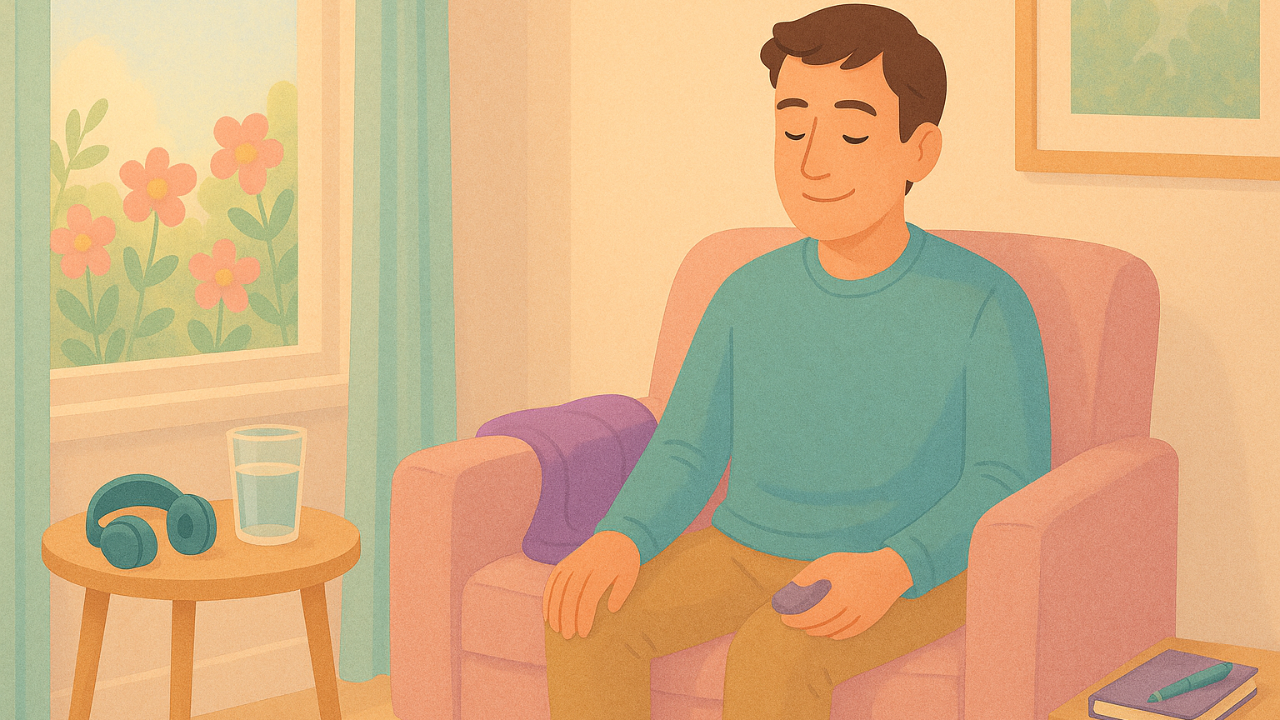
Day 4: Create a tiny “sensory safety kit.” This might be earplugs, a soft hair tie on your wrist, a smooth stone, or noise-reducing headphones.
Day 5: If you feel up to it, pair the reset with one small resilience-building practice, like checking in with how big your stress feels on a 1–10 scale at the start and end.
Day 6: Try the wired version or the numb version, depending on what your system does most often.
Day 7: Reflect: What was kinder than you expected? What was too much? Adjust the reset so it fits your actual life, not an ideal version of you.
If you want to understand the bigger pattern of how often your nervous system flips into overload or shutdown, the Stress Loop Quiz can give you a simple starting map.
Common sticking points (and gentle fixes)
“I do not have five minutes.”
You might not have five quiet minutes, but you usually have 30 seconds. Even softening your gaze and pressing your feet into the floor for a few breaths counts.
“I forget the steps when I am overwhelmed.”
Most people do. Try shrinking it into a two-step version:
-
Reduce one input.
-
Touch one steady thing.
That is enough.
“Breathing makes everything worse.”
Then skip it. Many bodies with trauma histories find breath work triggering. Stay with touch, movement, or visual focus instead.
“I feel silly doing this in public.”
Most of this reset is invisible from the outside. No one can see you counting your exhales or pressing your tongue gently to the roof of your mouth.
“I do all of this and I still feel overloaded.”
Your nervous system may be asking for more regular care, not just emergencies. That does not mean you are failing. It means your system has been holding a lot for a long time. Small daily practices, like brief morning or evening resets, can help.
The Stress Loop Quiz can help you see which “loop” your system most often gets stuck in, so you can choose next steps that match your pattern.
More Gentle Reads
If this five minute reset speaks to you, these pieces may feel like natural next steps:
FAQs
What is sensory overload, really?
Sensory overload is when your nervous system is taking in more input than it can process. Sounds, lights, movement, social cues, or even your own thoughts can all pile up until your body feels flooded.
Will a five minute reset fix everything?
No. A single reset will not erase long-term stress or trauma. What it can do is buy you a little space inside your body, so you have more options than freezing, snapping, or disappearing. Over time, repeated small resets can gently shift your baseline.
How often should I use this reset?
As often as your life allows. Some people use it once a day after work. Others reach for it several times during a loud or busy day. There is no wrong amount.
What if I start the reset and feel worse?
This is important. Stop right away, and back up to the last step that felt neutral or okay. You might only be able to tolerate turning your body away from noise and holding an object. That still counts. If this happens a lot, consider talking with a trauma-informed professional who can help you adjust the practices.
Can I teach this to my kids or partner?
Yes, in tiny pieces. You might show a child how to hold onto a favorite toy and press their feet into the floor. You might invite a partner to soften their gaze and hold a warm mug when they are overloaded. Go slowly and always ask for consent.
How does this fit with therapy or medication?
This reset is not a replacement for therapy, medication, or medical care. It is a body-based support you can layer in alongside those things. Many people find that when their body feels a bit calmer, it is easier to use cognitive tools from therapy or stay consistent with other care.
Disclaimer: This article is educational and not medical advice. If you have health concerns, consider speaking with a qualified professional.
Discover Your Vagal Tone
Find out how dysregulated your nervous system is and get your personalized roadmap to feeling calm, energized, and in control