Micro Practices To Exit Dissociation At Work
Dissociation at work can feel quietly terrifying. One moment you are typing, listening, or talking. The next, it feels like you are far away, foggy, or watching yourself from a distance.
If this is happening to you, it does not mean you are weak or failing at your job. It usually means your nervous system has hit “too much” and is trying to protect you.
If you want a soft starting point to understand your pattern, you can take the Stress Loop Quiz and see which stress loop you tend to get stuck in.
In many workplaces, you cannot lie down, cry, or take a long walk every time you begin to float away. So this guide focuses on micro practices. Tiny, subtle nervous system cues that you can use at your desk, in meetings, and in hallways to gently return to your body.
Quick Answer Box
What are micro practices to exit dissociation at work?
Micro practices are small, 10 to 60 second actions that give your nervous system a cue of safety and “here-ness” without needing a full break. They might include grounding your feet on the floor, orienting to three objects in the room, feeling texture under your fingers, sipping water with awareness, or taking a longer, softer exhale. These practices do not force you to “snap out of it.” Instead, they offer your body a gentle bridge from protective distance back into present time.
If you also struggle with going numb or checked out during stress, you may find this gentle explainer on why your body goes numb during stress helpful as background.
Why Dissociation At Work Happens More Than People Talk About
Work is often a perfect storm for dissociation.
There might be:
- Constant notifications and task switching
- Subtle power dynamics or conflict
- Past trauma that gets stirred up by tone, criticism, or pressure
- Long periods of sitting still while your body wants movement
Your system may slide into a “shutdown” or “far away” mode that looks like zoning out, feeling unreal, losing time, or not sensing your body. This can overlap with burnout, though they are not identical. If you want more detail on the difference, you might like this gentle guide on shutdown versus burnout and how to tell them apart in real life.
Understanding that dissociation is often a nervous system response, not a moral failing, is part of trauma informed care. It is about asking “what happened to your nervous system” rather than “what is wrong with you.”
Gentle Science: Dissociation As A Nervous System Strategy
From a nervous system view, dissociation is often linked with dorsal vagal shutdown. The body pulls energy away from connection and action. You may feel floaty, foggy, blank, or like you cannot move.
If you like having a simple map, this step-by-step guide to an orienting practice can help you understand how looking around your environment can nudge you out of threat mode and back into now.
You do not have to fix the whole pattern at once. Micro practices are small “pings” to your system that say:
- I am here.
- This room is now.
- My body has some support.
Micro Practices You Can Do At Your Desk
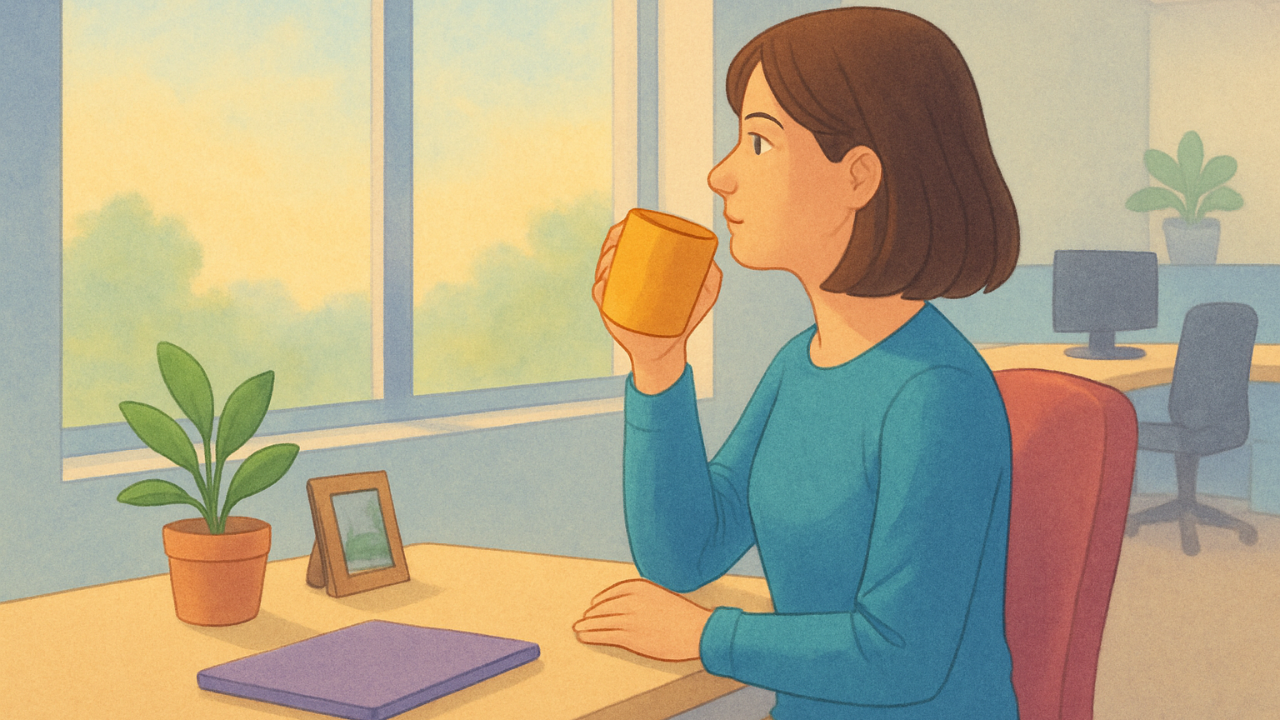
These are quiet, desk-friendly ways to help your body notice it is sitting in a real chair, in a real room, right now.
1. Feet-First Grounding
-
Place both feet flat on the floor.
-
Let your weight sink down through your heels and the balls of your feet.
-
Notice one small detail. The temperature of the floor. The kind of shoes you are wearing.
-
Take a gentle exhale that is slightly longer than your inhale.
If you often feel overloaded before you even open your laptop, this list of ten nervous system microbreaks for the workday pairs nicely with the feet practice above.
2. Three Objects, Three Breaths
When you feel yourself drifting:
-
Let your eyes land on one object in the room. Name it silently.
-
Take a soft breath out.
-
Find a second object. Name it silently.
-
Soft breath out.
-
Third object. Soft breath out.
You are giving your brain three clear “I am here” signals without anyone knowing.
If you want a little more structure for this kind of simple, repeated reset, you might like this ten minute nervous system reset for overwhelm that you can adapt for your workday.
3. Texture Check
Keep one “anchor object” on your desk. A pen, the seam of your sleeve, the edge of your keyboard, a smooth stone.
When you feel far away:
-
Gently touch the object for a few seconds.
-
Notice texture, shape, or temperature.
-
Let your shoulders drop one percent.
You are not trying to feel a lot. Just “a little more here.”
4. Micro-Script For Your Nervous System
Sometimes words help your system reorient.
In your head, try a very simple script like:
“Body, we are at my desk.
The date is today.
This moment is now.”
Say it slowly along with the feet grounding or texture check. You are speaking to your nervous system in clear, gentle language.
If you notice that even small practices make you more anxious, you are not alone. Many people with sensitive systems find that deep breathing is too much. This guide on why deep breathing sometimes makes anxiety worse, and what to do instead, offers alternatives you can blend with these micro steps.
Micro Practices During Meetings And Calls
In meetings, there is extra pressure to appear “fine.” These practices are almost invisible to others.
1. Hidden Hand Anchor
-
Place one hand on your thigh under the table.
-
Gently press your fingertips into the fabric for a few seconds.
-
While someone else is talking, feel the pressure and softness.
You do not have to look “grounded.” Your body just needs a small anchor.
2. Soft Blink Reset
When you notice your focus slipping:
-
Let your eyes close in one slow blink.
-
As they reopen, let your gaze widen slightly, as if you are taking in the whole room.
-
Exhale quietly through your nose.
You can repeat this every few minutes. It is a tiny orienting reset.
3. Internal Sound-Tagging
Without moving your head:
-
Notice one sound in the room or through your headphones.
-
Name it silently: “typing,” “air conditioner,” “voice.”
This gives your brain a single, manageable point of contact with the present.
If you often feel spun out or spacey after meetings, this gentle post-meeting comedown routine can pair beautifully with your micro practices, especially on days packed with calls.
Micro Practices In Hallways, Elevators, And Bathrooms
These are perfect when you can step away for just thirty to ninety seconds.
1. The Pause Step
As you walk down a hallway:
-
Let one step slow down just a bit more than the others.
-
Feel your heel, then the ball of your foot, then toes.
-
Let your exhale lengthen on that slower step.
You do not have to change your whole walk. Just one or two steps that say “I am in this body.”
2. Doorframe Touch
As you move through a doorway:
-
Lightly brush your knuckles or fingertips on the doorframe as you pass.
-
Let that contact be a small “I am passing from one room to another, right now.”
3. Bathroom Reset
In a stall:
-
Place both hands on the sides of your ribs.
-
Feel the movement as you breathe.
-
Count three slow exhales.
-
Look at one stable object in the space. A tile. The hook on the door.
If your work includes many virtual meetings, this piece on quick nervous system relief for Zoom fatigue may give you extra ideas to pair with these small hallway and bathroom resets.
When Dissociation Shows Up As Numb, Frozen, Or Drained
Some dissociation feels less “floaty” and more like your body is made of wet concrete. Heavy. Blank. Hard to move.
Try very small, low-effort movements:
-
Gently roll your shoulders forward and back a few times.
-
Alternate pressing your feet into the floor, left then right.
-
Wiggle your toes in your shoes.
-
Take a tiny sip of water and feel it travel down your throat.
If you want more support for this kind of shut-down pattern, this guide on signs of dorsal vagal shutdown and how to gently come back can help you recognize what is happening faster and respond more kindly to yourself.
When Dissociation Feels More Like Overwhelm Or Panic
Sometimes dissociation comes after a spike. Panic, anxiety, or a rush of adrenaline. You might flip between hyper-aware and checked out.
To soften the edges:
-
Let your gaze widen to include more of the room, instead of laser focusing on your screen.
-
Place a hand on your chest or belly under the desk. Feel the contact.
-
Try one gentle exhale that empties just a little more than usual.
-
Name three colors you can see in the room.
If panic is a familiar visitor, you may feel less alone reading this guide on what panic attacks are, why they happen, and some ways to work with them.
You can also combine these micro practices with slightly longer grounding tools that do not require talk therapy, such as the gentle ideas in this guide to grounding during panic that you can use anywhere.
A 7-Day Micro Practice Plan For Work
Think of this as a tiny experiment, not a test. Adjust anything that feels too much.
Day 1: Before opening your inbox, ground your feet and name three objects around you. Repeat once in the afternoon.
Day 2: Choose one anchor object at your desk. Practice the texture check three times during the day.
Day 3: In one meeting, use the hidden hand anchor and soft blink reset at least once.
Day 4: On one hallway walk, try the Pause Step. Notice one sound as you walk.
Day 5: Take a short bathroom reset once during the day, with hands on your ribs and three slow exhales.
Day 6: When you feel numb or heavy, pick the tiniest movement possible. Toes, shoulders, or fingers. Repeat a few times.
Day 7: Choose the one practice that felt most doable and repeat it three times across your workday.
If you are not sure which pattern is loudest for you right now, the Stress Loop Quiz can help you see your main loop and choose which micro practices to emphasize.
Common Sticking Points
“I do not notice I am dissociating until I am already far away.”
This is very common. At first, you might only notice afterward. Over time, you may start catching earlier cues, like losing track of what someone just said, feeling your eyes glaze, or realizing you have not felt your body for a while.
“I feel guilty stepping away or slowing down at work.”
Needing micro regulation is not weakness. It is maintenance. Just like stretching your legs or drinking water. Over the long term, tiny moments of nervous system care often support more consistent focus.
For more support on working while dysregulated, this guide on how to focus when you feel dysregulated may give you language and ideas that fit your work reality.
“Grounding feels like nothing. It does not work.”
You might be expecting a huge shift. Often the change is small. Two percent more here. A tiny softening in your jaw. A slightly clearer sense of the room. That still counts.
“Sometimes grounding makes me feel worse.”
If bringing attention inside feels too intense, lean more on external orienting. Objects, sounds, temperature, or gentle movement. You get to choose the level that feels safe enough.
“The dissociation keeps coming back throughout the day.”
That does not mean you are failing. It means your nervous system is working through layers. Repeating micro practices is like offering many small supportive nudges, rather than one big push.
If you would like help finding a broader pattern-based plan beyond this one article, you can always circle back to the Stress Loop Quiz and let it point you to the next gentle step.
More Gentle Reads
If dissociation at work is part of a bigger pattern for you, these pieces may feel like good companions:
- Grounding Techniques for Dissociation that Actually Work
- How to Widen Your Window of Tolerance Daily
- Daily Nervous System Reset at Home
FAQs
1. Is dissociation at work the same as “spacing out”?
Sometimes it looks similar, but dissociation usually comes with a sense of distance, unreality, or “I was here but not really here.” It is often a nervous system response to overload or old threat patterns, not just boredom or distraction.
2. Are these micro practices enough if my dissociation is severe?
These tools may help you feel a bit more present, yet they are not a substitute for professional care. If dissociation is frequent, intense, or interfering with daily life, consider speaking with a therapist, doctor, or other qualified professional who understands trauma and nervous system responses.
3. How many times a day should I use these practices?
Think frequent and tiny. Ten to sixty seconds, several times a day, is often more sustainable than one big attempt. Pair them with natural transitions, like before opening your inbox, before a meeting, and after you finish a task.
4. What if I cannot feel my body at all when I try these?
It is okay if the sensations are very faint. You can start by noticing visual cues and sounds instead. Over time, as your system feels safer, body sensations may slowly become more available.
5. What if my job does not allow breaks or looks down on any slowing down?
That is hard and very real. In those environments, the most realistic options are the almost invisible ones. Soft blink resets, hidden hand anchors, feet grounding under the desk, and internal scripts. You might also explore whether there are microbreaks you can safely take, as described in this piece on nervous system microbreaks for remote workers, which many people adapt even inside strict workplaces.
6. How do I explain this to my therapist or doctor?
You might say something like, “At work I often feel far away, unreal, or like I lose chunks of time. I am trying small grounding practices, and I would like support with dissociation and shutdown patterns.” You can also share articles like this one to give them language for what you are experiencing.
Closing
You are not lazy, weak, or broken for dissociating at work. Your body is trying to protect you with the tools it has. Micro practices are a way to offer it new, kinder options, one tiny moment at a time.
Disclaimer: This article is educational and not medical advice. If you have health concerns, consider speaking with a qualified professional.
Discover Your Vagal Tone
Find out how dysregulated your nervous system is and get your personalized roadmap to feeling calm, energized, and in control