The Polyvagal Ladder, Gently Explained for Overwhelmed Beginners
If you feel anxious, numb, or like your body is always “too much,” it can be confusing and lonely. You might wonder why you snap at people you love, shut down when you need to speak up, or feel frozen when nothing “bad” is happening right now.
The polyvagal ladder gives you a map. Not to judge yourself, but to understand how your nervous system is trying to keep you safe.
If you want a quick way to see where you might be on that ladder today, you can start with the Stress Loop Quiz. It is short and gentle, and many people find it clarifying.
You do not need to fix yourself. You are learning how your system works.
A short, beginner-friendly answer
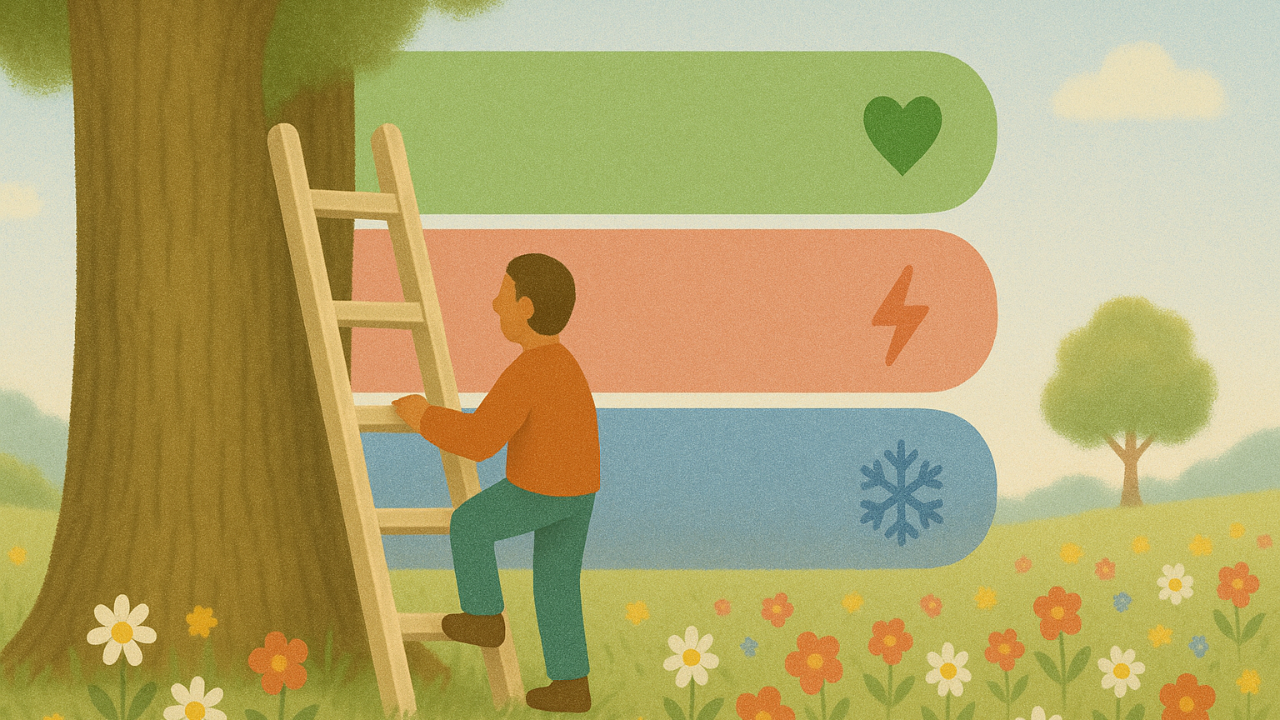
The polyvagal ladder is a way of describing three main nervous system states.
At the top is ventral, where you feel safe enough and connected.
In the middle is sympathetic, where you feel activated, stressed, or ready to fight or run.
At the bottom is dorsal, where you feel shut down, numb, or far away.
You do not choose these states with your mind. Your body shifts between them based on how safe or threatened it feels. The goal is not to stay at the top all the time. The goal is to notice where you are, and use small, kind steps to help your body move in the direction of more safety.
If you want a simple explanation of the science behind all this, you might like a gentle primer on polyvagal theory that uses everyday language.
The top of the ladder: ventral, the “safe enough” state
In ventral, you usually feel more like yourself. You may notice:
-
It is easier to breathe.
-
You can make eye contact if you want to.
-
You can feel both your own needs and the needs of others.
-
You have access to some curiosity or playfulness, even if life is still hard.
Ventral is not perfect calm. It is “safe enough.” You might still feel sad, or tired, or stretched. But you can move through your day with some sense of choice.
If you want support in gently training this state, you might explore simple safe-and-social exercises you can do at home, like soft eye contact, humming, and slow gestures.
Small, consistent practices matter more than big dramatic ones. You are teaching your system that safety is possible again, one cue at a time.
The middle of the ladder: sympathetic, the “fight or flight” state
In sympathetic activation, your body is mobilized for action. You may notice:
-
A racing heart or jittery feeling.
-
Tight jaw, shoulders up by your ears.
-
Feeling snappy, irritable, or “ready to jump out of your skin.”
-
Trouble sitting still or focusing on one thing.
This state is not wrong or bad. It is a survival setting that helped your ancestors respond to danger.
If you often feel like your body is braced for something terrible “for no reason,” it may help to read about how big or chronic stress can keep your nervous system on alert even when life looks calm on the surface.
For many people, sympathetic activation shows up during panic. You might feel chest tightness, dizziness, or a sense that something terrible is about to happen. Learning what panic actually is and why it happens can take away some of the fear of the feeling itself.
When you notice sympathetic activation, the next step is not forcing yourself to relax. It is offering your body a way to use that energy in small, safe ways, like pressing your feet into the floor or doing gentle, contained movement with your arms.
The bottom of the ladder: dorsal, the “shutdown” state
When your system decides “this is too much for too long,” it may move into dorsal shutdown. In this state, you may notice:
-
Feeling heavy, numb, or far away from your own life.
-
Struggling to get out of bed, even when you want to.
-
Staring at a wall or a screen and feeling nothing.
-
Moving and thinking more slowly than usual.
This is not laziness or failure. Dorsal is your body pulling the emergency brake to protect you when your system feels overwhelmed.
If you recognize yourself here, it can be helpful to see real-life signs of dorsal shutdown described in detail, along with gentle ways to come back without shocking your system.
Shutdown and dissociation often live close together. Many people say “my body goes numb” or “I feel like I leave my body when things are too much.” Seeing those patterns named and paired with somatic tools can make them feel less mysterious and less shameful.
In dorsal, the goal is not to jump to full energy. Often the next rung up is “slightly more present,” not “happy and motivated.” That is enough.
How you move up and down the ladder
You shift between these states all the time, often without noticing. A loud noise, a harsh email, an argument, or even hunger can move you down. A kind smile, a warm drink, or a soft blanket can move you up.
There is also a fourth pattern that many people talk about: fawn. This is when your body chooses safety by pleasing, appeasing, or shrinking yourself so others do not get upset. Fawn can show up inside any part of the ladder.
If you want to see what fight, flight, freeze, and fawn look like in ordinary life, along with gentle exits from each one, there is a helpful guide with real-world examples.
The ladder is not a test you pass or fail. It is a way to track where you are, and to offer your system what it needs at each rung.
If you would like help noticing your own patterns day by day, the Stress Loop Quiz can give you a simple starting point and language for what you are feeling.
Tiny practices for each state
You do not need to fix everything at once. Think in tiny experiments.
When you feel shut down or far away
Start very small. Your body may not be ready for big movement yet.
Try one of these:
-
Place one hand on something solid near you, like the edge of a table or the arm of a chair.
-
Name three colors you can see from where you are.
-
Gently move your gaze to the left, then the right, noticing the shapes in your space.
-
If it feels okay, wiggle your toes inside your socks.
Over time, practices like orienting to your environment can help you slowly come back toward connection without forcing yourself.
When you feel stressed, wired, or “too activated”
When your system is in fight or flight, it usually needs somewhere safe to send that energy.
You might try:
-
Planting your feet on the floor and pressing down for 5 to 10 seconds, then releasing.
-
Doing slow shoulder rolls, letting your exhale soften as you roll.
-
Squeezing a pillow or rolled blanket for a few seconds, then letting go.
-
Doing a minute of gentle, small shaking in your arms or hands, then letting your body settle.
Working with your body this way, in small portions, can help widen your window of tolerance so daily stress does not knock you off the ladder as easily.
When you feel safe enough
When you notice ventral moments, even small ones, you can gently strengthen them.
You might:
-
Hum a quiet tune you like.
-
Look at someone or something that feels kind or comforting, even a pet or a plant.
-
Place a hand on your chest or cheek and notice any sense of warmth or gentleness.
-
Offer yourself a simple sentence like, “Right now, in this moment, I am safe enough.”
Over time, your nervous system can become more familiar with this state. It does not erase hard things, but it may make them more bearable.
A simple 7-day polyvagal ladder plan
You can think of this as an experiment, not a strict program. Adjust anything that feels like too much.
Day 1: Name where you are.
Once or twice today, simply notice: do I feel more safe, more activated, or more shut down?
Day 2: Add one grounding cue.
When you feel stressed, try a small physical anchor like pressing your feet into the ground.
Day 3: Support yourself in shutdown.
If you feel heavy or far away, gently look around the room and name three objects without judging yourself.
Day 4: Notice tiny moments of safety.
Catch even a five-second window where you feel “a bit okay.” Maybe while drinking water or seeing a tree outside.
Day 5: Help your body complete stress.
Give yourself one minute for gentle movement, shaking, or stretching to let activation move through.
Day 6: Build tolerance slowly.
When something mildly stressful happens, notice your first body reaction, and see if one small tool helps you stay a bit more present.
Day 7: Reflect and choose one favorite.
Ask, “Which practice felt kindest to my system this week?” Keep that one and repeat it.
If you want a more structured way to notice which loops your nervous system is stuck in and what tends to pull you off the ladder, the Stress Loop Quiz can offer a personalized starting point.
Common sticking points and kind answers
“I keep sliding between states and it feels chaotic.”
That does not mean you are broken. It usually means your system has had to adapt to a lot. You might find it settling to learn how resilience is built, slowly, through repeated small signals of safety instead of big changes all at once.
“I cannot tell what I am feeling at all.”
This is very common after long-term stress or trauma. Your system may have learned that turning down sensation was safer. Gentle interoception and body-based work can be helpful over time, but it is okay to start simply by noticing broad states like “more up” or “more down” on the ladder.
“I feel ashamed that I cannot just ‘push through’ and function.”
Your body is not failing. It is responding to what it has been through. The ladder offers language so you do not have to call yourself lazy or dramatic when you are actually in survival states.
“I am afraid of going into my body because it feels scary there.”
You are allowed to go slowly. You can start with looking around the room, or feeling your feet on the floor, instead of going straight into intense sensations. This is called titration, and it is a trauma-informed way to pace nervous system work.
FAQs
1. What is the polyvagal ladder in very simple language?
It is a way of talking about three main nervous system states: safe and connected at the top, stressed and activated in the middle, and shut down or numb at the bottom. It helps you describe where you are and what you might need, without blaming yourself.
2. How is this different from the usual “fight, flight, freeze” idea?
Fight, flight, freeze, and fawn are patterns that live inside the ladder. The ladder gives you a bigger picture of how all those patterns sit in relation to safety, stress, and shutdown. You might move between them many times a day.
3. Can I climb the ladder by willpower alone?
Usually not. The ladder is mostly about automatic body responses, not conscious decisions. You can, however, offer your nervous system gentle cues that over time help it feel safer and more flexible.
4. How do I know which state I am in?
You can notice your energy level, your breath, your ability to connect with others, and how much choice you feel. You can also keep a simple daily note of “more safe,” “more activated,” or “more shut down” as a way to start tracking your patterns.
5. Will understanding the ladder cure my anxiety or trauma?
Understanding the ladder is often a big relief, but it is not a cure. It is an educational tool that can help you make sense of your reactions and choose kinder supports. If your symptoms are intense or frightening, consider talking with a qualified professional.
6. Can I use this alongside therapy or medication?
Yes. Many people use polyvagal concepts along with therapy, medication, support groups, and other forms of care. The ladder does not replace any of those. It simply gives you a map for what your body is already doing.
More Gentle Reads
If this article felt supportive, you might also like:
- How to Track Nervous System States (Journal Prompts)
- How To Improve Vagal Tone Naturally For Anxiety: A Kind, Practical Guide
- 5 Simple Somatic Exercises to Feel Safe Again
If you want personalized guidance on how your nervous system tends to react, your next step could be the Stress Loop Quiz. It is gentle, short, and created with nervous-system sensitivity in mind.
Disclaimer: This article is educational and not medical advice. If you have health concerns, consider speaking with a qualified professional.
Discover Your Vagal Tone
Find out how dysregulated your nervous system is and get your personalized roadmap to feeling calm, energized, and in control