Stay Grounded: Orienting Exercises for Busy Public Places
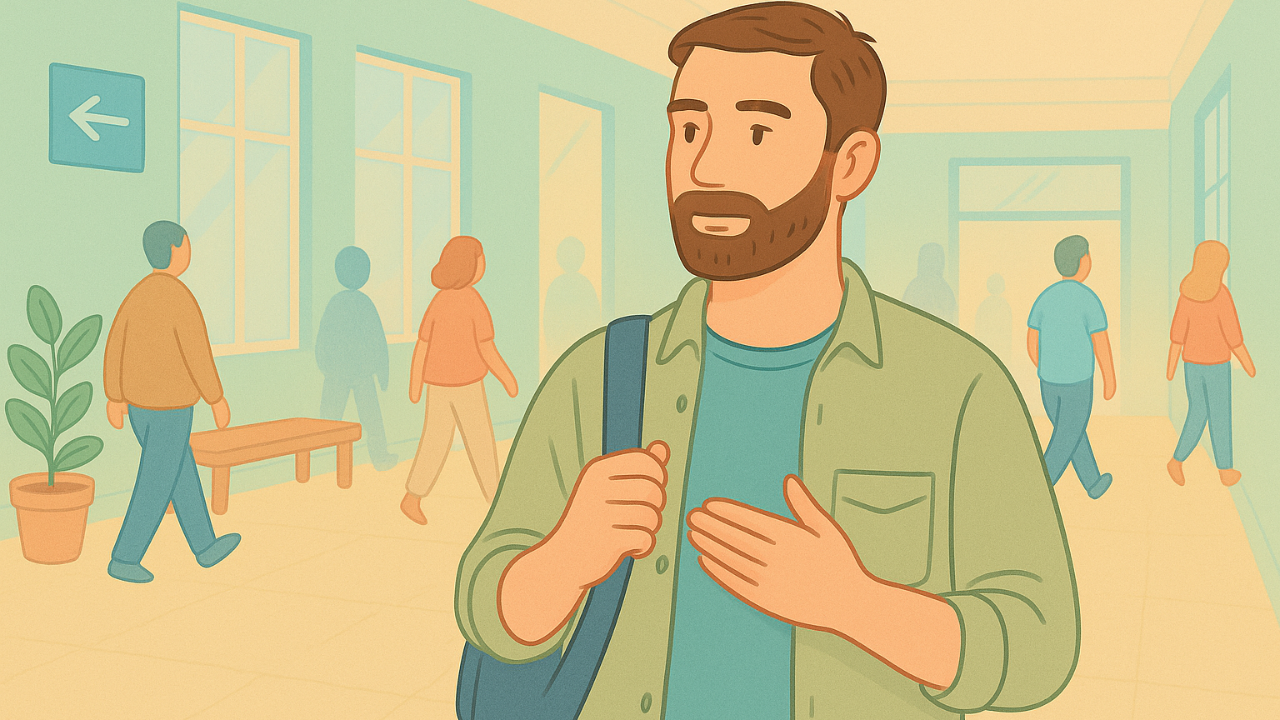
You are in a grocery store, a train station, or a crowded waiting room.
Noise rises. People move in every direction. Your chest tightens and your body feels like it is on edge, even if “nothing is wrong.”
If this is familiar, you are not weak or “too sensitive.” Your nervous system is reacting to a lot of input at once. Orienting exercises for busy public places can give your body something solid and kind to do, instead of only bracing and pushing through.
If you want a quick snapshot of how your stress patterns show up, you can start with the free Stress Loop Quiz.
It may help you see why certain environments hit you harder than others.
Quick answer: What are orienting exercises for busy public places?
Orienting exercises are small, intentional actions that help your nervous system notice where you are right now, instead of staying stuck in “constant danger mode.” In busy public places, this usually means gently using your eyes, ears, touch, and breath to scan for cues of safety, not just threat.
For example, you might:
-
Look around and name three steady, neutral objects.
-
Feel your feet on the floor or the weight of your body on the seat.
-
Notice a regular, predictable sound, like air conditioning or soft music.
-
Let your exhale be a little longer than your inhale.
Done regularly, orienting may help your body realize, “I am here, in this moment, not in that old situation,” which can soften anxiety and lessen the urge to flee. Most orienting steps are invisible to other people, so you can use them in shops, transport, and waiting rooms without drawing attention.
If you want a slower, step by step practice to learn at home first, you can explore a gentle orienting practice that walks you through the basics.
Why orienting helps in crowded, noisy spaces
Busy spaces can trigger your survival system fast. When your nervous system has dealt with chronic stress or trauma, it may be primed to react even more.
Some things that might be happening inside:
-
Your senses pick up sudden movements and sounds faster than your thinking brain can make sense of them.
-
Old survival patterns switch on, like scanning for exits, bracing your muscles, or zoning out.
-
Your body may confuse “crowded and loud” with “unsafe and dangerous,” even when nothing bad is happening right now.
If you often feel like you are ready to jump out of your skin for no clear reason, it can help to know you are not alone in that experience.
Orienting gives your body a different job. Instead of scanning only for threat, you gently invite it to also search for neutral or safe things, like:
-
A calm color on the wall.
-
The feeling of your shoes gripping the floor.
-
A steady sound that is not sharp or sudden.
This is not about positive thinking. It is about feeding your nervous system new sensory data so it can update its idea of what is happening now.
Before you walk in: a tiny pre-orienting check in
If you know a place will be busy, you can orient before you even step inside. This can take 20 seconds and still help.
Doorway pause (10 to 20 seconds)
At the entrance or just outside:
-
Feel contact. Notice your feet on the ground or your seat if you are on the bus or train. You might gently press your toes into the floor once and let them release.
-
Soft eye scan. Let your eyes move slowly around the space. Find one thing that looks steady or neutral, such as a tree outside, a sign, or a piece of furniture.
-
Name your place. In your mind or quietly under your breath, say something like:
-
“It is Thursday afternoon. I am at the supermarket.”
-
“I am sitting in the clinic waiting room for my appointment.”
-
-
Longer exhale. Take a breath in, then let your exhale be a little longer than your inhale. You can try “in for 3, out for 4 or 5,” without forcing.
You are not trying to make the environment perfect. You are helping your nervous system register, “This is where we are.”
A simple orienting sequence you can do almost invisibly
You can use this any time you notice your system going on high alert in public.
The 3–3–3 public orienting sequence
Use this while standing in line, sitting on a train, or walking slowly down an aisle.
-
Three sights
-
Let your eyes wander gently. Pick out three things that feel neutral or slightly pleasant.
-
Examples, a green plant, a blue sign, the pattern on the floor, a wooden chair.
-
Briefly name them in your mind, “green plant, blue sign, wooden chair.”
-
-
Three sounds
-
Notice three different sounds. You are not judging them, just naming.
-
Examples, “door beep, someone talking, hum of the fridge.”
-
If one sound is sharp or unpleasant, pair it with something neutral, “loud cart, soft music, air conditioning.”
-
-
Three touch points
-
Feel three points of physical contact in your body.
-
Examples, your feet on the ground, fabric against your legs, your hand on your bag, your back against the chair.
-
Let each one register for one or two breaths.
-
-
One anchor phrase
-
Finish with a simple phrase that feels true enough, such as:
-
“Right now I am standing in line. Nothing dangerous is happening in this moment.”
-
“My body feels jumpy and I am still here, breathing.”
-
-
If panic is part of what you deal with in these spaces, you might also find it helpful to learn what panic attacks are, why they happen, and what is actually going on in your body.
Knowing the pattern can make orienting feel less mysterious and more like one tool inside a bigger map.
Variations if you feel wired versus numb
Your nervous system can respond in very different ways. You might feel wired and electric, or foggy and far away. Orienting can be adjusted for both.
If you feel wired, jittery, or on the verge of panic
This can look like:
-
Heart racing.
-
Hands shaking.
-
Difficulty staying still.
-
Feeling like you have to escape.
Try:
-
Soften your gaze. Instead of staring hard at one thing, let your eyes move slowly and widen your field of vision. This can signal to your body that you are not locked on a threat.
-
Lower your shoulders on the exhale. On each out breath, imagine your shoulders dropping one or two millimeters. No forcing, just permission.
-
Track one steady movement. Watch something repetitive and neutral, like automatic doors opening and closing, people walking at a distance, or the slow swing of a sign.
-
Short phrase. Use something like, “I feel scared, and I am still here,” or “My body is loud, and I am allowed to go slowly.”
If you want more tools that do not rely on talking everything through, you might like this gentle guide to grounding during panic without talk therapy.
If you feel numb, foggy, or checked out
This can look like:
-
Feeling far away from your body.
-
Moving on autopilot.
-
Struggling to think clearly.
Try:
-
Gentle physical contact. Press your feet into the floor, tap each finger lightly against your thumb inside your pocket, or press your tongue gently to the roof of your mouth.
-
Color hunt. Choose one color, such as green or blue, and quietly look for five things in that color around the space.
-
Temperature check. Notice where you feel warm or cool. The air on your face. A warm drink in your hand. A cool metal rail.
-
Warm phrase. Try, “Numb is how my body protects me,” or “I am allowed to come back in little pieces.”
If dissociation shows up often, you might want some grounding techniques for dissociation that are designed to actually work in real life.
Using objects and landmarks as anchors
In busy public spaces, you usually cannot control the environment. But you can pick one or two anchors that your body can return to.
Possible anchors:
-
A plant in the corner.
-
A clock on the wall.
-
The pattern of tiles on the floor.
-
A sign at the end of the aisle.
-
Your own keys, bag, or jewelry.
How to use them:
-
Let your eyes land on your anchor for a few seconds.
-
Breathe out gently while looking at it.
-
Notice one detail, like the color, shape, or texture.
If the space is very intense or bright, it can also help to plan a short five-minute reset for sensory overload that you do after you leave, so your system does not stay stuck in “crowd mode” for the rest of the day.
7 day tiny orienting plan for busy places
Use this as a gentle experiment, not a test. Adjust any step if it feels like too much.
Day 1: Notice only
Spend 5 to 10 minutes in a mildly busy place, such as a small shop. Your only job is to notice when your body starts to tighten, buzz, or go numb. No changing yet. Just observe and leave when you need to.
Day 2: Add one anchor
Go somewhere similar. Choose one visual anchor, such as a sign or plant. Each time your system spikes, let your eyes rest on it for two slow breaths.
Day 3: Add three sights
Use the “3 sights” part of the 3–3–3 sequence. Pick three neutral things to look at and name them privately. Then leave, even if you feel like you could “handle more.” Stopping early can build trust with your nervous system.
Day 4: Add sounds
In a slightly busier environment, maybe a supermarket, use “3 sights, 3 sounds.” Afterward, give yourself extra quiet time. You could add a short home practice, such as a simple orienting or grounding sequence, so your body knows it will get proper care later.
Day 5: Add touch
Practice the full “3 sights, 3 sounds, 3 touch points” in a place that is mildly uncomfortable, but not your hardest environment. You are not trying to push through. You are testing a new response.
Day 6: Practice while moving
Walk slowly through a store, station, or hallway using 3–3–3 on the move. Keep your gaze soft. Take breaks by pausing near a wall or display when you need to.
Day 7: Reflect and adjust
Spend a few minutes journaling or just thinking about what helped the most. Which steps felt kind, and which felt like too much. Adjust your personal orienting kit for next week.
If you also spend a lot of time in airports, trains, or buses, it might be helpful to pair these tools with a nervous system plan for travel anxiety when you are on the go.
And if you would like to see whether your stress patterns shift over time, you can retake the free Stress Loop Quiz after a week or two.
Common sticking points and gentle fixes
“I forget to use the tools until I am already overwhelmed.”
This is very common. One idea is to tie orienting to a physical cue.
For example, every time your hand touches a door handle, your bus card, or your phone in your pocket, you do one tiny orienting step. Maybe just “3 sights” or one longer exhale.
You can also practice orienting in easier places, like your living room, so it becomes more natural and easier to remember when you are out.
“I feel silly. People will notice.”
Most orienting steps are invisible from the outside. Looking around, shifting your weight, or lengthening your exhale looks like normal behavior. If looking up feels exposed, you can orient to things closer to you, like your bag, your shoes, or the floor.
If you feel deeply self conscious, start with hidden touch based tools, like pressing your thumb and finger together inside your pocket.
“Sometimes it feels like nothing helps.”
If your system has been stuck in survival states for a long time, it may not respond quickly. That does not mean orienting is useless. It may mean that you need shorter exposures, more support outside of public places, or a combination of practices.
Some people find that pairing orienting with nervous system grounding during panic that they can use anywhere gives their body more than one path toward safety:
And if you notice that you often go numb or feel far away, remember that there are reasons your body does this, and there are gentle somatic ways to reconnect.
“Crowds remind me of old painful experiences.”
Your body is not being dramatic. It is trying to protect you with the information it has. Orienting is not about erasing your history. It is about giving your system new evidence that, in this specific moment, you are here, not there.
If your past is heavy, it may help to work with a trauma informed practitioner who can move at your pace. It can also be soothing to read about trauma informed care and what it means for how you are treated.
FAQs: Orienting in busy public places
1. How often should I use orienting exercises in public?
As often as you like. Many people find it helpful to do a small orienting check in at the entrance, again in the middle, and once more before leaving. Over time, your nervous system may start to orient on its own with less effort.
2. Will orienting stop a panic attack in a crowded place?
Sometimes orienting can reduce the intensity of a rising panic, but it is not a guaranteed switch. Think of it as building a kinder baseline so your system has more options than only fight, flight, or freeze. If panic attacks are frequent or intense, consider talking with a qualified professional for extra support.
3. What if looking around feels unsafe?
You do not need to make eye contact with anyone. You can orient to objects, colors, floors, ceilings, or your own belongings. You can also use internal anchors, like feeling your feet or hands. Start with whatever feels least threatening to your body.
4. Can I use headphones and still orient?
Yes. Headphones can reduce overwhelming noise. You can still gently scan with your eyes, feel your feet, and notice your breath. You can even orient to the sounds inside your headphones, like a calm song or white noise.
5. Is orienting safe if I have a trauma history?
For many people with trauma histories, orienting can be supportive, because it helps your system tell “then” apart from “now.” If paying attention to your body or surroundings brings up big memories or distress, go gently and consider support. You can keep practices very small and stop if it feels like too much.
6. How long does it take to feel a difference?
Some people feel a small shift within a few tries. Others need weeks of gentle repetition. This is not failure. Your nervous system is learning that you will show up for it. Kind consistency matters more than doing it perfectly.
If you would like a clearer picture of your own stress patterns and how they might be playing out in public spaces, you can take the Stress Loop Quiz. It may give you language for what you are feeling and point you toward the kinds of practices that fit your system best.
Disclaimer: This article is educational and not medical advice. If you have health concerns, consider speaking with a qualified professional.
More Gentle Reads
If you want to keep building a sense of steadier safety in your body, you might also like:
- How To Calm Travel Anxiety And Reset Your Nervous System On The Go
- Micro Practices To Exit Dissociation At Work
- Nervous System Tools to Ease Zoom Anxiety Before a Call
Discover Your Vagal Tone
Find out how dysregulated your nervous system is and get your personalized roadmap to feeling calm, energized, and in control