Simple, Kid-Friendly Ways to Teach Kids About the Nervous System
If you’re trying to explain big, body based concepts to a child who already feels jumpy, clingy, or shut down, it can feel like too much. You might wonder, “Is this even age appropriate?” or “Will I scare them if I talk about the nervous system?”
Here is the truth. Kids are already learning about their nervous system. They learn it from the way your voice changes, how fast you move, and whether your body can come back to calm. Putting gentle words to what their body already feels can lower shame and build safety.
If you want to understand your own stress patterns first, you can start with the Stress Loop Quiz. Many parents find it helpful to see their own nervous system pattern mapped out before they teach their kids.
Quick Answer Box
Kids understand the nervous system best through stories, pictures, and body sensations, not long science lessons. You can explain that their body has a “helper system” that has three main modes: wiggly (high energy), slumpy (low energy), and just-right (calm enough). When you normalize these modes and show them tiny practices like feeling their feet, naming their “body weather,” or finding one thing that helps them feel steady, children start to see their reactions as signals instead of “being bad.”
Why Simple Nervous System Language Helps Kids Feel Safer
Many sensitive kids grow up thinking, “Something is wrong with me,” when what is actually happening is a dysregulated nervous system doing its best to protect them. If you want a clear adult view of what dysregulation looks like, you may find it helpful to read a gentle list of signs your nervous system is dysregulated and what helps it come back.
When you understand your own patterns, it becomes easier to say things like:
-
“My body feels buzzy right now, so I’m going to shake my hands for a minute.”
-
“I notice my shoulders went tight. That means my helper system is working very hard.”
This kind of simple language is trauma informed care in daily life. It tells your child, “Your body is not your enemy. It is trying to keep you safe.”
If you want more background for yourself, a gentle explainer like Polyvagal Theory explained simply can help you translate complex ideas into kid friendly stories about the body’s different safety modes.
Other Words You Might Hear for These Ideas
If you’re searching for help or talking with teachers, therapists, or other parents, you might notice that people use different words for the same basic ideas. This can feel confusing at first, especially when you’re just trying to support a child gently.
Here are some common terms that often point to the same nervous system concepts, explained in simple language.
When people talk about the nervous system, they may also say:
- “Body safety system”
- “Stress response”
- “Fight, flight, freeze, or fawn”
- “Regulation and dysregulation”
- “Polyvagal states” or “polyvagal theory”
- “Window of tolerance”
All of these are ways of describing how the body reacts to feeling safe, overwhelmed, or shut down.
When people talk about teaching kids to regulate, they might use phrases like:
- Emotional regulation
- Self-regulation skills
- Co-regulation (when an adult helps a child settle)
- Body based calming
- Somatic tools for kids
- Trauma-informed parenting
When people describe kids who struggle more with these patterns, they may say:
- Sensitive nervous system
- Highly sensitive child
- Big feelings kids
- Anxious or overwhelmed kids
- Kids who go into shutdown or meltdown
Different words, same core truth: the child’s body is responding to stress, not misbehaving on purpose.
If you want a deeper adult explanation of these patterns, you might recognize similar language in articles about panic, chronic stress, feeling "on edge" or “ready to jump out of my skin for no reason.” The concepts are the same, just translated into kid-friendly terms here.
What matters most is not which term you use, but the message underneath it: your child’s body is doing its best to protect them, and it can learn new patterns with safety, patience, and support.
Use a Simple Story: “Your Body Has Three Modes”
Kids love characters more than diagrams. You can introduce the nervous system as a friendly helper inside their body that has three main modes.
The Wiggly Mode (High Energy)
You might say:
“Wiggly Mode is when your body feels jumpy, loud, or too fast. This might happen when a room is noisy, when someone yells, or when a lot of things are happening at the same time. Your helper thinks it has to get ready to move or shout to stay safe.”
This is the “ready to jump out of your skin” feeling many adults know well. It can be comforting to remember that this is a safety response, not a character flaw.
The Slumpy Mode (Low Energy)
Then you can add:
“Slumpy Mode is when your body feels heavy and tired, like you want to hide under a blanket or stare at nothing. Your helper is trying to keep you safe by making everything slow and quiet.”
This is very close to what some adults experience as shutdown. If you want more language about this for yourself, you might resonate with articles describing dorsal shutdown and how to come back gently, then simplify that language when you talk to your child.
The Just-Right Mode (Calm Enough)
Finally:
“Just-Right Mode is when your body feels calm enough to think, play, and choose. Not perfectly calm, just calm enough.”
You can invite them to pick new names, like “Rabbit Mode, Turtle Mode, and Cat Mode,” or whatever animals and characters feel fun and safe.
Let Them Feel It, Not Memorize It
Children do not need to memorize terms. They need to feel safe inside their own skin.
Before you teach your child tools, it can help to practice a few yourself. Many parents find that regulating their own nervous system with small kids around changes the whole tone of the house, even when the kids never see the full “practice,” only the softened version in daily life.
Here are a few tiny, kid friendly practices.
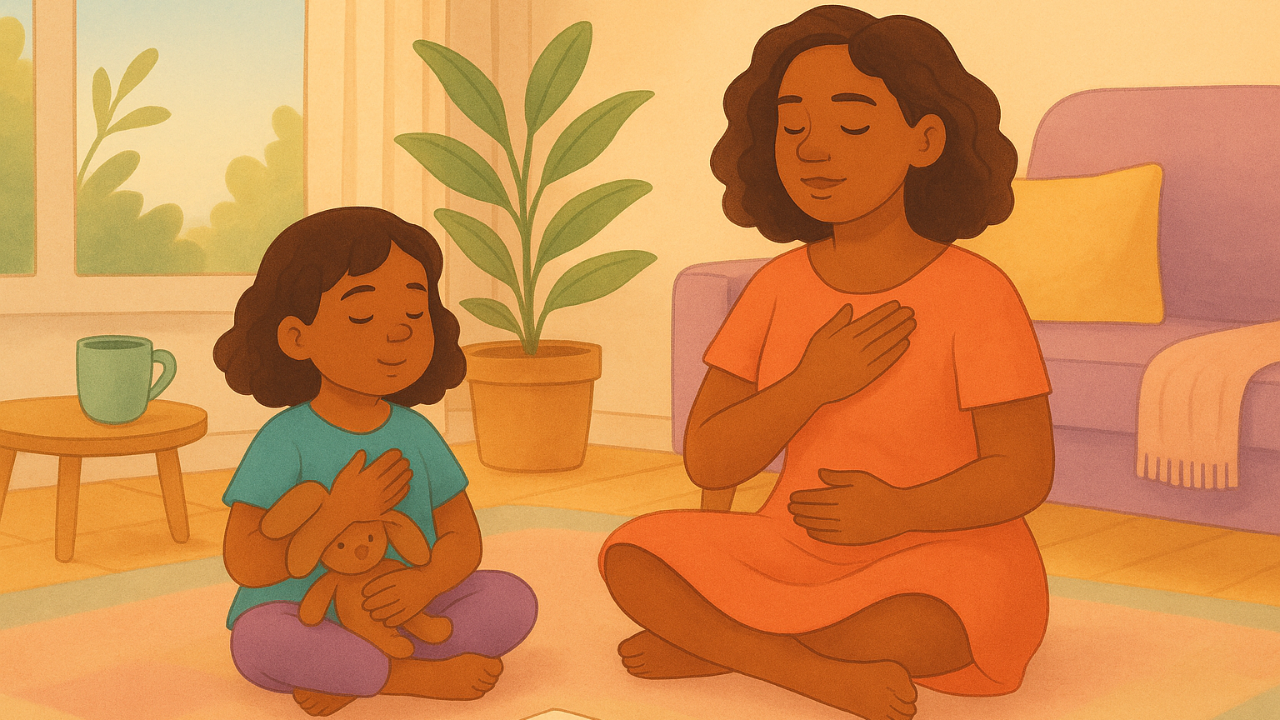
Practice 1: “Find Your Anchor”
Invite them to gently touch something steady:
-
Their feet on the floor
-
A favorite stuffed animal
-
Their own hands pressed together
You can say:
“This is your anchor. When you feel wiggly or slumpy, touching this helps your helper remember you are here and you are not alone.”
Practice 2: “Name Your Weather”
Instead of asking, “How do you feel?” (which can be confusing), ask:
“What is the weather inside your body right now? Stormy, windy, sunny, cloudy, foggy?”
They can point to a picture chart if words are hard. This turns overwhelming emotions into something they can observe rather than something they are failing at.
Practice 3: “Far, Middle, Near Sounds”
Invite them to listen for three sounds:
-
One far away sound
-
One sound in the middle distance
-
One sound very close, maybe their own breath
This gentle orienting tells their nervous system, “We are here in this room, right now,” which is especially helpful for kids who tend to dissociate or drift away inside.
A Tiny 7-Day Teaching Plan
This is meant to be imperfect and very small. Two to five minutes per day is enough.
Day 1: Story Day
Tell the “three modes” story using animals or characters they love. Let them rename the modes.
Day 2: Spot the Mode
During the day, gently notice one moment:
“Oh, I think my body went into Rabbit Mode when the door slammed.”
Invite them to spot their own mode without pressure.
Day 3: Anchor Practice
Practice “Find Your Anchor” once, maybe before leaving the house or after school.
Day 4: Weather Check at Bedtime
Ask, “What’s the weather in your body tonight?” and respond with care, not correction.
Day 5: Tiny Movement Reset
Add a 30-second movement break. Shake hands, stretch arms above the head, or stomp feet gently. For yourself, you might explore a daily practice to widen your window of tolerance so you have more room for their big feelings:
Day 6: Far, Middle, Near Game
Play the sound-listening game once during a calm-ish moment, not in the middle of a full meltdown.
Day 7: Celebrate the Body
Name one way their body helped them this week. It can be tiny. “Your body helped you pause and squeeze your bear instead of yelling earlier. That was your helper working.”
If you want support in seeing your own patterns clearly before guiding them, you can always revisit the Stress Loop Quiz.
Common Sticking Points
“My child won’t slow down long enough to try this.”
Many kids in Wiggly Mode cannot sit still on command. Instead of forcing calm, pair practices with movement. You can do an “anchor check” while they walk or fidget. Think of it as planting small seeds, not teaching a long class.
“They think they’re ‘bad,’ not dysregulated.”
If a child has already absorbed the message that they are “too much,” “too emotional,” or “too sensitive,” nervous system language can be deeply relieving. You might say:
“You are not bad. Your helper is just working really hard. We are learning together what helps it feel safer.”
This aligns with a trauma informed way of seeing behavior as adaptation, not moral failure. If you want more context, you might find it helpful to read what trauma informed care really means in practice, then borrow phrases that fit your family.
“I get triggered when they are dysregulated.”
You are not alone. Many parents have a nervous system that spins up when their child cries, yells, or shuts down. This is especially true if you did not have co-regulation growing up.
One gentle step is to name your own nervous system state out loud, without blaming them:
“My body is in Rabbit Mode right now, so I’m going to take three steps back and feel my feet. I still love you. I will come close again when my helper is calmer.”
You might find it supportive to read about how to co-regulate with a toddler during meltdowns and adapt the language to your child’s age.
Remember, your job is not to be perfectly calm. Your job is to notice, repair, and keep everyone as safe as you reasonably can.
A Mini-Plan For Parents: 14 Days Of Tiny Parent Resets
The more regulated you are, the easier it is to teach regulation. Here is a simple, parent-focused plan you can do alongside your child.
Days 1–3: Notice Your Own Modes
Several times a day, quietly ask yourself, “Am I in Wiggly, Slumpy, or Just-Right Mode?” No fixing, just noticing.
Days 4–6: One Tiny Body Cue
Pick one body cue you will track, like jaw tension, shoulder lift, or chest tightness. When you feel it, pause for one slow exhale or a gentle shoulder roll.
Days 7–9: One Safe Phrase
Choose one sentence you will say to yourself when you notice your system spike or collapse, such as “My body is trying to protect me.” This is a small example of building resilience for the storms of stress you face daily.
Days 10–12: Pair a Reset With a Daily Habit
Add a 30-second nervous system reset to something you already do, like washing dishes or brushing teeth.
Days 13–14: Share One Thing With Your Child
Tell your child one thing you are practicing and invite them in if they want. For example, “I’m practicing feeling my feet when I get mad. You can try it with me if you like.”
If you want deeper support in understanding and resetting your own system after old experiences, you might want to explore how to reset your nervous system after trauma in small, doable steps.
And if you want a clear snapshot of your main stress pattern, take the Stress Loop Quiz.
FAQs
1. What age can kids start learning about their nervous system?
You can start as early as age three in very simple ways. Use sensations, animals, stories, and pictures. There is no need to label “nervous system” at first. Just talk about “your helper inside your body that keeps you safe.”
2. Should I use proper anatomical terms with children?
You can, especially with older kids, but it is not required. Many kids understand faster when you use characters, colors, and gentle metaphors. As they grow, you can layer in words like “nervous system” and “vagus nerve” if they are curious.
3. What if my child gets overwhelmed easily when we talk about feelings?
Some children feel flooded by direct questions like “Why are you upset?” In those cases, talk more about bodies and weather than about feelings and “why.” Offer smaller pieces, like one sensation or one weather word. If they still look overwhelmed, pause and come back later.
4. Can this actually reduce meltdowns?
It may help over time. When a child understands that their big reactions are body signals, not proof that they are “bad,” shame usually decreases. This can create more room for them to pause, reach for a tool, or accept your help. It is a gradual process, not an overnight fix, and professional support can be very helpful if meltdowns are frequent or intense.
5. What if my own nervous system feels out of control most days?
You are not failing. Many parents are raising children while their own body is still recovering from chronic stress or trauma. It may help to focus first on a few tiny parent practices and to get support where you can. Learning about your own patterns and practicing one or two gentle tools, day by day, can make it easier to stay present with your child.
6. How often should we practice these tools with kids?
Short, frequent moments tend to work better than long sessions. Think two minutes here, one minute there, woven into daily life. You might practice once in the morning, once in the afternoon, and once at bedtime, in very small ways. Over time, this builds a shared language of safety between you and your child.
More Gentle Reads
If this topic speaks to you, you might also like:
- Quick Nervous System Resets for New Parents
- A Soft, Connected Bedtime Routine For Anxious Kids (The Parent Version)
- Simple Regulation Scripts Teens Actually Learn From
And if you want to see your own patterns clearly so you can model calmer cues, you can always return to the Stress Loop Quiz.
Disclaimer: This article is educational and not medical advice. If you have health concerns, consider speaking with a qualified professional.
Discover Your Vagal Tone
Find out how dysregulated your nervous system is and get your personalized roadmap to feeling calm, energized, and in control