Trauma-Informed Holiday Travel Guide
Holiday travel is sold as “magical,” but your body might tell a different story.
Airports, long drives, packed houses, money stress, family history. All landing on a nervous system that might already be overstretched or carrying trauma.
If just picturing the trip makes your chest tighten, you are not being dramatic. Your body is trying to protect you. This guide is here to help you shape holiday travel around your nervous system as much as you can, instead of forcing your body to survive the plans.
If you want to understand how your own stress patterns tend to loop on repeat, you can start with the free Stress Loop Quiz.
Quick answer: What is a trauma-informed holiday travel guide?
A trauma-informed holiday travel guide is a way of planning and moving through travel that centers safety, choice, and your nervous system, not just tickets and schedules. It means:
-
Noticing what your body does in crowds, noise, or family conflict
-
Building in exits, pauses, and grounding instead of only “pushing through”
-
Planning for sleep, food, and nervous system support like you would plan for luggage
It respects that your body might be reacting to echoes of old experiences, not just this year’s trip, and it gives you realistic tools to move through travel without abandoning yourself.
What “trauma-informed travel” really means
Trauma-informed does not mean fragile. It means honest.
Many people who carry trauma feel that holiday travel pokes at old wounds:
-
Being stuck somewhere you cannot easily leave
-
Feeling watched, judged, or criticized
-
Loud arguments or sudden changes in plans
-
Unpredictable moods around you
If you want a simple, non-clinical explanation of what “trauma informed” actually covers, this gentle piece on what trauma-informed care means in real life may help the language feel less abstract.
A trauma-informed travel mindset:
-
Assumes your nervous system has valid reasons for reacting
-
Expects that “just relax, it’s a vacation” will not land for everyone
-
Puts agency back in your hands where possible
-
Makes room for both “I want to see people” and “I need to stay within my window of tolerance”
If you notice that holidays already ramp your stress up, you might pair this with a gentle nervous system plan for holiday stress so your travel fits inside a bigger support plan.
Before you book: listening to your nervous system
1. Check your baseline honestly
Before you look at flight times or routes, ask:
-
How has my sleep been this month?
-
Do I already feel close to burnout, shutdown, or constant edge-of-panic?
-
When I imagine this trip, what happens in my body first? Tight chest, buzzing, numbness, heaviness?
If your stress is already high, you may not have as much capacity for crowded airports or multiple houses in a few days. Trauma-informed travel starts from “What is my real bandwidth?” not “What do people expect me to manage?”
If you want practical journal prompts to notice your patterns, you might play with this gentle guide on tracking nervous system states over time.
2. Sort plans into “essential,” “flexible,” and “optional”
Not everything holds the same weight, even if your guilt says it does.
You can try making three lists:
-
Essential: Legal, medical, or truly non-moveable commitments
-
Flexible: Events you can attend briefly, arrive late, or leave early
-
Optional: Traditions that are lovely but not required for your worth
Simply naming something as “optional” can lower your internal pressure, even if you still choose to go.
3. Aim for “good enough” travel, not a perfect holiday
Perfection often pushes your nervous system right out of its window.
Instead of “We must see everyone and do everything,” try:
-
One core purpose for the trip
-
One or two “nice if it happens” visits or activities
-
Clear permission with yourself to shorten, reschedule, or cancel if your body is at its limit
If travel anxiety is already familiar, this more focused guide on calming travel anxiety and resetting your nervous system on the go pairs well with this article.
Preparing your body for holiday travel
Think of travel as a stressor your body needs support for, like recovery from an illness or a big life change. Even a small prep window can help.
1. Choose one tiny daily practice the week before
Pick something that takes 3 to 5 minutes:
-
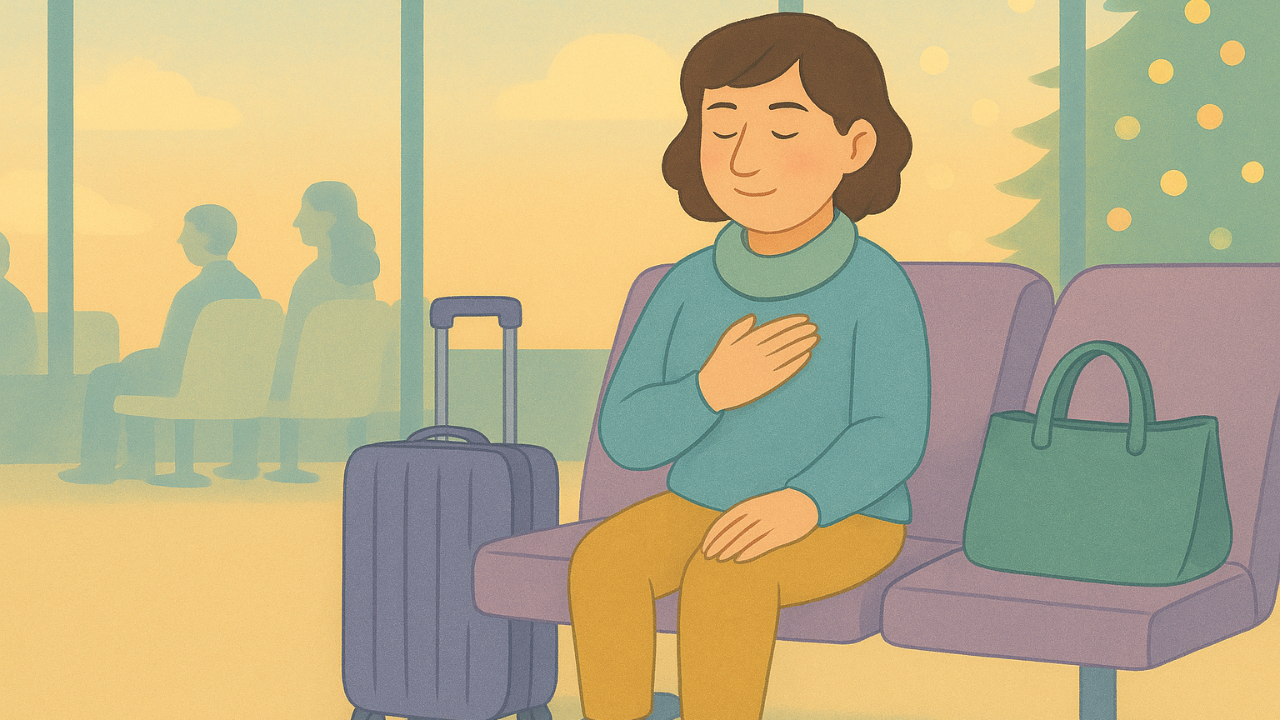
A simple self-holding pose, like one hand on your chest and one on your ribs
-
A short body scan where you gently notice your feet, legs, hips, and so on
-
A mini nervous system reset before bed or after work
If you want a structured option, you might borrow ideas from a daily nervous system reset you can do at home and then shrink them into tiny versions you can actually keep.
2. Plan your personal safety kit
A “safety kit” is not childish. It is practical.
You could gather:
-
Noise-reducing headphones or a simple pair of earplugs
-
One or two objects that feel soothing in your hands
-
A small scarf, hoodie, or soft layer that helps you feel less exposed
-
A few snacks and a water bottle
For more ideas, you can read this gentle guide to building a personal safety kit for your nervous system, then adapt it for airports, trains, or long car rides.
3. Set realistic sleep expectations
Holiday travel and good sleep are not always best friends.
Trauma-informed travel does not insist on eight perfect hours. It looks more like:
-
Protecting the first half of the night when you can
-
Expecting that you might wake more often and having soft tools ready
-
Being kind to yourself if sleep is rough for a few nights
If your body already has trouble powering down, this piece on what to do when your body will not downshift at night can give you a kind, nervous-system lens on those restless evenings.
If you want help seeing which “stress loop” you are most often stuck in before you travel, you can take the Stress Loop Quiz.
Your travel-day nervous system toolkit
A. For airports, stations, and crowds
Big public spaces can wake up old survival patterns. Bright lights, lines, security checks, families arguing nearby. Your body may read it as “not safe” even when you know logically that you are okay.
You might experiment with:
-
Orienting your eyes: Slowly let your gaze move around the space, pausing briefly on anything neutral or pleasant. A plant, a sign, a window, a piece of art.
-
Choosing one anchor: Pick one object you can see from where you are, and return your eyes to it whenever you feel overloaded.
-
Micro exits: Stepping into a quieter corner, stairwell, or bathroom for a few breaths, even for 60 seconds.
If crowds specifically are hard on your body, you can layer in a more detailed orienting practice as a gentle way to calm your nervous system and use it anywhere lines form.
B. For planes, buses, and cars
You may not be able to leave the space, but you can still offer your system choices.
Some ideas:
-
Containment touch: Crossed arms in a loose self-hug, both hands on your thighs, or palms wrapped around your upper arms.
-
Small, repeatable movements: Press your heels into the floor, roll your shoulders, or gently press your tongue to the roof of your mouth, then release.
-
Soft gaze: Instead of staring at your phone or the seat in front of you, let your focus soften on one object so your eyes and neck can rest.
Short phrases you might repeat quietly:
-
“My body is reacting, and I am allowed to support it.”
-
“I cannot change this seat, but I can change how tightly I grip myself.”
-
“Small movements count.”
If panic feels close, this kind guide to grounding during panic without needing talk therapy in the moment may give you extra ideas for long rides.
C. Food, blood sugar, and caffeine on travel days
Travel often means skipped meals, fast food, and extra caffeine. All of that touches your nervous system.
Gentle supports:
-
Try not to arrive at the airport or car already starving. Even a small snack can help.
-
Keep something simple that feels safe for your body, like nuts, crackers, or fruit, so you are not stuck with only options that spike and crash you.
-
Notice how much caffeine actually helps you feel more steady, and where it tips into agitation.
If anxiety has been pulling your appetite away, this article on how to eat when you feel too anxious to be hungry may help you find “good enough” nourishment during travel.
D. Boundaries and micro-scripts with family
You do not need to hand over your trauma history to justify your limits. Short, repeatable phrases are often enough.
Examples:
-
“I am going to step outside for a few minutes. I will be back.”
-
“I love seeing everyone and I also need some quiet time to reset.”
-
“This topic is hard on my body right now. Can we talk about something else?”
If you know there will be tricky conversations, this guide on regulating your nervous system before hard conversations can help you prepare your body before the words even start.
If you feel wired, numb, or on the edge
Travel does not always bring one clear feeling. You might swing between hyper, numb, and shut down. Trauma-informed travel assumes this and offers options.
When you feel wired or jittery
You might notice:
-
Racing thoughts
-
Tight jaw or chest
-
Feeling like you want to run or snap
Gentle ideas:
-
Press your feet into the floor or footrest for 5 to 10 seconds, then slowly release. Repeat a few times.
-
Let out a long sigh through slightly parted lips, like you are fogging up a window.
-
Pick one color around you and find five objects in that color.
If your nervous system tends to live in “go, go, go,” this simple explanation of the polyvagal ladder for overwhelmed beginners might help you understand why travel can shoot you up and down the ladder so quickly.
When you feel numb, foggy, or checked out
You might notice:
-
Heaviness in your limbs
-
Feeling far away from what is happening
-
Trouble forming words or caring about anything
Gentle ideas:
-
Splash cool water on your hands or wrists if you can.
-
Name three things you can see, two you can touch, one you can hear. Quietly is fine.
-
Place one hand firmly on your chest or upper arm as a reminder: “I am still here.”
If numbness is a familiar pattern, this nervous-system view on why your body goes numb during stress and somatic ways to reconnect can help you feel less alone inside it.
A gentle 7-day holiday travel plan
You can shorten this if you have less time. The point is rhythm, not perfection.
Day 1
Name your current state. “Right now my nervous system feels…” Then pick one part of the travel plan to simplify by even 10 percent.
Day 2
Spend 3 minutes with a simple grounding practice, like self-holding or a body scan. Do it once in the morning and once before bed.
Day 3
Gather your safety kit items and put them in one place. Imagine how you will use each one at the airport, in the car, or at your relative’s house.
Day 4
Write down 2 or 3 boundary sentences you can use with family. Say them out loud at least once so they feel less strange.
Day 5
Walk through your travel day slowly in your mind. Picture not just stress points, but the moments when you will pause, drink water, or ground yourself.
Day 6
Check your clothes and packing for comfort. Soft fabrics, layers, shoes you can stand in. Anything that lowers body stress even a little.
Day 7 (Travel day)
Use one opening ritual (a tiny nervous system practice before you leave the house) and one closing ritual (a few minutes of gentle grounding after you arrive).
If you want another lens on where your stress loops tend to grab you during this week, you can revisit the Stress Loop Quiz
Common sticking points (and gentle responses)
“My family thinks I am being too sensitive.”
You can still care about family and also protect your nervous system. A simple line like, “I am working on my stress levels, so I may need more breaks than usual,” is enough. You do not need everyone to fully understand it for it to be valid.
“I feel guilty skipping gatherings or leaving early.”
Guilt often shows up whenever you do something new, not only when you do something wrong. You can start with smaller adjustments, like arriving later or leaving a bit earlier, and notice how your body responds.
“I had a trauma response during the trip and now I feel like I ruined everything.”
You did not ruin the holiday by having a nervous system. Your body pulled out an old survival pattern in a stressful, loaded context. Afterward, you might simply ask, “What helped even 5 percent?” and build from there next time.
“I planned all these tools and then forgot them in the moment.”
This is so common. Overwhelm narrows your choices. You might keep a short list in your phone or on a note card with three tools and one sentence that calms you. When you notice yourself spiraling, just read the list and pick one.
“Travel feels impossible on top of caregiving, work, or parenting.”
Your body is right to notice its limits. You might decide that this year is about doing less and protecting a smaller window of capacity. This can be an act of care, not failure.
More Gentle Reads
If you want more soft, practical support around holidays, sleep, and travel, you might like:
Holiday travel can stir up old pain, current stress, and a lot of “shoulds.” You deserve a way of traveling that includes your body and your history, not just your itinerary.
If you would like help naming your own patterns and getting gentle next steps, you can take the Stress Loop Quiz.
Disclaimer: This article is educational and not medical advice. If you have health concerns, consider speaking with a qualified professional.
Discover Your Vagal Tone
Find out how dysregulated your nervous system is and get your personalized roadmap to feeling calm, energized, and in control